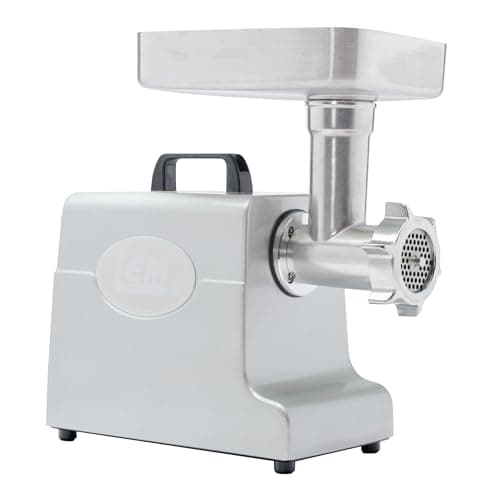
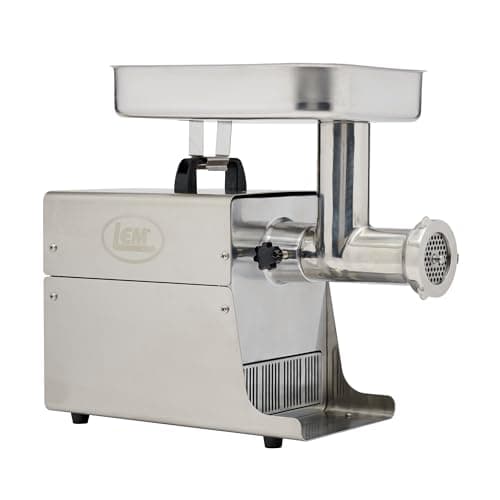
Buy the BigBite #8 if you take two or more deer most seasons. LEM rates it at up to 7 lb a minute against the MightyBite's 4 to 5, builds it with a stainless motor housing, knife and plates, and warrants it for five years instead of two. Buy the MightyBite #8 if you grind one deer a year and store the grinder in a cupboard. At under 14 lb it is the easiest LEM electric to lift, it has metal gears and a built-in circuit breaker, and its one-way knife removes the single most common assembly mistake.
They are both #8 grinders, so plates and the general head geometry sit in the same family. Everything else — the metal, the speed, the term of the warranty — is a tier apart.
Every published figure, side by side
| Spec | BigBite #8 | MightyBite #8 |
|---|
| Motor | 0.5 HP, 110 V | 500 W |
| Rated output | Up to 7 lb per minute | 4 to 5 lb per minute |
| Housing | Stainless steel | Aluminum |
| Gears | Steel (BigBite line spec) | Metal |
| Head opening | 2 in. hole published | Not published |
| Plates included | Stainless 4.5 mm, 10 mm, stuffing plate | Coarse 3/8 in., fine 3/16 in., stuffing plate |
| Knife | Standard | One-way knife — cannot go on backwards |
| Weight | Heavier | 13.89 lb |
| Warranty | 5 years + lifetime customer support | 2 years |
| Bones | Not for bones (LEM) | Not for bones (LEM) |
What actually separates them
1. Speed, and what it means in real minutes. At the Ohio DNR average of 52.19 lb of venison a deer, a three-deer season blended 80/20 and ground twice is about 392 lb through the head. On the BigBite's 7 lb a minute that is roughly 56 minutes of feeding. On the MightyBite's 4 to 5, it is 78 to 98. Add stops to clear sinew and one is an afternoon job while the other is a morning.
2. Stainless against aluminum. Stainless is easier to keep clean and does not pit the way aluminum can under salt and acid, and the BigBite's knife and plates are stainless too. LEM wants all grinder parts hand-washed in warm soapy water and hand-dried immediately — they are not dishwasher safe, and LEM warns that discoloration may occur — so the metal you are drying matters over a decade of seasons. Our cleaning guide walks the whole routine.
3. Five years against two. This is the clearest difference on paper, and on a machine with a motor and a gearbox it is the one that costs money later. LEM also says it carries replacement parts for past and present models, which is worth as much as the term itself.
4. The one-way knife. LEM's Grinder Workshop says the flat side of the knife goes against the cutting plate, and that a backwards knife mushes the meat instead of chopping it. The MightyBite's knife can only be fitted one way, which quietly eliminates that failure for a first-time owner. The manual adds a check: assembled correctly, the plate sticks out 1/8 to 3/16 inch past the end of the head.
5. Weight, in the direction you might not expect. At 13.89 lb the MightyBite is the one that actually gets used by someone who has to carry it up from a basement once a year. A grinder in a cupboard because it is too heavy to bother with grinds nothing.
Which one for your season
| Your season | Pick | Why |
|---|
| One deer, most years | MightyBite #8 | About 130 lb of feed; the speed gap costs you minutes, the weight saves your back |
| Two deer | BigBite #8 | 37 minutes against 65, plus the 5-year term |
| Three or more deer | Neither — go to a #12 | LEM rates its own #12 at about 11 lb a minute; see BigBite #8 vs #12 |
| Sausage is the main job | BigBite #8 | Stainless stuffing plate and tubes, and more headroom for a slow stuffing pass |
| You already own a KitchenAid mixer | Check the attachment first | See attachment vs standalone |
The ten-year view
Grinders are not an annual purchase, so the right way to read this comparison is over a decade rather than a season. Three things decide how either machine ages, and only one of them is on the spec sheet.
Parts, first. LEM says it carries replacement parts for past and present products, and that applies to both lines — which is the single best argument for buying either of these over a cheaper unbranded grinder. A grinder whose knife, plate, auger bushing and washer can all still be bought in 2035 is a grinder you can keep running. LEM also flags that the bushing and washer are wear parts that need changing for the unit to work properly, which is a maintenance item rather than a fault.
Then the metal at the sink. The BigBite's stainless housing, knife and plates survive being washed badly better than aluminum does, and they will be washed badly at some point — LEM's manual asks for a hand wash in warm soapy water, a clear hot rinse and an immediate hand dry, with no soaking and no dishwasher, and nobody follows that perfectly for ten years. The MightyBite's aluminum housing is not a defect; it is a material that shows its history sooner.
And then the warranty clock. Five years against two is a real difference in a category where the gearbox is the expensive failure. Neither term is a prediction — plenty of two-year grinders run for fifteen — but it is the maker telling you how long it is prepared to stand behind the drivetrain, and that is the most honest signal either listing contains.
If you want the cheapest route to a grinder that will still be serviceable in a decade, the answer on this page is the BigBite #8. If you want the cheapest route to grinding one deer well this November, it is the MightyBite, and there is no shame in that being the right call.
Two things both share
Neither is for bones: LEM says so on both listings, and there is no setting or technique that changes it. If you want bone-in cuts you want a saw, which our bones-in-a-grinder guide covers.
And neither will save a bad cold chain. LEM's manual asks for meat at 40 °F or colder to grind (28 to 32 °F for sausage) and warns against grinding deep-frozen food; Penn State Extension makes the same point about keeping game cold through processing. Warm meat mushes on a #8 of either metal.