Meat Grinders ◆ Guide
Can You Put Bones in a Meat Grinder? No, and Here Is What to Use
Every home grinder we cover is sold with the same line somewhere in its paperwork: not for bones. The honest answer is a saw, and the choice between a hand saw and a bandsaw is about volume.
We earn a commission if you buy through our links, at no extra cost to you. It never decides the ranking — the method is published · Affiliate disclosure
No. Do not put bones through a home meat grinder. LEM's own listings for both its MightyBite #8 and its BigBite #8 say the grinder is not for bones, and the manual that ships with the #8 asks for meat that is free of “gristle, sinew, silver skin, and bone” before it reaches the head. No plate size, motor rating or reverse switch changes that. Bone-in work is a saw job: a 22-inch hand butcher saw for most seasons, and an electric bandsaw only if you are cutting a lot of bone-in portions year after year.
That answer holds even at the top of the range. The 1.5 HP #32 machines on our commercial-grade grinder page are rated for 17 and 18 pounds of meat a minute, and neither maker claims bone. More motor moves more meat; it does not change what a knife and plate can shear.
What actually breaks
A grinder shears meat by wiping a rotating knife across the face of a perforated plate. Bone does not shear. It chips, and then the chips sit between two hardened steel faces that are designed to run in contact. Three things follow:
- The knife and plate go first. Chipped cutting edges and a dished plate face mean mush rather than strands from then on, and the pair has to be replaced together — LEM's advice is to change plates and knives simultaneously.
- Then the gearbox. A bone jam stalls the auger against a motor that is still trying to turn it. Weston's Butcher #22 manual publishes an all-hardened-steel gear transmission, which is a reason to like the machine and not a licence to stall it.
- And the warranty. Using an appliance outside its stated use is the textbook definition of misuse. LEM's warranty language excludes damage from misuse; MEAT!'s lifetime warranty excludes ordinary wear and commercial use. Putting bone through a machine the maker says is not for bones is not a claim you want to have to argue.
Why people ask in the first place
Usually one of three reasons, and they have different answers:
| What you are trying to do | The grinder answer | Do this instead |
|---|---|---|
| Get the last of the meat off the bones | No | A boning knife — the scraps are worth more as trim than as risk |
| Cut shanks, ribs or chops through the bone | No | A hand butcher saw, or a bandsaw at volume |
| Grind bone for raw pet food | No, not a home grinder | See the section below |
| Make stock | No need | Bones go in the pot whole; sawing them in half is enough |
That middle row is the common one. Most home processors bone out entirely and never need a saw, which is why our meat saw roundup opens by asking whether you need one at all. If you do want bone-in shanks, a saw is cheap and a grinder repair is not.
What to use instead
A hand butcher saw is a stainless serrated blade in a tensioned frame, and the three specs worth checking are blade length, whether the frame holds tension under load, and whether replacement blades are sold. A 20-inch saw is easier to steer on a kitchen counter; a 22-inch is the general-purpose length; 25 inches gives the longest stroke for elk or beef. Our bone saw vs bandsaw comparison covers where the electric machine starts to earn its footprint.
Picks for this job
The tools that actually cut bone
Two hand saws and the electric step up. Pick the hand saw first: for most home seasons it is the only bone tool you need, and it costs a fraction of a replacement grinder head.
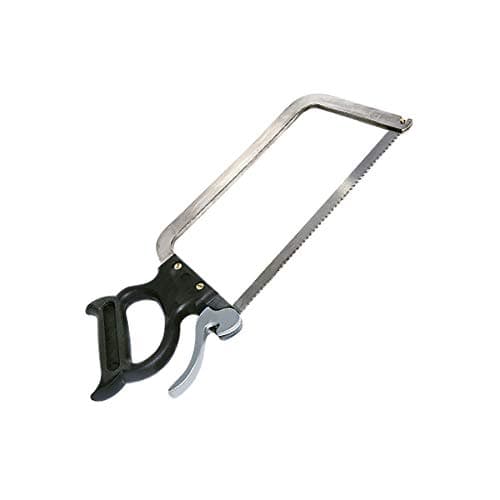
Best meat saw for most hunters
Weston 22 in Butcher Meat and Bone Saw (47-2201)
The general-purpose 22 in: stainless serrated blade and frame, a trigger lock that holds tension, quick-release handle and replacement blades sold.
$39.99Amazon#ad · Price as of November 4, 2026 · Affiliate disclosure for the link to Weston 22 in Butcher Meat and Bone Saw (47-2201)
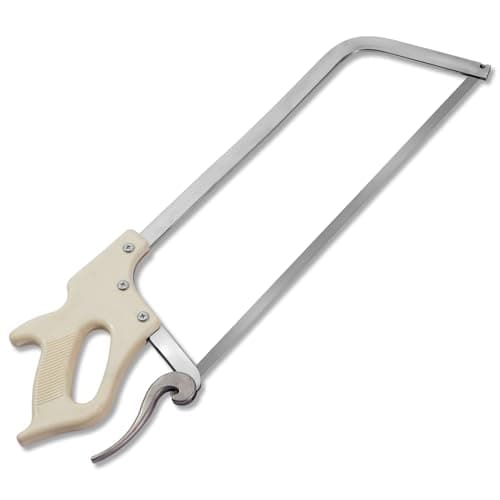
Best compact saw for 1-2 deer
KATA 20 in Manual Butcher Meat Saw
20 in, which is the easier length to steer on a counter or a small table if you are mostly cutting shanks.
$42.99Amazon#ad · Price as of November 4, 2026 · Affiliate disclosure for the link to KATA 20 in Manual Butcher Meat Saw
- VEVORNo image
Heavy tier: bone-in cuts at volume
VEVOR 650W Electric Meat Bandsaw (BS-130)
Only for heavy bone-in volume year after year, and only after you have confirmed the electrical specs this listing does not publish.
Check price · Amazon#ad · Price as of November 4, 2026 · Affiliate disclosure for the link to VEVOR 650W Electric Meat Bandsaw (BS-130)
The raw pet-food question
This is the version of the question most often asked about bone, and the answer is still no for a home grinder. Commercial raw pet-food production uses purpose-built bone grinders with hardened cutting sets built for the job; a household meat grinder sold for venison and sausage is not that machine, and its maker says so. If raw feeding is the goal, buy ground product from a producer who grinds bone on equipment designed for it, rather than taking a #12 head apart in the middle of a batch.
Chicken bones are the usual follow-up. They are softer than venison leg bone, but “softer” is not the same as rated, and the machines on this site are not rated. We will not recommend running them through a grinder whose maker excludes bone.
Keeping bone out of the grinder in the first place
Most bone in ground venison arrives by accident, not intention: a bullet-shattered rib fragment, a sliver left by a saw cut, a piece of knuckle that came away with the trim. Three habits catch nearly all of it.
- Bone out, then trim on a clean board. LEM's manual wants meat free of gristle, sinew, silver skin and bone before grinding, and the trim table is where that happens.
- Treat the wound channel as a separate pile. Penn State Extension's guidance on processing wild game is to trim away damaged tissue; that is also where shattered bone hides.
- Run your fingers over every piece going into the lug. It takes seconds per handful and it is the only inspection step in the whole process.
Then keep the rest of the routine tight — chilled meat, a sharp knife and plate, a steady feed — and the grinder will do the job it is rated for. Our how to grind deer meat guide covers the sequence from trim table to lug, and meat grinder sizes explained covers which size keeps up with your season.
Questions
Frequently asked
Can you put bones in a meat grinder?
What about a 1.5 HP commercial grinder — can that grind bone?
What do you use to cut through bone at home?
Can you grind chicken bones for raw pet food in a home grinder?
Does grinding bone void a grinder warranty?
Keep going down the chain
Related
Receipts
Sources
- LEM Products — #8 Electric Meat Grinder, Model 1158, Use & Maintenance manual (June 2014) [PDF]
- LEM Products — #8 BigBite Meat Grinder, 0.5 HP (product page, SKU 1779)
- LEM Products — MightyBite #8 Aluminum Grinder (product page, SKU 1158)
- LEM Products — Meat Processing Tips (January 2025)
- Weston — Butcher Series #22 Electric Meat Grinder instruction manual (hosted by Hamilton Beach) [PDF]
- MEAT! Your Maker — Warranty information (lifetime, original owner, excludes commercial use)
- Penn State Extension — Proper Processing of Wild Game and Fish (updated June 2023)
- Amazon listing, manufacturer-supplied copy — LEM BigBite #8 (17791)
- Amazon listing, manufacturer-supplied copy — LEM MightyBite #8 (1158)
- Amazon listing, manufacturer-supplied copy — Weston butcher saw 47-2201
- Amazon listing, manufacturer-supplied copy — KATA 20 in butcher meat saw
- Amazon listing, manufacturer-supplied copy — VEVOR 650W meat bandsaw BS-130
Specs come from the maker's own pages, manuals and maker-supplied listing copy (labeled as such); food-safety figures from USDA and university extension publications; yield from the Ohio Division of Wildlife; prices live from Amazon. Where a figure isn't published, we say so. Read the full method.