Meat Grinders ◆ Guide
How to Grind Deer Meat at Home, From Trimmed Cubes to Freezer Packs
The order that keeps a grinder cutting instead of smearing: trim hard, chill everything, grind coarse, add fat, grind fine, package the same day. The food-safety rules come from USDA and state extension guidance.
We earn a commission if you buy through our links, at no extra cost to you. It never decides the ranking — the method is published · Affiliate disclosure
To grind deer meat, trim off the deer fat, silver skin and sinew, cut the meat into pieces that drop into the throat, and chill it to 40°F or colder until it is firm but not frozen solid. Grind once through a coarse plate, add pork or beef fat, then grind again through a 3/16-inch (4.5 mm) plate. Package it the same day and cook it to 160°F.
Every step below exists to stop one of two failures. The first is meat that smears into paste instead of leaving the plate in clean strands, which LEM's grinder manual calls "mashing instead of extruding in strings" and blames on warm meat and on a knife or plate that is dull or badly installed. The second is meat that sits warm long enough to matter, which is USDA's concern. Here is the order that avoids both.
Before you start
Deer rules vary by state. Check your state wildlife agency's carcass-transport and chronic wasting disease (CWD) rules before you move or process a deer, and follow Ohio State University Extension's advice to avoid eating meat from deer that look sick or test positive for CWD. If you are breaking the deer down yourself, our guide to processing a deer at home covers the steps before this one.
Know the load. Ohio Division of Wildlife staff averaged 52.19 lb of venison per deer across 115 whitetails. If most of a deer becomes burger, that is just over one 50-lb meat lug per deer (the capacity LEM lists for its heavy-duty lugs), and it sets how many batches you will chill and run.
USDA's fact sheet on ground beef explains why ground meat gets more care than a steak: grinding "allows any bacteria present on the surface to be mixed throughout the meat." USDA goes as far as to caution against grinding beef at home, because whole cuts aren't tested the way a plant's grinding trim is. Venison isn't beef, but the surface-to-center logic is the same, which is why every step here keeps the meat cold and why ground venison is cooked to 160°F.
Step 1: Trim hard
LEM's manual says the meat you feed a grinder should be "free of gristle, sinew, silver skin, and bone." Utah State University Extension adds the deer's own fat to that list: remove it, because venison fat "has a very strong 'game' flavor." That fat is exactly what you will replace with pork or beef fat in Step 4, so trim it without guilt.
Silver skin and sinew are the parts a grinder knife struggles with. They don't disappear in the grind; they collect in the head, which is why LEM's manual has you stop after the first pass and clear out the sinew, fat and gristle that built up. Every minute you spend at the trim table saves one spent unclogging the head, and if yours already jams, our guide to why a meat grinder keeps clogging walks through each cause.
Cut the trimmed meat into strips or cubes that "easily fit into the throat of the grinder head," as LEM puts it. For scale, LEM lists a 2.25-inch opening into the head on its BigBite #12, so smaller grinders want smaller pieces. Keep bone out entirely; LEM's #8 grinder listings say plainly "not for bones."
Step 2: Chill the meat and the grinder
Cold comes up in nearly every piece of maker guidance on grinding. LEM's manual wants the meat at 40°F or colder for grinding, and "well-chilled (28°-32°F)" when you are making sausage. LEM's Grinder Workshop says warm meat leads to mushing and that putting the meat in the freezer until it firms up helps prevent fat smear. Bass Pro's grinding tips suggest about 30 to 45 minutes in the freezer before you start, and putting the grinder's knife, auger and head in there too if you have room.
Don't overshoot. LEM's manual also warns against grinding "deep frozen food." You want the meat firm at the edges, not a block. Work in batches: grind one lug while the next waits in the refrigerator, rather than setting the whole deer out on the bench.
Step 3: Assemble and run the coarse grind
- Knife on the right way. The knife sits on the square of the auger stud with the sharp blades facing out, flat side against the plate. LEM's Grinder Workshop warns that a backwards knife mushes the meat instead of chopping it.
- Plate seated. Line up the notch in the plate with the locating pin in the head.
- Ring hand-tight. LEM's manual says to screw the retaining ring on until hand-tight and not to over-tighten, which causes needless wear on the knife and plate.
For the first pass, use a coarse plate. LEM's plate guide calls its 10 mm (3/8-inch) plate "ideal for the first grind" and its 12 mm (1/2-inch) plate "perfect for the first grind." Kits vary: LEM's MightyBite #8 and BigBite #12 ship with 10 mm and 4.5 mm plates, while Weston's Pro Series ships with 7 mm and 4.5 mm.
Feed slowly and use the stomper, never your fingers. LEM's instruction is simple: "Do not force meat, allow grinder to do the work." When the lug is through, unplug the grinder, take off the coarse plate and clean out the sinew, fat and gristle collected in the head. If the meat has warmed, put it back in the cold before the second pass; LEM's manual says to chill the meat again if you want a finer grind.
Step 4: Add the fat
Venison is lean, and most published guidance adds fat for burger. LEM's manual says "add a minimum of 10% pork fat" when making burger from wild game, and to use beef fat if pork isn't available. Penn State Extension and Ohio State University Extension both suggest one part high-quality pork fat to three or four parts venison "before grinding," which works out to 20-25% of the finished blend. Our venison burger fat ratio guide puts every published ratio side by side with the math per deer.
There are two ways to work the fat in:
- Grind it in from the start. Cube the cold fat, weigh it against the venison, toss the two together and run them through both passes. This follows Penn State's "before grinding" advice.
- Mix after the coarse pass. Utah State Extension's fresh game sausage method grinds the meat coarse, mixes in the other ingredients, then grinds a second time through a fine plate. The second grind does the final blending.
Keep the fat as cold as the meat. Bass Pro's first rule is to keep everything below 40°F, and warm fat is the first thing to smear.
Step 5: The fine grind
LEM's plate guide recommends its 4.5 mm (3/16-inch) plate for "the second grind, coarse Hamburger and regular sausage," and its 3 mm (1/8-inch) plate for "hamburger, bologna, hot dogs and jerky." For burger, 4.5 mm is the maker's pick for the second pass; go to 3 mm when you want a finer texture or plan to shoot ground jerky. Our grinder plate size guide has the full chart.
Bass Pro makes the case for grinding twice at all: starting coarse and finishing fine "helps break down tougher cuts of meat and slices through stringy sinew." Watch what comes out. Strands are right. If it comes out mushed, stop: LEM's manual says to chill the meat to 40°F and check that the plate and knife are installed properly, and that a dull knife or plate causes mashing too.
Step 6: Package, label and freeze
Package the same day. USDA's ground beef guidance is to keep ground meat at 40°F or below and use it within 1 or 2 days, or freeze it. For the freezer, USDA lists heavy-duty plastic wrap, aluminum foil, freezer paper or bags made for freezing, and says to mark every package with the date it went in. Frozen ground beef stays safe indefinitely but, per USDA, is best within 4 months; Utah State Extension puts the quality window for frozen ground venison at 6 to 9 months. Our guide to packaging deer meat for the freezer compares paper and vacuum bags.
When you cook it, cook it to 160°F internal, measured with a food thermometer. USDA and Penn State Extension give the same number for ground meat.
Step 7: Clean up the same day
LEM's manual has a neat trick for the meat left in the head: pass a slice of bread through it. Then unplug the grinder and take the head apart. For LEM's MightyBite #8, the manual says to hand-wash every part in warm soapy water, not to soak them, not to use the dishwasher, to rinse with hot water and hand-dry immediately, and to coat the knife and plates with silicone spray. LEM's processing tips add a brush to reach the nooks. The manual's warning is worth repeating: any part exposed to raw meat can harbor bacteria, so be thorough.
USDA's steps for the rest of the bench: wash your hands with soap and warm water for at least 20 seconds before and after handling ground meat, wash utensils and surfaces that touched raw meat with soap and hot water, and sanitize them with 1 tablespoon of unscented liquid chlorine bleach per gallon of water. Don't reuse packaging materials.
The gear that makes this easier
You need nothing beyond the grinder to follow these steps, but three things take pressure off the cold chain and the cleanup. A spare plate-and-knife set means a sharp knife is always on hand. Stackable meat lugs let you stage trimmed, chilled and coarse-ground batches without crowding the refrigerator. And a hand-crank mixer blends fat and seasoning evenly without warming the meat with your hands.
Picks for this job
Plates, lugs and a mixer for grinding day
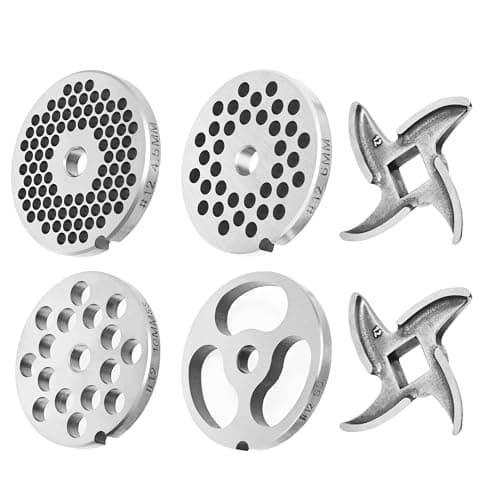
Best #12 plate kit
BOLEXINO #12 Stainless Grinder Plate Set with 2 Knives
For #12 grinders: 3/16, 1/4 and 3/8-inch plates, a stuffing plate and two knives, per the listing. Measure your plate first.
$35.99Amazon#ad · Price as of Sep 19, 2026 · Affiliate disclosure for the link to BOLEXINO #12 Stainless Grinder Plate Set with 2 Knives
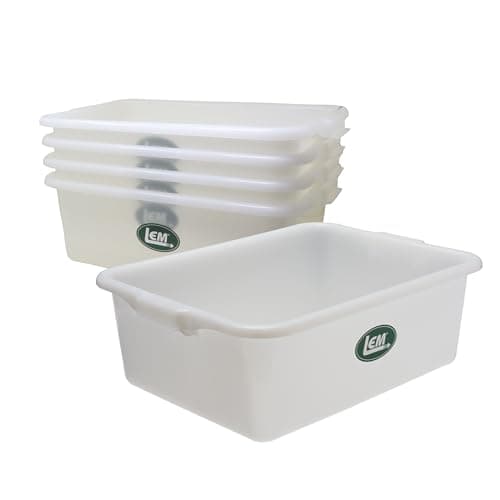
Best for 3-5 deer
LEM Heavy Duty Meat Lugs, 5-Pack
Five food-grade HDPE lugs, 21-3/4 x 15-1/2 x 7 inches and rated to 50 lb each; low enough to sit under a BigBite head.
$91.99Amazon#ad · Price as of Sep 19, 2026 · Affiliate disclosure for the link to LEM Heavy Duty Meat Lugs, 5-Pack
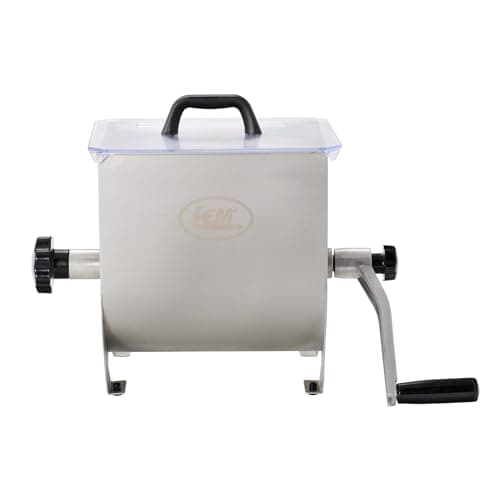
Best for 1-2 deer
LEM MightyBite 10 lb Manual Meat Mixer (1896)
Hand-crank stainless tub with four paddles for 10-lb batches of burger and fat; freestanding, it doesn't attach to a grinder.
$132.38Amazon#ad · Price as of Sep 19, 2026 · Affiliate disclosure for the link to LEM MightyBite 10 lb Manual Meat Mixer (1896)
Still picking the grinder itself? Our best meat grinders for deer ranks them by the season each one can keep up with.
Questions
Frequently asked
How do you grind deer meat with pork fat?
Can you grind deer meat with beef fat?
Should you grind deer meat twice?
Can you grind deer meat while it is frozen?
How long does ground venison last?
How do you use a meat grinder for the first time?
Keep going down the chain
Related
- Venison burger fat ratioHow much pork or beef fat to add, with the pounds per deer.
- Grinder plate sizesHole sizes for burger, sausage and chili.
- Why a meat grinder keeps cloggingSinew, heat and a backwards knife, each with its fix.
- Meat grinder sizes explainedWhich size keeps up with 1-2, 3-5 or 6+ deer.
- How to make venison sausageWhere the ground venison goes next.
- How to package deer meat for the freezerPaper, bags and vacuum sealing compared.
Receipts
Sources
- Ohio Department of Natural Resources, Division of Wildlife — Venison Meat Yield (115 deer, 2017 gun season) [PDF]
- USDA Food Safety and Inspection Service — Ground Beef and Food Safety (fact sheet, rev. August 2012; copy hosted by Utah State University Extension) [PDF]
- USDA Food Safety and Inspection Service — Basics for Handling Food Safely (fact sheet, rev. June 2011; GovInfo archive) [PDF]
- Penn State Extension — Proper Processing of Wild Game and Fish (updated June 2023)
- Ohio State University Extension (Ohioline) — Food Preservation: Freezing and Canning Venison, HYG-5367 (2019)
- Utah State University Extension — How to Preserve Venison
- LEM Products — #8 Electric Meat Grinder, Model 1158, Use & Maintenance manual (June 2014) [PDF]
- LEM Products — Grinder Workshop (troubleshooting FAQ)
- LEM Products — Meat Processing Tips (January 2025)
- LEM Products — #10/12 Grinder Plates (2-3/4 in. diameter; hole sizes and uses)
- LEM Products — #12 BigBite Meat Grinder, 0.75 HP (product page)
- Bass Pro Shops 1Source — Three Tips for Better Ground Venison (June 2020)
- Amazon listing, manufacturer-supplied copy — Weston Pro Series 10-1201-W
- Amazon listing, manufacturer-supplied copy — LEM BigBite #8 (17791)
- Amazon listing, manufacturer-supplied copy — LEM Heavy Duty Meat Lugs, 5-pack (360CT)
- Amazon listing, manufacturer-supplied copy — BOLEXINO #12 plate set with 2 knives
- Amazon listing, manufacturer-supplied copy — LEM MightyBite 10 lb manual mixer (1896)
We haven't bench-tested this gear and we don't pretend to. Specs come from the maker's own pages, manuals and maker-supplied listing copy (labeled as such); food-safety figures from USDA and university extension publications; yield from the Ohio Division of Wildlife; prices live from Amazon. Where a figure isn't published, we say so. Read the full method.