Meat Grinders ◆ Guide
Meat Grinder Keeps Clogging or Mushing? Six Causes and the Fix for Each
Before you blame the motor, check the head. Sinew, warm meat, a reversed or dull knife and an overfed throat are the causes grinder makers list, and each one has a fix.
We earn a commission if you buy through our links, at no extra cost to you. It never decides the ranking — the method is published · Affiliate disclosure
The causes grinder makers list for clogging and mushing come down to five: sinew and silver skin wrapped around the knife, meat that is too warm, a knife installed backwards, a dull or mismatched knife and plate, and a throat that's being overfed. Unplug the grinder, clear the head, re-chill the meat and check that the knife's flat side sits against the plate. A sixth cause, a worn or unseated bushing, is rarer but worth knowing.
Match the symptom to the cause
| What you see | Likely cause |
|---|---|
| The motor runs but meat stops coming out and backs up in the throat | Sinew wrapped on the knife (1) or an overfed throat (5) |
| Paste or mush instead of clean strands | Warm meat (2), a backwards knife (3) or a dull knife or plate (4) |
| Gray, smeared flecks through the grind | Meat forced between the auger stud and the plate's center hole (6) |
| The auger or head runs hot | A bushing that needs lubrication (6) |
| Mush only when you stuff sausage through the grinder | Grinding and stuffing in one pass (6) |
| The motor bogs or trips its breaker on a long session | Overfeeding (5), or a grinder too small for the season (see the last section) |
The mushing causes come straight from LEM's troubleshooting: its #8 grinder manual says that if meat is "mashing instead of extruding in strings," you should chill the meat to 40°F, check that the plate and knife are installed properly, and know that "a dull knife or plate will also cause mashing." The rest are from LEM's Grinder Workshop FAQ and the grinder makers' own listings, cited below.
1. Sinew and silver skin wrapped around the knife
Why it happens: connective tissue doesn't cut cleanly, so it collects in the head. LEM's manual says meat going into a grinder should be free of "gristle, sinew, silver skin, and bone," and has you stop after the first pass to clean out the "sinew, fat or gristle that has accumulated." Once enough builds up on the knife and behind the plate, meat has nowhere to go.
The fix: unplug, unscrew the ring, pull the plate and knife, strip the sinew off both, and reassemble. Then go back to the trim table: the cheapest cure is to trim harder before the meat ever reaches the grinder. Grinding twice helps too: Bass Pro says a coarse pass followed by a fine one "slices through stringy sinew."
If your grinder has a reverse switch, this is the job it's for. Weston says the forward-reverse mode on its Pro #22 is "useful for grinding tougher meats and meats with connective tissue," and the reverse function on its #12 electric "helps to prevent jams." VEVOR's #8 lists a reverse function for the same reason. Without one, the fix is always unplug and clear.
2. The meat (or the head) is too warm
Why it happens: LEM's Grinder Workshop says warm meat leads to mushing, and that firming the meat up in the freezer helps prevent the fat smear behind it. Soft fat smears instead of cutting, and the grinder starts pushing paste.
The fix: stop, and put the meat and the head back in the cold. LEM's manual wants meat at 40°F or colder for grinding (28-32°F for sausage), and Bass Pro suggests 30 to 45 minutes in the freezer before you start, with the knife, auger and head in there too if they fit. Don't overshoot: LEM warns against grinding "deep frozen food." Work in smaller batches straight from the refrigerator. That's also USDA's rule, which says never to leave ground meat out more than 2 hours (1 hour at 90°F and above). Our guide to how to grind deer meat lays out the whole cold-chain routine, batch by batch.
3. The knife is on backwards
Why it happens: the knife goes back on after every cleaning, and it only works one way round. LEM's Grinder Workshop says to place "the flat side of the knife against the cutting plate," and that if it's on backwards "the meat will not be chopped and will be mushed."
The fix: unplug, take the ring and plate off, and flip the knife so the sharp edges face out toward the plate. LEM's MightyBite #8 comes with a one-way knife that can only go on one direction, which removes the guesswork. On that grinder, LEM's manual adds a quick check: when assembled correctly, the plate sticks out 1/8 to 3/16 inch past the end of the head.
4. A dull or mismatched knife and plate
Why it happens: LEM's processing tips say that if meat is "mashing" and doesn't come out in strings, "the grinding knife may be dull." The knife and plate wear together, so a new knife against an old plate, or a knife that doesn't quite fit, cuts poorly too. LEM also warns against two habits that damage the cutting parts: over-tightening the ring, which it says causes needless wear on the knife and plate, and running the grinder empty, which it says can damage the head and auger.
The fix: replace the knife and plate as a pair. LEM's advice is to "change grinder plates & knives simultaneously for optimum performance." Buy by measurement, not just by size number: one #12 knife listing says it does not fit the LEM #12 or Cabela's #12. Our grinder plate size guide covers diameter, center and notch. Tighten the ring by hand only.
5. The throat is overfed
Why it happens: packing the throat and leaning on the stomper is the opposite of what the maker asks for. LEM's manual says to cut the meat into pieces that "easily fit into the throat," feed it slowly, and "not force meat, allow grinder to do the work."
The fix: cut smaller strips, feed at a steady pace, and use the stomper to guide, not to pack. The same rules apply to stand-mixer attachments. KitchenAid's grinder attachment runs off the mixer's own motor through its power hub, so small, cold batches matter even more; our KitchenAid attachment vs standalone grinder comparison covers where the attachment runs out of room.
6. A worn or unseated bushing, washer or ring
Why it happens: LEM's Grinder Workshop lists improperly seated bushings and washers among the causes of mushing. It also explains the gray flecks some people see: meat forced into the gap between the auger stud and the plate's center hole gets smeared into an off-color paste instead of cut.
The fix: check that the washer is on the drive end of the auger (LEM's manual) and that the bushing is seated. If the auger runs hot, LEM says to remove the bushing, lubricate it with food-grade silicone, LEM's lubricant spray or mineral oil, and put it back. For gray flecks, LEM suggests lubricant spray and chilling the meat first. And if the mushing only happens when you stuff sausage through the grinder, LEM's advice is to stop grinding and stuffing in one pass: grind first, then use the stuffing plate on its own.
When the grinder is the problem
If you've trimmed hard, chilled everything, fitted a fresh knife and plate the right way round and fed slowly, and the grinder still stalls halfway through the second deer, the machine is probably too small for your season. Put numbers on it. At the Ohio DNR average of 52.19 lb of venison per deer, a two-deer weekend at 80/20, ground twice, is 260 lb through the head. At the 4 to 5 lb a minute LEM rates for its aluminum MightyBite #8, that's 52 to 65 minutes of motor time on paper, before any stops to clear sinew. At the 7 to 10 lb a minute MEAT! rates for its 0.75 HP #12, it's 26 to 37 minutes.
That is the point where the fix is a bigger machine rather than a better habit. Our meat grinder sizes guide maps each size to a season, and the best meat grinders for deer ranks the picks by the season each one can keep up with. Before that, try the cheap fix: a new knife and plate.
Picks for this job
Fix the head first, then size up
Start with a sharp knife and plate pair. If the grinder still stalls on a full season, the last two are the step up.
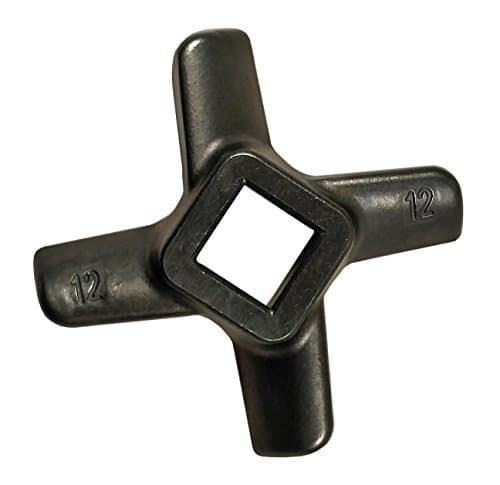
Best #12 replacement knife
Food Service Knives #12 Drop-Forged Grinder Knife
Replacement knife: solid drop-forged steel, sharpened in the USA, sold to fit nearly every #10 and #12 grinder. Measure yours first.
$19.99Amazon#ad · Price as of Sep 19, 2026 · Affiliate disclosure for the link to Food Service Knives #12 Drop-Forged Grinder Knife
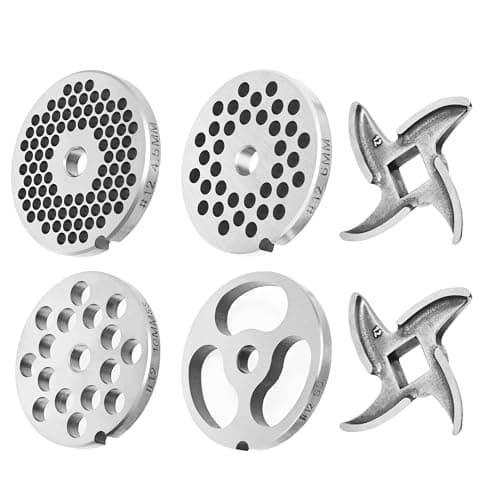
Best #12 plate kit
BOLEXINO #12 Stainless Grinder Plate Set with 2 Knives
Knife and plates together: three #12 plates, a stuffing plate and two knives, so you can replace both as LEM advises.
$35.99Amazon#ad · Price as of Sep 19, 2026 · Affiliate disclosure for the link to BOLEXINO #12 Stainless Grinder Plate Set with 2 Knives
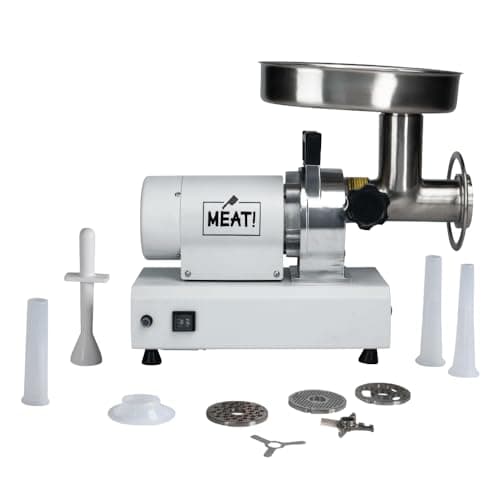
Best for 3-5 deer
MEAT! Your Maker #12 Pro-Grade Meat Grinder (.75 HP)
The step up for 3-5 deer: 0.75 HP and 7-10 lb a minute, all stainless, per MEAT!'s listing.
$579.99Amazon#ad · Price as of Sep 19, 2026 · Affiliate disclosure for the link to MEAT! Your Maker #12 Pro-Grade Meat Grinder (.75 HP)
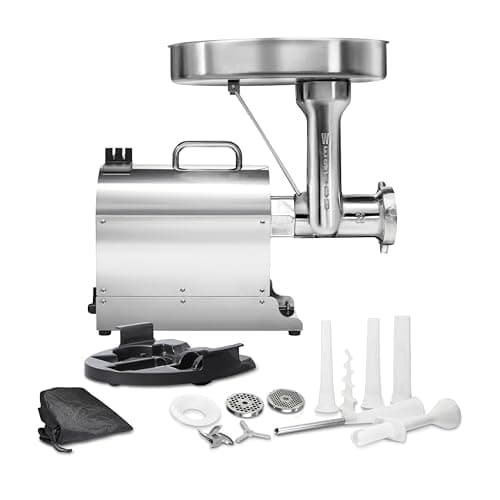
Best with reverse, 6+ deer
Weston Pro Series #22 Electric Meat Grinder (1.5 HP)
For 6+ deer: 1.5 HP, 14 lb a minute, and a forward-reverse mode Weston pitches for connective tissue.
$891.14Amazon#ad · Price as of Sep 19, 2026 · Affiliate disclosure for the link to Weston Pro Series #22 Electric Meat Grinder (1.5 HP)
Questions
Frequently asked
Why is my meat grinder not grinding?
Why does my ground meat come out mushy?
Why does my KitchenAid meat grinder keep clogging?
Should meat be frozen before grinding?
How often should I replace my grinder knife and plate?
Does a reverse switch stop a meat grinder from jamming?
Keep going down the chain
Related
- How to grind deer meatThe trim-chill-grind routine that prevents most clogs.
- Grinder plate sizesBuying a replacement knife and plate that fit.
- KitchenAid attachment vs standalone grinderWhere the mixer attachment runs out of room.
- Best meat grinders for deerThe upgrade, ranked by season.
- Meat grinder sizes explainedWhich size keeps up with your season.
- LEM BigBite #8 vs #12The most common step up from a stalling #8.
Receipts
Sources
- Ohio Department of Natural Resources, Division of Wildlife — Venison Meat Yield (115 deer, 2017 gun season) [PDF]
- LEM Products — #8 Electric Meat Grinder, Model 1158, Use & Maintenance manual (June 2014) [PDF]
- LEM Products — Grinder Workshop (troubleshooting FAQ)
- LEM Products — Meat Processing Tips (January 2025)
- Bass Pro Shops 1Source — Three Tips for Better Ground Venison (June 2020)
- USDA Food Safety and Inspection Service — Ground Beef and Food Safety (fact sheet, rev. August 2012; copy hosted by Utah State University Extension) [PDF]
- Amazon listing, manufacturer-supplied copy — LEM MightyBite #8 (1158)
- Amazon listing, manufacturer-supplied copy — MEAT! #12 Pro-Grade grinder (1159178)
- Amazon listing, manufacturer-supplied copy — Weston Pro Series 10-2201-W
- Amazon listing, manufacturer-supplied copy — Weston #12 Electric Meat Grinder (33-1301-W)
- Amazon listing, manufacturer-supplied copy — VEVOR #8 commercial electric grinder
- Amazon listing, manufacturer-supplied copy — KitchenAid KSMFGA food grinder attachment
- Amazon listing, manufacturer-supplied copy — Food Service Knives #12 drop-forged knife
- Amazon listing, manufacturer-supplied copy — VTurboWay #12 knife 2-pack (fit list)
- Amazon listing, manufacturer-supplied copy — BOLEXINO #12 plate set with 2 knives
We haven't bench-tested this gear and we don't pretend to. Specs come from the maker's own pages, manuals and maker-supplied listing copy (labeled as such); food-safety figures from USDA and university extension publications; yield from the Ohio Division of Wildlife; prices live from Amazon. Where a figure isn't published, we say so. Read the full method.