Meat Grinders ◆ Guide
Sharpening Meat Grinder Blades and Plates: What Works, and When to Just Replace Them
A grinder knife does not cut like a kitchen knife. It shears against the plate face, which means the job is flatness, not an edge angle - and it means the two wear as a matched pair.
We earn a commission if you buy through our links, at no extra cost to you. It never decides the ranking — the method is published · Affiliate disclosure
You can restore a grinder knife and plate by lapping both flat faces on abrasive — but the manufacturers' own advice is to replace them as a pair, and on a home grinder that is usually the better call. LEM puts it plainly in its processing tips: change grinder plates and knives simultaneously for optimum performance. A fresh knife against a worn plate cuts badly, which is why sharpening one alone rarely fixes anything.
LEM also tells you what dullness looks like before you take anything apart: if meat is mashing instead of extruding in strings, the grinding knife may be dull — and its #8 manual lists a dull knife or plate alongside warm meat and a misinstalled plate as the three causes of mashing.
How a grinder actually cuts
A grinder knife is not a blade you slice with. The auger drives meat against the back of a perforated plate; the rotating knife wipes across that plate face and shears whatever sits in the holes. Two surfaces have to stay in intimate contact for that to work: the flat face of the knife and the flat face of the plate. LEM's Grinder Workshop makes the orientation rule explicit — put the flat side of the knife against the cutting plate, because with the knife on backwards “the meat will not be chopped and will be mushed.”
So “sharpening” a grinder knife means two things at once: restoring the cutting edges on the knife wings, and restoring the flatness of both mating faces so there is no gap for meat to squeeze through. Flatness is the one that usually fails first, and it is why a knife that still looks sharp can produce paste.
Is it dull, or is it something else?
| Symptom | Dull pair? | Check this first |
|---|---|---|
| Paste instead of clean strands | Possibly | Meat temperature (LEM wants 40 °F or colder) and knife orientation |
| Motor runs, nothing comes out | No | Sinew wrapped on the knife, or an overfed throat |
| Gray smeared flecks through the grind | No | Meat forced between the auger stud and the plate's centre hole |
| Visible shiny wear ring on the plate face | Yes | Lap or replace the pair |
| You can rock the knife on the plate face | Yes — flatness is gone | Lap or replace the pair |
Work through that list before you reach for abrasive. Our clogging and mushing guide covers each of the non-sharpening causes in detail; most mushing complaints turn out to be temperature.
Lapping the pair flat
The method is the same one used on any two surfaces that must seal: rub them flat against a flat abrasive, then against each other. Unplug the grinder first, and handle both parts carefully — LEM warns in capitals that the knife and plates are sharp.
- Wash and dry both parts so you are not grinding fat into the abrasive.
- Lay wet-or-dry abrasive on something genuinely flat — a glass sheet or a granite offcut. A medium grit to start, a fine grit to finish.
- Lap the plate face in figure-eights, flat and with even hand pressure, until the shiny wear ring disappears and the scratch pattern is uniform across the whole face.
- Lap the knife's flat face the same way. Keep it flat; rounding this face is the one mistake that cannot be undone.
- Mate them. A few rotations of the knife against the plate face, with a little water or oil, beds the two together.
- Wash, hand-dry immediately and oil both with food-grade silicone before they go back — see our cleaning routine.
Reassemble with the flat side of the knife against the plate, the washer on the drive end of the auger, and the ring finger-tight. LEM warns that over-tightening the ring causes needless wear on exactly the parts you just spent an hour saving. On its MightyBite #8, LEM gives a useful check: assembled correctly, the plate sticks out 1/8 to 3/16 inch past the end of the head.
What not to do
- Do not put a grinder knife on a bench grinder. Heat draws the temper out of the steel and loses you the hardness that holds the cutting edge, and freehand grinding destroys flatness.
- Do not sharpen the knife and leave the plate. They wear as a pair; LEM's advice is to change them simultaneously for exactly this reason.
- Do not try to sharpen the inside of the plate holes. The holes are not the cutting feature; the plate face is.
- Do not run the grinder empty to “seat” the pair. LEM says running it empty can damage the head and auger.
- Do not lap away a pitted face. Corrosion pitting means the metal is gone, not displaced. Replace.
When to replace instead
On a home grinder, replacement is usually the honest answer. A knife and plate pair is a modest spend against an hour of careful lapping and the risk of rounding a face, and a new pair is flat to a tolerance you cannot reproduce on a glass sheet. Replace rather than lap if the faces are pitted from rust, if the knife wings are visibly rounded or chipped, if the plate is dished, or if you have already lapped the pair once.
Picks for this job
Replacement knives and plates
Buy the pair, not the piece — and buy by measurement. Several aftermarket knives publish a fit list that excludes specific machines even within the same size number.
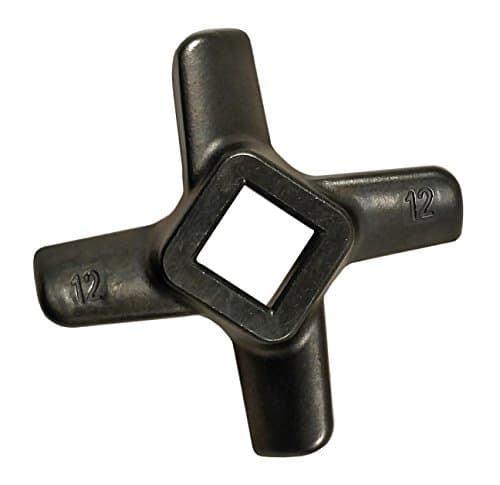
Best #12 replacement knife
Food Service Knives #12 Drop-Forged Grinder Knife
A single drop-forged #12 knife, sharpened in the USA, sold as a fit for most #10 and #12 grinders. Measure the square drive and the diameter first.
$20.99Amazon#ad · Price as of November 4, 2026 · Affiliate disclosure for the link to Food Service Knives #12 Drop-Forged Grinder Knife
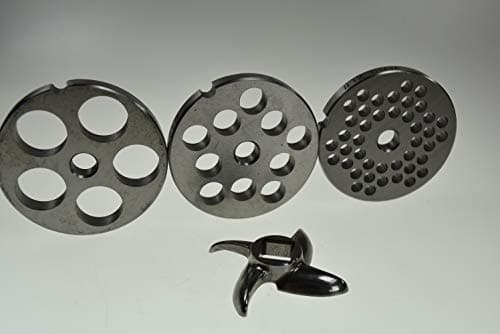
Best #12 coarse plate set
Smokehouse Chef #12 Grinder Plate Set with Knife
A #12 plate-and-knife set, which is how LEM asks you to replace them: both at once, so the two faces are new together.
$69.75Amazon#ad · Price as of November 4, 2026 · Affiliate disclosure for the link to Smokehouse Chef #12 Grinder Plate Set with Knife
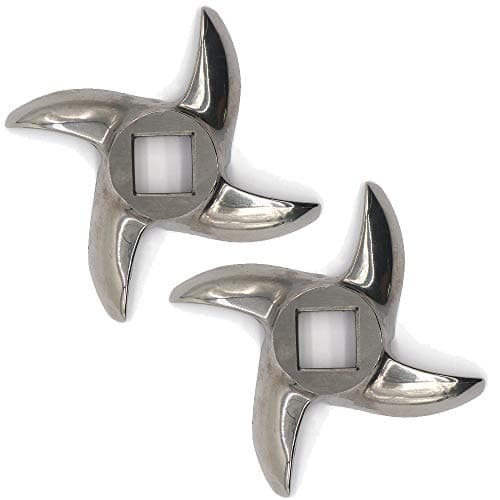
Budget spare for generic #12s
VTurboWay #12 Stainless Grinder Knives (2-Pack)
A two-pack, so there is a spare on the shelf the next time a session turns to paste mid-deer. Note the published not-fit list before ordering.
$9.99Amazon#ad · Price as of November 4, 2026 · Affiliate disclosure for the link to VTurboWay #12 Stainless Grinder Knives (2-Pack)
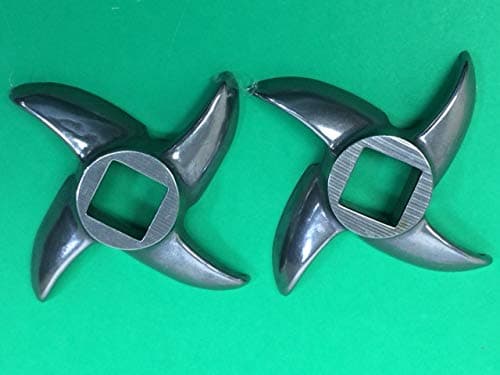
Best #22 knives
Smokehouse Chef #22 Stainless Grinder Knives (2-Pack)
The #22 equivalent twin pack, for the bigger heads where a dull knife costs you most in feed time.
$29.75Amazon#ad · Price as of November 4, 2026 · Affiliate disclosure for the link to Smokehouse Chef #22 Stainless Grinder Knives (2-Pack)
Buying a replacement that fits
Size number alone is not a fit. One aftermarket #12 knife listing publishes a not-fit list that specifically excludes LEM's #12 and Cabela's #12 — same number, different geometry. Measure three things before ordering: the plate diameter, the centre hole, and the drive square or notch on the knife. Our grinder plate size guide walks through the measurements and the hole sizes for each job.
Making a pair last
Most grinder knives die of corrosion rather than cutting. The routine that prevents it is the one in LEM's manual: clean immediately after use, hand wash, rinse with clear hot water, hand-dry immediately, never soak, and lubricate the knife and plates with silicone spray before they go away. Then stop feeding the pair what kills it: trim silver skin and sinew off the meat before it reaches the head, keep the meat at 40 °F or colder, and keep bone out of the grinder entirely — LEM's listings say its grinders are not for bones, and our guide to bones in a grinder explains what to use instead.
Questions
Frequently asked
Can you sharpen meat grinder blades?
How do I know if my grinder knife is dull?
Should I replace the grinder knife and plate together?
Can I use a bench grinder to sharpen a grinder knife?
How often do grinder knives and plates need replacing?
Keep going down the chain
Related
- Best grinder plates and knivesWhen sharpening is past it, replace the pair.
- Meat grinder keeps cloggingRule these out before you blame the knife.
- Grinder plate sizesThe three measurements a replacement has to match.
- How to clean a meat grinderThe routine that stops corrosion ending a pair.
- How to grind deer meatTrimming and chilling, which is what dulls a knife slowest.
Receipts
Sources
- LEM Products — Meat Processing Tips (January 2025)
- LEM Products — Grinder Workshop (troubleshooting and maintenance FAQ)
- LEM Products — #8 Electric Meat Grinder, Model 1158, Use & Maintenance manual (June 2014) [PDF]
- LEM Products — #10/12 Stainless Steel Grinder Knife (product page, SKU 485SS)
- Amazon listing, manufacturer-supplied copy — Food Service Knives #12 drop-forged knife
- Amazon listing, manufacturer-supplied copy — VTurboWay #12 knife 2-pack (published fit list)
- Amazon listing, manufacturer-supplied copy — Smokehouse Chef #12 plate and knife set
- Amazon listing, manufacturer-supplied copy — Smokehouse Chef #22 knife twin pack
- Amazon listing, manufacturer-supplied copy — BOLEXINO #12 plate set with 2 knives
Specs come from the maker's own pages, manuals and maker-supplied listing copy (labeled as such); food-safety figures from USDA and university extension publications; yield from the Ohio Division of Wildlife; prices live from Amazon. Where a figure isn't published, we say so. Read the full method.