Meat Grinders ◆ Guide
Grinder Plate Sizes: Which Hole Size for Burger, Sausage or Chili
Two different numbers get called plate size: the hole size, which sets the texture, and the plate diameter, which has to match your grinder. Here are both, from the maker's own charts.
We earn a commission if you buy through our links, at no extra cost to you. It never decides the ranking — the method is published · Affiliate disclosure
For hamburger, use a 3/16-inch (4.5 mm) plate on the second grind, or 1/8-inch (3 mm) for a finer burger. For summer sausage, salami, pepperoni and snack sticks, use 1/4-inch (6 mm). For chili grind and first grinds, use 3/8-inch (10 mm) or 1/2-inch (12 mm). Those are LEM's own recommendations, and they are the same across its #5 to #32 plates.
The other number, plate diameter, has nothing to do with texture. It is set by your grinder's size, and getting it wrong is how people end up with a plate that doesn't seat. Both are below.
Grinder plate hole size chart
| Hole size | Metric | LEM's recommended use | Pass |
|---|---|---|---|
| 1/8 in. | 3 mm | Hamburger, bologna, hot dogs, ground jerky | Fine / second |
| 3/16 in. | 4.5 mm | Second grind, coarse hamburger, breakfast, Polish or German sausage | Second |
| 1/4 in. | 6 mm | Coarse sausages: summer sausage, salami, pepperoni, snack sticks | Single or second |
| 3/8 in. | 10 mm | First grind, chili, chorizo, linguica | First |
| 1/2 in. | 12 mm | First grind, coarse chili, stew meat | First |
The uses are paraphrased from LEM's plate pages, which list identical recommendations for every grinder size (see LEM's #20/22 plates, for example). The pattern is simple: big holes open up the meat on the first pass, small holes set the final texture on the second. Our guide to grinding deer meat walks through the two passes step by step.
Watch out for the words "coarse" and "fine," because they aren't standard. Weston ships its Pro Series grinders with a 7 mm coarse and a 4.5 mm fine plate. LEM ships its BigBite #12 with 10 mm and 4.5 mm plates. VEVOR's #8 comes with 6 mm and 8 mm plates. Bass Pro's ground-venison tips call 1/4-inch coarse and 1/8-inch fine. When a recipe says "coarse," check the millimeters on your plate.
Plate diameter by grinder size
The plate diameter has to match the head. These are LEM's figures for its own plates, which also show where two sizes share a plate:
| Grinder size | Plate diameter | Hole sizes LEM sells |
|---|---|---|
| #5 | 2-1/8 in. | 3, 4.5, 6, 10 mm |
| #8 | 2-3/8 in. | 3, 4.5, 6, 10, 12 mm |
| #10 and #12 | 2-3/4 in. | 3, 4.5, 6, 10, 12 mm |
| #20 and #22 | 3-1/4 in. | 3, 4.5, 6, 10, 12 mm |
| #32 | 3-7/8 in. | 3, 4.5, 6, 10, 12 mm |
Other makers land close to LEM but not always on it. STX lists its #12 Turboforce plates at 2-5/8 inches. A Food Service Knives #22 plate is 3-1/4 inches, matching LEM, while Smokehouse Chef sells its #22 knives for grinders with 3-3/16-inch plates. A sixteenth of an inch either way is exactly why you measure before you buy. If you're still choosing a grinder, our meat grinder sizes guide explains what each size number means for a season's worth of meat.
LEM also sells each size in two steels: 420 stainless, and what it calls "Premium Salvinox Stainless Steel," which is "slightly thicker, providing you with a longer life."
What's already in the box
Before you buy plates, check what your grinder shipped with. Most come with two cutting plates, and the pair tells you which gap to fill. These are the plates listed for grinders we track:
| Grinder | Plates included | What to add for a deer season |
|---|---|---|
| LEM MightyBite #8 | 10 mm, 4.5 mm, stuffing plate | 6 mm for summer sausage and snack sticks |
| LEM BigBite #12 | 10 mm, 4.5 mm, stuffing plate | 6 mm; 3 mm if you shoot ground jerky |
| Weston Pro Series #8, #12, #22 | 7 mm, 4.5 mm | 10 or 12 mm for chili grind; 6 mm for coarse sausage |
| VEVOR #8 commercial | 6 mm, 8 mm | 4.5 mm for the second burger grind |
| Weston #10 manual | 4.5 mm, 10 mm | 6 mm for coarse sausage |
| KitchenAid KSMFGA attachment | One fine and one coarse plate (sizes not listed) | Check the maker's fit list before buying third-party plates |
The pattern is that most kits cover burger and skip the 6 mm plate LEM recommends for summer sausage, salami, pepperoni and snack sticks. If you plan to make any of those, that is the first plate to buy. Plate sets that include a 6 mm (1/4-inch) plate, like both #12 sets in the picks below, fill the gap in one order.
Dual-grind heads: two plates, one pass
A few grinders stack two plates in the same head so the meat is ground coarse and fine in a single pass. LEM's BigBite Dual Grind #8 and #22 ship with a "first grind plate," 4.5 mm and 10 mm plates, a stuffing plate and a dual-blade knife. MEAT!'s Dual Grinder #22 pairs a stainless "first grinding plate" with your choice of a coarse or fine second plate "in the same throat."
The trade is output per pass. LEM rates its Dual Grind #8 at about 4.5 lb a minute against about 7 for the single BigBite #8, and MEAT! rates its Dual #22 at 10 lb a minute against 11 to 14 for its standard #22. Since a dual head does both passes at once, those figures aren't directly comparable, but it does mean the plates and knife are specific to that head: a dual-blade knife and a first-grind plate aren't the same parts as a standard knife and plate, so buy replacements from the grinder's maker or check the fit carefully.
How to buy plates and knives that fit
- Measure the diameter of the plate you have, edge to edge, and match it to the listing.
- Check the center. The knife rides on the square of the auger stud (LEM's manual), so the knife's center hole has to match yours. Food Service Knives, for instance, lists a 1/2-inch square center hole on its #12 knife.
- Check the notch. The plate's notch lines up with a locating pin in the head. The Food Service Knives #22 plate is a single-notch design.
- Read the fit list. Size numbers aren't a guarantee: one #12 knife twin-pack says outright that it does not fit the LEM #12, the Cabela's #12 or KitchenAid's sausage maker.
- Replace the knife with the plate. LEM's advice on every plate page: "when changing your knife to change the plate at the same time for optimum performance."
Some plates are reversible. The Food Service Knives #22 plate is a hubless design with "two sharpened sides," and BOLEXINO says its hubless #12 plates "can be used on both sides." A dull knife-and-plate pair is one of the usual reasons a grinder starts to mush instead of cut; our clogging guide covers the rest.
Knives differ more than plates do. Food Service Knives sells a solid drop-forged #12 knife, sharpened in the USA and inspected before sharpening. LEM's own #10/12 knife is stainless. Smokehouse Chef's #22 twin pack is stainless with what it calls a swirl design, and one budget #12 two-pack in 420 stainless warns in its own listing that the knife is "fragile" and shouldn't be dropped. The knife is a small part that decides whether the meat cuts or smears, so favor one whose maker says how it is made and sharpened, and that lists the grinders it fits.
Care is the same for all of them: wash, dry right away, and oil. LEM's manual recommends silicone spray on the knife and plates; BOLEXINO suggests a little vegetable oil even on its stainless plates.
Which plates to own for a deer season
- Burger only: a 10 mm (3/8-inch) plate for the first grind and a 4.5 mm (3/16-inch) plate for the second. Many grinders ship with close to this pair already.
- Burger plus summer sausage or snack sticks: add a 6 mm (1/4-inch) plate, LEM's pick for coarse sausages.
- Chili grind: a single pass through 10 mm or 12 mm. Some aftermarket sets go coarser: the Smokehouse Chef #12 set includes a 3/4-inch plate, larger than anything on LEM's chart.
- Ground jerky: a 3 mm (1/8-inch) plate, LEM's pick for jerky, before the meat goes into a jerky gun.
- Stuffing through the grinder: a stuffing plate replaces the knife and plate. LEM's Grinder Workshop lists grinding and stuffing at the same time as a cause of mushing, which is one reason many people move to a dedicated stuffer; see sausage stuffer vs grinder attachment.
Plate and knife sets for #12 and #22 grinders
The #12 and #22 sit at the center of our grinder picks, and they are the sizes we found the most replacement plate and knife sets for. These four cover a burger-and-sausage season on a #12 and a sharp spare pair for a #22. Measure first.
Picks for this job
Plates and knives for #12 and #22
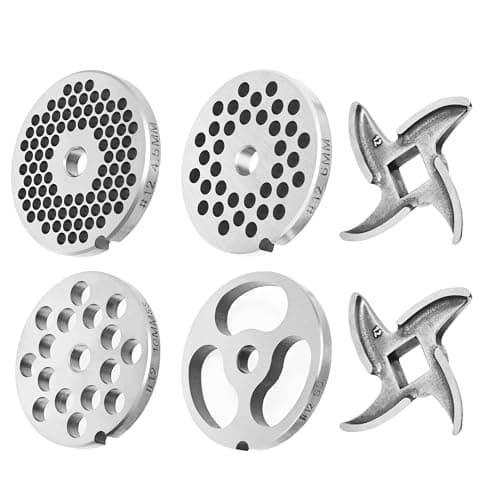
Best #12 plate kit
BOLEXINO #12 Stainless Grinder Plate Set with 2 Knives
#12: 3/16, 1/4 and 3/8-inch plates, a stuffing plate and two knives; the hubless plates can be used on both sides.
$35.99Amazon#ad · Price as of Sep 19, 2026 · Affiliate disclosure for the link to BOLEXINO #12 Stainless Grinder Plate Set with 2 Knives
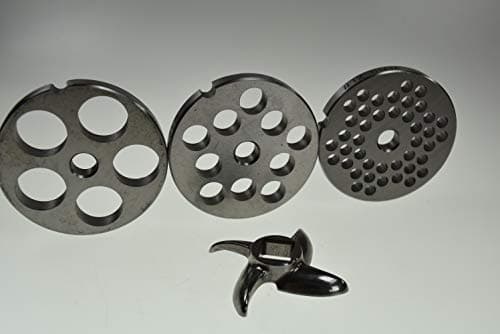
Best #12 coarse plate set
Smokehouse Chef #12 Grinder Plate Set with Knife
#12: 1/4, 1/2 and 3/4-inch stainless plates, 2-3/4 inches across, plus a knife, for burger, sausage and chili grind.
$69.75Amazon#ad · Price as of Sep 19, 2026 · Affiliate disclosure for the link to Smokehouse Chef #12 Grinder Plate Set with Knife
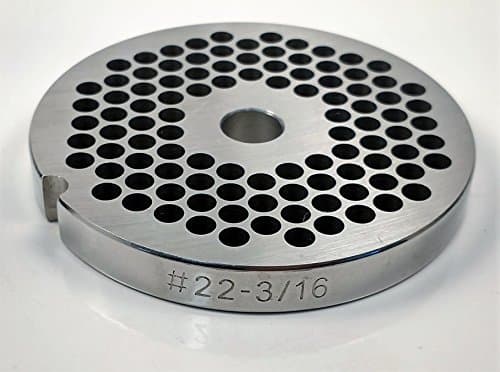
Best #22 plate
Food Service Knives #22 Grinder Plate, 3/16 in.
#22: one 3/16-inch plate, 3-1/4 inches across, reversible with two sharpened sides; machined and tempered in the USA.
$24.99Amazon#ad · Price as of Sep 19, 2026 · Affiliate disclosure for the link to Food Service Knives #22 Grinder Plate, 3/16 in.
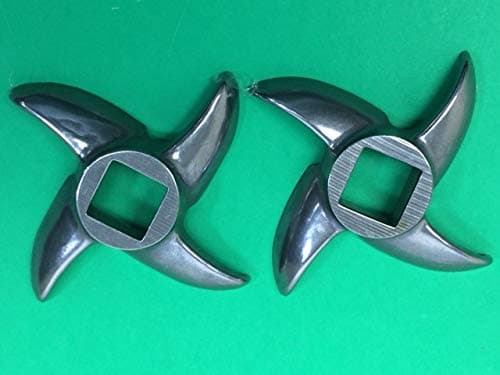
Best #22 knives
Smokehouse Chef #22 Stainless Grinder Knives (2-Pack)
#22: two stainless knives, 2-15/16 inches tip to tip, sold for grinders with 3-3/16-inch plates.
$29.75Amazon#ad · Price as of Sep 19, 2026 · Affiliate disclosure for the link to Smokehouse Chef #22 Stainless Grinder Knives (2-Pack)
Which set? For a #12 burger-and-sausage season, the BOLEXINO set covers the 3/16, 1/4 and 3/8-inch holes LEM recommends. For chili and very coarse grinds on a #12, the Smokehouse Chef set goes up to 3/4 inch. On a #22, pair a 3/16-inch plate with a fresh knife, and check the knife's plate-diameter spec against yours, since the two listings quote 3-1/4 and 3-3/16 inches.
Questions
Frequently asked
What size grinder plate is best for hamburger?
What size grinder plate is used for sausage?
What plate size is chili grind?
Do #10 and #12 grinder plates interchange?
Should I replace the grinder knife when I replace the plate?
Can you use both sides of a grinder plate?
Keep going down the chain
Related
- Meat grinder sizes explainedWhat #8, #12, #22 and #32 mean for your season.
- How to grind deer meatThe coarse and fine passes, in order.
- Venison burger fat ratioHow much fat goes into the grind.
- How to make venison sausageThe 4.5 mm and 6 mm plates put to work.
- Why a meat grinder keeps cloggingDull knives, warm meat and other causes.
- Best meat grinders for home useGrinders and the plates they ship with.
Receipts
Sources
- LEM Products — #5 Grinder Plates (2-1/8 in. diameter; hole sizes and uses)
- LEM Products — #8 Grinder Plates (2-3/8 in. diameter; hole sizes and uses)
- LEM Products — #10/12 Grinder Plates (2-3/4 in. diameter; hole sizes and uses)
- LEM Products — #20/22 Grinder Plates (3-1/4 in. diameter; hole sizes and uses)
- LEM Products — #32 Grinder Plates (3-7/8 in. diameter; hole sizes and uses)
- LEM Products — #8 Electric Meat Grinder, Model 1158, Use & Maintenance manual (June 2014) [PDF]
- LEM Products — Grinder Workshop (troubleshooting FAQ)
- LEM Products — Meat Processing Tips (January 2025)
- LEM Products — #12 BigBite Meat Grinder, 0.75 HP (product page)
- Bass Pro Shops 1Source — Three Tips for Better Ground Venison (June 2020)
- Amazon listing, manufacturer-supplied copy — Weston Pro Series 10-1201-W
- Amazon listing, manufacturer-supplied copy — VEVOR #8 commercial electric grinder
- Amazon listing, manufacturer-supplied copy — STX Turboforce 3000 (STX-3000-TF)
- Amazon listing, manufacturer-supplied copy — LEM MightyBite #8 (1158)
- Amazon listing, manufacturer-supplied copy — Weston #10 manual grinder (36-1001-W)
- Amazon listing, manufacturer-supplied copy — KitchenAid KSMFGA food grinder attachment
- Amazon listing, manufacturer-supplied copy — LEM BigBite #8 (17791)
- Amazon listing, manufacturer-supplied copy — LEM BigBite Dual Grind #8 (1784)
- Amazon listing, manufacturer-supplied copy — LEM BigBite Dual Grind #22 (1786)
- Amazon listing, manufacturer-supplied copy — MEAT! #22 Pro-Grade grinder (1159179)
- Amazon listing, manufacturer-supplied copy — MEAT! #22 Pro-Grade Dual Grinder (1193466)
- Amazon listing, manufacturer-supplied copy — BOLEXINO #12 plate set with 2 knives
- Amazon listing, manufacturer-supplied copy — Smokehouse Chef #12 plate and knife set
- Amazon listing, manufacturer-supplied copy — Food Service Knives #22 plate, 3/16 in.
- Amazon listing, manufacturer-supplied copy — Smokehouse Chef #22 knife twin pack
- Amazon listing, manufacturer-supplied copy — Food Service Knives #12 drop-forged knife
- Amazon listing, manufacturer-supplied copy — LEM #10/#12 stainless grinder knife
- Amazon listing, manufacturer-supplied copy — VTurboWay #12 knife 2-pack (fit list)
We haven't bench-tested this gear and we don't pretend to. Specs come from the maker's own pages, manuals and maker-supplied listing copy (labeled as such); food-safety figures from USDA and university extension publications; yield from the Ohio Division of Wildlife; prices live from Amazon. Where a figure isn't published, we say so. Read the full method.