A jerky gun turns ground meat into even strips or snack sticks. Load size decides how many refills a batch takes, so we ranked on build and capacity first, then ease and value.
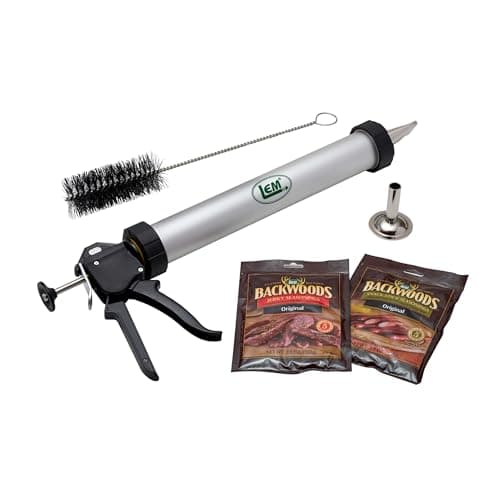
An anodized aluminum barrel that holds 1½ lb of ground meat, with stainless flat and snack-stick nozzles. It's the gun to buy if you make ground jerky more than once a season.
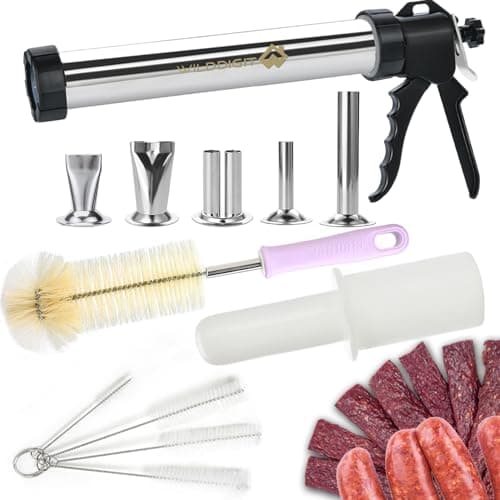
A stainless barrel, five stainless nozzles and five cleaning brushes. The listing's 2.1 lb figure is the largest on this page, but no warranty is published.
#ad · Prices come live from Amazon, last checked Sep 19, 2026; where we have no verified live price we show none. Scores are ours, compiled from published specs, manuals and warranty terms, not bench tests. Tap a row for the full write-up.
Buy the LEM Jerky Cannon. It has an anodized aluminum barrel that holds 1½ lb of ground meat, stainless flat and snack-stick nozzles, and a one-year warranty with parts support from LEM. The WILDDIGIT stainless kit gives you an all-metal barrel and five nozzles, but it publishes no warranty term. LEM's plastic Jerky Gun holds ¾ lb and is a low-cost way to find out whether you like ground jerky before you commit.
These rankings come from the makers' specs, not a bench test. Guns were scored on build (30), capacity per load (25), ease of loading and cleaning (25), and value at the live price (20).
Refills per batch: the capacity math
The number that shapes your afternoon is how often you stop to reload. Here's the arithmetic at each gun's published capacity, rounded up to whole loads. The 10 lb row matters because that's the ground-meat limit on a Hi Mountain jerky kit.
Batch of ground meat
LEM Jerky Cannon (1½ lb)
WILDDIGIT kit (2.1 lb, per title)
LEM Jerky Gun (¾ lb)
5 lb
4 loads
3 loads
7 loads
10 lb (one Hi Mountain kit, ground)
7 loads
5 loads
14 loads
15 lb
10 loads
8 loads
20 loads
The WILDDIGIT figure comes from the product title. The listing doesn't give barrel dimensions or state outright that 2.1 lb is load capacity, so treat that column as the seller's claim. LEM publishes barrel dimensions for both of its guns: about 14-15/16 by 2 inches on the Cannon and about 9⅛ by 2 inches on the Jerky Gun.
For scale, USDA says a pound of meat weighs about four ounces once it's jerky. A 10 lb batch ends up as roughly 2½ lb of finished jerky. That's 7 Cannon loads or 14 Jerky Gun loads to fill your trays for one kit's worth.
Ground jerky has its own safety rules
The gun is the easy part. Ground meat is harder to make safe than whole strips because, as PNW 632 explains, grinding distributes any pathogens on the meat's surface throughout the meat. NCHFP puts it plainly: disease-causing microorganisms "are more difficult to eliminate in ground meat than in whole meat strips." Ground jerky has to reach an internal 160°F just like sliced.
Our deer jerky guide walks through the whole ground path, from mixing the cure to the final bake. The curing salt guide covers what's in the cure packet and why it matters.
Which 160°F method suits ground jerky
Sliced jerky has several ways to reach 160°F. Ground jerky really has one. PNW 632 notes that ground meat jerky "may break apart during boiling," which rules out dropping gun-shaped strips into hot marinade. That leaves the post-drying bake. After drying, lay the strips on a baking sheet and heat them for 10 minutes in an oven preheated to 275°F. That's the method K-State gives for ground jerky, and PNW calls post-drying heat the easiest way to produce safe jerky. NCHFP adds that you should follow your dehydrator maker's directions for heating at the end of drying (NCHFP). Presto's manual, for one, gives the same 275°F, 10-minute bake for ground jerky.
Mixing matters too. PNW says ground jerky is flavored by mixing in spices, including salt, before it's shaped, and that the salt helps the meat hold together (PNW 632). Work the kit's seasoning and cure evenly through the whole batch before the first load goes into the gun, so every strip gets its share of cure.
The grinder side of jerky
People searching for the best meat grinder for jerky are usually asking two things. The first is whether their grinder can make lean enough meat. The answer is to grind lean venison and leave out the added fat you'd use for burger. That's the opposite of our venison burger fat ratio advice, because PNW and Ohio State set a 93% lean floor for ground jerky. The second is whether they need a bigger grinder. A 10 lb jerky batch is a small load next to a full deer, so the grinder that handles your season handles your jerky. Our grinder rankings for deer size that by how many deer you process.
Nozzles: flat jerky vs snack sticks
Both LEM guns ship with a flat nozzle and a ½-inch round nozzle. The Cannon's flat nozzle is 1-11/32 by 3/16 inch in stainless. The Jerky Gun's is 1-3/16 by 3/16 inch in plastic. A 3/16-inch ribbon sits under NCHFP's ¼-inch ceiling, the thickness its 275°F, 10-minute post-heat is written for. The round nozzle makes uncased snack-stick shapes. If you want real snack sticks in collagen casings, that's a stuffer job, covered in the best stuffers for snack sticks.
The ribbon's thickness also affects drying time. A 3/16-inch strip is thinner than a ¼-inch sliced one, and Penn State notes that thinner strips take less time to dry. Keep flat strips and round sticks on separate trays so you can pull each when it passes the bend test.
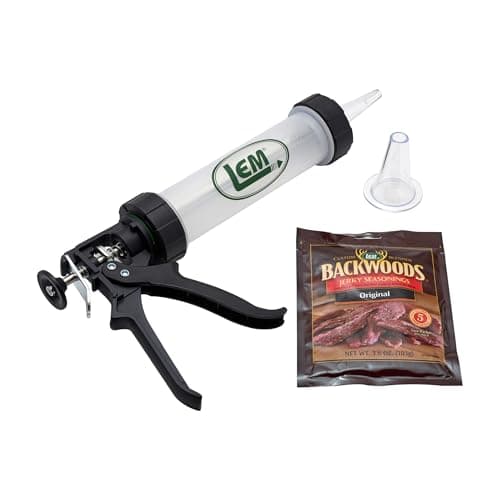
Loading is where the designs differ most. LEM flares the Cannon's barrel at both ends to make loading meat and seating the piston easier, and it sells disposable Jerky Cannon bags that it says also work with the Jerky Gun. The Jerky Gun's semi-transparent barrel shows how much meat is left before you run dry mid-strip.
Can you skip the gun?
Yes. PNW 632 describes pressing seasoned ground meat into a jellyroll pan ¼ inch thick and cutting it into strips. That costs nothing but a pan. What the gun adds is speed and consistency: every strip comes out at the nozzle's size, and you can extrude straight onto the dehydrator trays, as Presto's manual describes. If you make ground jerky once, try the pan. If you make it every season, the gun earns its drawer space.
In detail
The picks, in full
1
Best jerky gun
LEM Jerky Cannon
8.3 /10
An anodized aluminum barrel that holds 1½ lb of ground meat, with stainless flat and snack-stick nozzles. It's the gun to buy if you make ground jerky more than once a season.
#ad · Price as of Sep 19, 2026 · Affiliate disclosure for the link to LEM Jerky Cannon
2
Most nozzles, no warranty listed
WILDDIGIT 2.1 lb Stainless Steel Jerky Gun Kit
8.0 /10
A stainless barrel, five stainless nozzles and five cleaning brushes. The listing's 2.1 lb figure is the largest on this page, but no warranty is published.
#ad · Price as of Sep 19, 2026 · Affiliate disclosure for the link to LEM Jerky Gun with Backwoods Seasoning
What to look for in a jerky gun
Barrel material. The Cannon's barrel is anodized aluminum and the WILDDIGIT's is stainless. The Jerky Gun's is plastic, which keeps it light and lets you see how much meat is left. We score metal higher on build.
Capacity per load. See the refill table. If you run full kit batches, 1½ lb or more per load saves real time.
Nozzle material and count. The Cannon has two stainless nozzles and the WILDDIGIT has five. The Jerky Gun's are plastic.
Cleaning. The Cannon is hand wash only and comes with a nylon brush. For the plastic Jerky Gun, LEM's product page says dishwasher-safe and the Amazon listing says it isn't, so hand-wash it. The WILDDIGIT includes five brushes, including one for the flat nozzle's slot.
Warranty and parts. LEM backs both guns for one year and sells replacement parts. The WILDDIGIT listing promises a 24-hour response but publishes no warranty term.
Whichever you buy, clean it like any raw-meat tool. PNW 632 says to wash equipment, then sanitize it in 1 tablespoon of chlorine bleach per gallon of room-temperature water and let it air-dry. That includes the nozzles and the piston.
What to pair with the gun
A jerky gun is one part of the ground-jerky setup. You also need a cure-and-seasoning kit (Hi Mountain's kits handle up to 10 lb of ground meat each), a dehydrator whose dial reaches at least 160°F (see our dehydrator rankings), and an oven for the final 275°F heat. Lay ground strips on the trays the same way as sliced ones: close together but not touching, per NCHFP.
As a gift
A jerky gun and a cure kit make a practical gift pairing. If that's why you're here, the gifts for deer hunters page covers gear across price levels.
How we picked
Units we claim to have bench-tested: none
Plenty of sites say they ground two hundred pounds through every grinder. We didn't, and we say so. What we do instead: read the maker's spec sheet, manual and warranty terms, record the figures that decide whether a machine keeps up with your season (size number, motor rating, rated pounds per minute, capacity, duty cycle, gearing), check parts availability, and score each pick on a published rubric. Then we show the season math — pounds per deer from the Ohio Division of Wildlife's yield study — so you can redo it with your own numbers.
The LEM Jerky Cannon. It has an anodized aluminum barrel, a 1½ lb load, stainless flat and round nozzles, and a one-year warranty with parts support. It needs half the refills of LEM's ¾ lb plastic Jerky Gun.
Do you need cure for ground meat jerky?+
The research USDA cites found that cured ground-beef jerky had greater bacterial destruction than uncured, and Ohio State Extension pairs ground jerky with a curing mix. It still has to reach 160°F, so do the 10-minute, 275°F post-bake too.
How much meat does a jerky gun hold?+
LEM rates the Jerky Cannon at 1½ lb and the Jerky Gun at ¾ lb. The WILDDIGIT kit's title says 2.1 lb but gives no barrel dimensions.
What lean percentage should ground meat be for jerky?+
At least 93% lean, per PNW 632 and Ohio State Extension.
Can a jerky gun make snack sticks?+
Yes, uncased ones. Both LEM guns include a ½-inch round nozzle. For snack sticks in casings, use a sausage stuffer with a snack-stick tube.
We haven't bench-tested this gear and we don't pretend to. Specs come from the maker's own pages, manuals and maker-supplied listing copy (labeled as such); food-safety figures from USDA and university extension publications; yield from the Ohio Division of Wildlife; prices live from Amazon. Where a figure isn't published, we say so. Read the full method.