Jerky ◆ Guide
Ground Venison Jerky: How to Make Deer Jerky From Ground Meat
Ground jerky is faster than whole muscle, kinder to a tough deer, and chewier in a way most people prefer. It is also the version where the food-safety steps stop being optional.
We earn a commission if you buy through our links, at no extra cost to you. It never decides the ranking — the method is published · Affiliate disclosure
Mix a cure through lean ground venison, press it into strips with a jerky gun at no more than a quarter inch thick, bring the meat to 160 °F, then dry it at a steady 130-140 °F or higher until it cracks but does not snap. The cure and the 160 °F step are the two things that separate ground jerky from a gamble, and they are the two steps home recipes most often leave out.
USDA's guidance on jerky is to heat meat to 160 °F (poultry to 165 °F) before dehydrating, and to dry at a steady 130 to 140 °F or higher. That applies to whole-muscle jerky too, and it applies with more force here, for the reason in the next section.
Why ground instead of whole muscle
Three honest reasons, and one that is not usually admitted:
- It uses the meat you have. Whole-muscle jerky wants a solid, grain-aligned piece — the hindquarter muscles, in practice. Ground jerky uses trim, which is what is actually left after you bone out a deer.
- It is forgiving of a tough animal. Grinding cuts through connective tissue that would make a whole-muscle strip leathery, so a mature buck makes decent ground jerky and mediocre sliced jerky.
- It is faster. No partial freezing, no slicing, no judging the grain. Mix, press, dry.
- The texture is the one most people actually like. Ground jerky is tender and uniform rather than fibrous. It is also the texture of nearly every commercial jerky stick.
The trade is that you lose the whole-muscle chew, and you take on more responsibility for the process. If you want the sliced version instead, our how to slice meat for jerky and best cuts for jerky pages cover it.
Why ground jerky needs more care than sliced
The published home-drying guidance exists because of this. The National Center for Home Food Preservation, PNW 632 from the Idaho, Oregon State and Washington State extension services, Penn State Extension and Kansas State's MF3173 all converge on the same shape of process: cure or a heat step, a controlled drying temperature, and a thickness limit. Follow one of them properly rather than averaging four recipes off the internet.
One more thing specific to venison: our deer jerky guide covers the cold-chain handling from the field onward, and that is where a safe batch actually begins. Ground jerky made from trim that sat warm in a truck bed is not rescuable by a dehydrator.
Cure is not seasoning
A jerky kit contains both and they do different jobs. The seasoning is flavour. The cure is sodium nitrite at a dose calculated for a stated weight of meat, and it is doing preservation work. Buy a kit, or buy a preblended cure and follow its usage rate — do not improvise the nitrite.
Hi Mountain's Original Blend kit is the one we point to because its ratios are published for both preparations: seasoning and cure for 15 lb of whole-muscle jerky or 10 lb of ground. Note the difference — the same kit covers less meat when it is ground, because the cure has to be distributed through the mass rather than onto a surface. Weigh your meat.
For the wider question of which curing salt is which, our curing salt guide covers Prague Powder No. 1 and No. 2 and where each belongs.
The process, step by step
- Start with lean trim, ground once. Fat does not dry, and fat is what turns jerky rancid in storage. Trim hard before it reaches the grinder — silver skin and sinew out — and use a coarse plate. Our how to grind deer meat guide covers the routine.
- Weigh the meat. Every cure dose on every kit is per pound. This is the step that makes the rest of it work.
- Mix the cure and seasoning through thoroughly. Evenly is the whole point; a pocket of uncured meat is the failure mode. Mix cold, in a lug or a bowl, and keep it cold.
- Rest it in the refrigerator for the time your kit specifies, so the cure distributes.
- Press the strips. Load the gun and lay strips straight onto dehydrator trays or a lined sheet pan — not thicker than a quarter inch.
- Bring the meat to 160 °F. Either before drying or as a finishing step, per the published method you are following. This is not optional.
- Dry at a steady 130-140 °F or higher until a strip cracks when bent but does not snap in two.
- Cool completely, then store. Warm jerky in a sealed bag makes its own condensation.
Thickness, and what the gun sets for you
This is the quiet advantage of ground jerky: the nozzle sets the thickness for you, identically, every strip. LEM publishes its nozzle dimensions — the Jerky Cannon's stainless flat nozzle is 1-11/32 by 3/16 inch, and the plastic Jerky Gun's flat nozzle is 1-3/16 by 3/16 inch. Three-sixteenths of an inch is inside the quarter-inch ceiling the extension publications set, with no knife skill involved.
With sliced jerky you are chasing that number by hand or with a board; our jerky boards and slicers page exists because holding a quarter inch consistently is genuinely hard. A gun removes the variable, and uniform thickness is what makes a whole tray finish at the same moment.
Both LEM guns also carry a round nozzle — 1/2 inch inside diameter — which turns the same batch into sticks rather than strips. If sticks are the goal and you want them cased, that is a different product; see our snack stick kits.
The 160 degree step, and how to verify it
A dehydrator that cannot hold a high enough temperature cannot do this job, which is why our dehydrator roundup treats the top of the temperature range as a hard spec rather than a feature. Check that your machine reaches 160 °F — the NESCO Snackmaster Pro is adjustable to it, and the Excalibur Select machines run a digital thermostat across a wide range.
Verify with a thermometer, not with the dial. The dial is a setpoint; what matters is the meat. A strip of ground jerky is thin, so measure by stacking two or three strips and probing through them, or use the oven step the published methods describe and measure there. USDA's safe minimum internal temperature chart is the reference. Our jerky time and temperature guide has the thickness-to-time table.
The gear for a ground batch
Picks for this job
A gun, a cure and something that reaches 160 degrees
That is the whole kit. The gun sets thickness, the kit sets the cure dose, and the dryer has to be able to hit the temperature the published methods require.
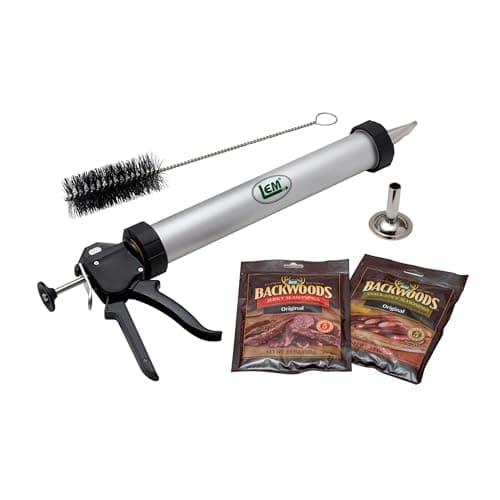
Best for ground venison
LEM Jerky Cannon
The gun to buy if you make ground jerky more than once a season: an anodized aluminium barrel holding 1.5 lb per load, stainless flat and round nozzles, hand wash only, one-year warranty.
$59.99Amazon#ad · Price as of November 4, 2026 · Affiliate disclosure for the link to LEM Jerky Cannon
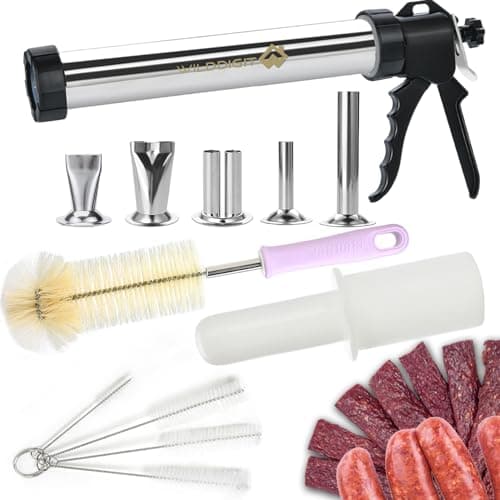
Most nozzles in the box
WILDDIGIT 2.1 lb Stainless Steel Jerky Gun Kit
A stainless barrel with five stainless nozzles and five cleaning brushes - the most nozzle options in the box. No warranty term is published.
$40.90Amazon#ad · Price as of November 4, 2026 · Affiliate disclosure for the link to WILDDIGIT 2.1 lb Stainless Steel Jerky Gun Kit
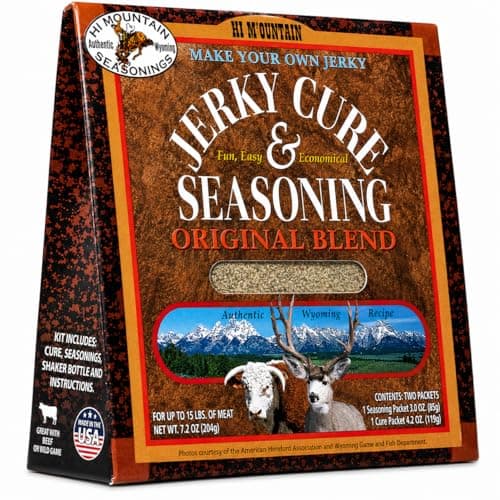
Best kit for beef jerky
Hi Mountain Original Blend Jerky Seasoning and Cure Kit
Seasoning and cure with published ratios for both preparations: 15 lb whole muscle or 10 lb ground. The ground figure is the one to use here.
$12.49Amazon#ad · Price as of November 4, 2026 · Affiliate disclosure for the link to Hi Mountain Original Blend Jerky Seasoning and Cure Kit
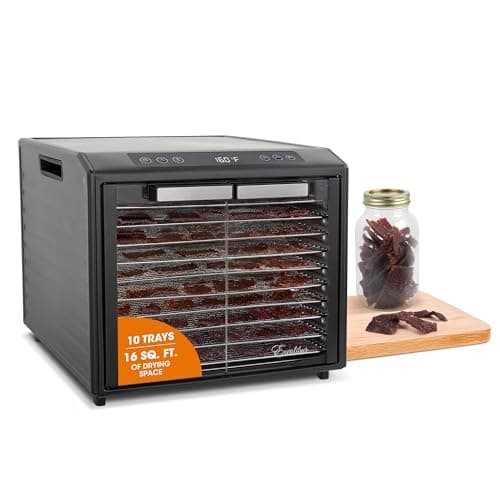
Best for big venison batches
Excalibur Select Series 10-Tray Food Dehydrator
Ten trays and a digital thermostat, for a season's worth of strips in one or two runs rather than six.
$228.79Amazon#ad · Price as of November 4, 2026 · Affiliate disclosure for the link to Excalibur Select Series 10-Tray Food Dehydrator
Two things worth knowing before you buy a gun. Load capacity decides how many refills a batch takes: the Jerky Cannon holds 1.5 lb against the plastic Jerky Gun's 3/4 lb, so a 10 lb batch is seven fills against fourteen. And cleanup is manual — LEM says hand wash only on the Cannon, and the stainless kit ships with brushes precisely because a flat nozzle is awkward to clean.
How much a season makes
At the Ohio Division of Wildlife average of about 52 lb of venison per deer, a two-deer season is roughly 104 lb of venison. If a fifth of that goes to jerky, that is around 20 lb of ground meat — which is two Hi Mountain kits at the 10 lb ground rate, and about fourteen loads through a 1.5 lb jerky gun.
| Your season | Venison | If a fifth goes to jerky | Jerky Cannon loads |
|---|---|---|---|
| 1 deer | about 52 lb | about 10 lb | 7 |
| 2 deer | about 104 lb | about 21 lb | 14 |
| 4 deer | about 209 lb | about 42 lb | 28 |
Which is the practical argument for tray count. A 5-tray dehydrator will do 20 lb of jerky, just not in one afternoon. Our dehydrators under $100 page covers the budget end and best dehydrators for jerky the full field.
Cooling and storing
Let the strips cool to room temperature completely before they go into anything sealed, or the residual warmth condenses inside the bag and you have introduced the moisture you spent eight hours removing. Then store cool, dark and airtight.
Ground jerky keeps less well than whole muscle for one reason: more surface area and, usually, more residual fat. Trim lean, and if you are keeping a batch for months rather than weeks, vacuum seal it and freeze it — our vacuum sealers for food page covers the machines, and freezer burn covers what happens to badly packaged meat in a freezer.
Questions
Frequently asked
How do you make deer jerky from ground meat?
Is ground jerky safe to make at home?
Do you need cure for ground venison jerky?
How thick should ground jerky strips be?
Is ground jerky better than sliced jerky?
How much ground meat does one jerky kit make?
Can you make ground jerky without a jerky gun?
Keep going down the chain
Related
Receipts
Sources
- USDA Food Safety and Inspection Service — Jerky and Food Safety
- Ohio Department of Natural Resources, Division of Wildlife — Venison Meat Yield (115 deer, 2017 gun season) [PDF]
- National Center for Home Food Preservation (University of Georgia) — Jerky
- Pacific Northwest Extension PNW 632 — Making Jerky at Home Safely (University of Idaho, Oregon State University, Washington State University; rev. 2020)
- Penn State Extension — Drying Jerky (updated April 2024)
- Ohio State University Extension, Ohioline HYG-5362 — Food Preservation: Making Jerky
- Kansas State University Research and Extension MF3173 — Dehydrating Meat Safely at Home (rev. March 2026) [PDF]
- USDA Food Safety and Inspection Service — Safe Minimum Internal Temperature Chart
- USDA Food Safety and Inspection Service — Ground Beef and Food Safety (fact sheet, rev. August 2012; copy hosted by Utah State University Extension) [PDF]
- LEM Products — Jerky Cannon product page
- LEM Products — Jerky Gun product page
- NESCO — FD-75PR Snackmaster Pro product page
- Amazon listing, manufacturer-supplied copy — LEM Jerky Cannon (468)
- Amazon listing, manufacturer-supplied copy — WILDDIGIT WD-JK-150 stainless jerky gun kit
- Amazon listing, manufacturer-supplied copy — LEM Jerky Gun (555)
- Amazon listing, manufacturer-supplied copy — Hi Mountain Original Blend jerky seasoning and cure kit
- Amazon listing, manufacturer-supplied copy — Excalibur Select Series 10-Tray (EXC-DH)
- Amazon listing, manufacturer-supplied copy — NESCO FD-75A Snackmaster Pro
Specs come from the maker's own pages, manuals and maker-supplied listing copy (labeled as such); food-safety figures from USDA and university extension publications; yield from the Ohio Division of Wildlife; prices live from Amazon. Where a figure isn't published, we say so. Read the full method.