Jerky ◆ Guide
The Best Meat for Jerky, From Beef Round to Venison Leg
Lean is the whole rule: fat goes rancid in dried meat. Extension services name round, flank, sirloin, rump and chuck for beef, and loin, round and flank for venison.
We earn a commission if you buy through our links, at no extra cost to you. It never decides the ranking — the method is published · Affiliate disclosure
For beef jerky, use a lean cut. PNW Extension names chuck, flank, round, rump and sirloin, and Penn State singles out flank and round steak. For venison, PNW says any cut works because game is so lean, with loin, round and flank the best. Trim every bit of visible fat. For ground jerky, use meat at least 93% lean.
Why lean decides it
Fat is the one thing a jerky cut can't have much of. NCHFP says to trim and discard all fat "because it becomes rancid quickly." PNW 632 says highly marbled or fatty cuts don't work, because fat "turns rancid very quickly and develops off-flavors during drying and storage." Ohio State Extension sets a number: choose meat with less than 10 percent fat. The best jerky cut is a big, lean muscle with little fat inside it, so trimming the outside leaves you with clean meat. Even lean cuts render a little fat. NCHFP and Presto's manual both say to pat off beads of oil with paper towels once drying is done, before the jerky cools and goes into containers.
Beef: the cuts that work
| Beef cut | Named by | Notes |
|---|---|---|
| Round | PNW 632, Penn State, Presto manual | Penn State calls round steak a good choice; Presto lists beef and venison round |
| Flank | PNW 632, Penn State | Penn State pairs lean flank with round as its two picks |
| Sirloin | PNW 632, Presto manual | Presto lists beef and venison sirloin |
| Rump | PNW 632, Presto manual | Presto lists beef and venison rump |
| Chuck | PNW 632 | PNW lists it among the cuts that work well |
Grade matters too. PNW notes that USDA Select grade "is leaner and less marbled than choice or prime grades." For jerky, Select is the better pick: the marbling that makes a Prime steak is fat that goes rancid in jerky. If the case only has Choice, pick the round or flank with the least visible fat and plan to trim harder.
Buying beef for jerky at the counter
Ask for round or flank, and choose Select grade if it's offered (PNW). Look for the least visible marbling in the case; Ohio State's line is less than 10 percent fat (Ohio State Extension). Buy only what you'll process soon. USDA says to use whole red meats within 3 to 5 days or freeze them, and to thaw frozen meat in the refrigerator, not on the counter. If you're freezing it anyway, freeze it in slicing-size portions so you can bring one at a time to firm.
Venison: which part of the deer
PNW 632 says venison, elk and antelope make excellent jerky, so everything below applies to an elk or antelope quarter too. Because game meats are so lean, "any cut can be used, but the best cuts tend to be the loin, round, and flank." NDSU's field-to-freezer guide says the leg muscles separate along their natural seams into pieces "used as roast, jerky or sliced into steaks" (NDSU Extension).
The hind-leg round is where PNW's and NDSU's advice overlap: big, seamed muscles that separate cleanly, each one able to go to jerky or to the roast pile. The loin is on PNW's list too, but NDSU's guide turns it into boneless loin chops, so that's your call. NDSU sends the rib, flank and neck trimmings to the grinder, and that's where the ground-jerky path starts.
For venison, the cut only matters if the meat is clean
The best muscle on the deer is the wrong one for jerky if gut contents reached it. NCHFP says to avoid making jerky from that meat, to use it only where it will be thoroughly cooked, and to chill deer carcasses rapidly. The CDC says to strongly consider CWD testing before eating venison and not to eat meat from an animal that tests positive (CDC). Check your state wildlife agency for testing locations and carcass-transport rules.
Ground meat for jerky
Ground jerky has a lean floor. PNW 632 says to use ground meat that's at least 93% lean, and Ohio State says the same. Ohio State also notes that ground jerky is "mixed with a dry spice and curing mix instead of a marinade." For beef, Penn State suggests ground round or lean or extra-lean ground beef. For venison, that means grinding without the added pork or beef fat you'd mix in for burger. Ground meat is also harder to make safe than whole strips (NCHFP), so it needs a cure and a post-bake. See the ground path in how to make deer jerky. For grinding the meat itself, our deer grinding guide covers technique.
What to avoid
- Marbled, fatty cuts. Fat goes rancid in dried meat and develops off-flavors (PNW).
- Meat that touched gut contents. NCHFP says not to make jerky from it and to use it only in thoroughly cooked dishes. Presto's manual says the same about venison contaminated with entrails.
- Bear, cougar and feral hog without the heating step. PNW says these can carry Trichinella that freezing doesn't reliably kill. The post-drying or precooking heat treatment does.
- Raw poultry, if you're expecting classic jerky. NCHFP says raw poultry is generally not recommended because of the finished texture and flavor.
Pork, lamb and other meats
NCHFP says jerky can be made from almost any lean meat, including beef, pork, venison or smoked turkey breast, and Ohio State lists beef, pork and lamb as popular choices. Pork and wild game carry one extra step. NCHFP says to treat them for trichinella by freezing pieces 6 inches thick or less at 0°F or below for at least 30 days before slicing. PNW adds that freezing doesn't kill every Trichinella species found in bear, cougar and feral hog, but the heating steps do. For poultry, PNW names the breast, thigh and leg, while NCHFP generally doesn't recommend raw poultry for jerky. If you use it, USDA's target is 165°F, not 160°F.
Trim and prep
PNW's prep order is to trim visible fat, then remove thick connective tissue and gristle, and Presto's manual says the same for beef and venison. NCHFP adds that a tenderizer can be used according to package directions if a cut is on the tough side. Keep the meat cold. USDA says to hold raw meat at 40°F or slightly below and use whole red meats within 3 to 5 days, or freeze them. Partially freeze the trimmed muscle until it's firm but not solid, then slice it no thicker than ¼ inch. Our slicing guide covers thickness and grain in detail.
Picks for this job
For a round's worth of jerky
A 10-inch slicer with a 1-12 mm dial for ¼-inch strips, and a cure kit for each meat: Original for beef, Hunter's Blend for venison.
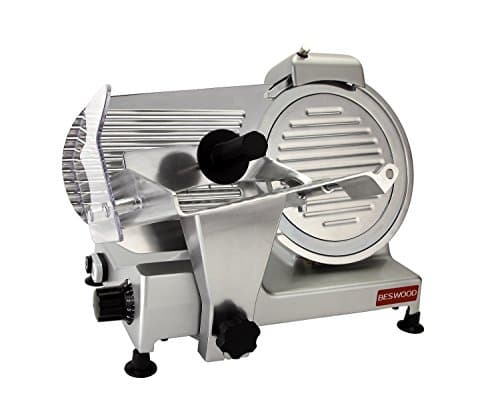
Best-documented 10-inch
BESWOOD 10-Inch Electric Deli Meat Slicer (BESWOOD250)
A chromium-plated high-carbon 10-inch blade, V-belt drive and a 1-12 mm thickness range. It's the deli-slicer pick with a published 12-month warranty.
$358.00Amazon#ad · Price as of Sep 19, 2026 · Affiliate disclosure for the link to BESWOOD 10-Inch Electric Deli Meat Slicer (BESWOOD250)
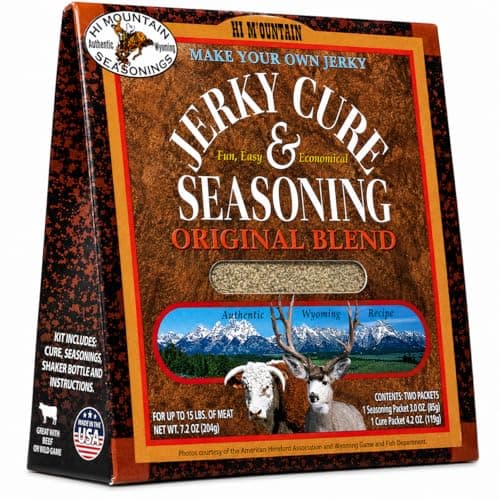
Best kit for beef jerky
Hi Mountain Original Blend Jerky Seasoning and Cure Kit
Separate seasoning and cure packets, a shaker bottle and instructions for up to 15 lb of whole-muscle jerky or 10 lb of ground. It's our default kit for beef.
$12.99Amazon#ad · Price as of Sep 19, 2026 · Affiliate disclosure for the link to Hi Mountain Original Blend Jerky Seasoning and Cure Kit
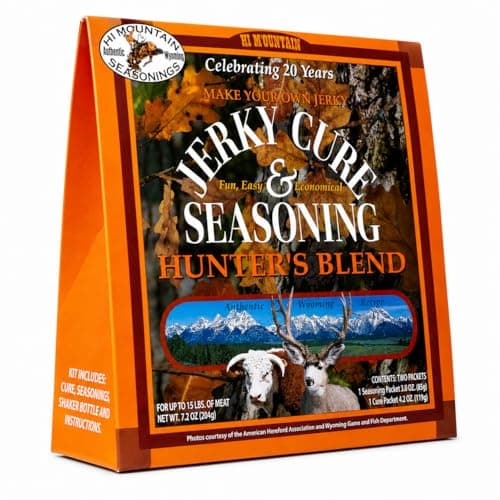
Best kit for deer jerky
Hi Mountain Hunter's Blend Jerky Seasoning and Cure Kit
Hi Mountain's wild-game blend, with seasoning, cure and a shaker for up to 15 lb of whole-muscle venison or 10 lb of ground.
$12.99Amazon#ad · Price as of Sep 19, 2026 · Affiliate disclosure for the link to Hi Mountain Hunter's Blend Jerky Seasoning and Cure Kit
Seasoning and cure
Once you have the right cut, the seasoning is the easy part. Hi Mountain's kits come with a separate cure packet sized to the seasoning. Each handles up to 15 lb of whole-muscle meat or 10 lb of ground, and works in an oven, smoker or dehydrator. To understand what the cure packet does, read our curing salt guide.
Questions
Frequently asked
What is the best meat for beef jerky?
What part of a deer is best for jerky?
Can you use ground beef for jerky?
Is flank or round better for jerky?
Should I use Choice or Select beef for jerky?
Keep going down the chain
Related
Receipts
Sources
- Pacific Northwest Extension PNW 632 — Making Jerky at Home Safely (University of Idaho, Oregon State University, Washington State University; rev. 2020)
- Penn State Extension — Drying Jerky (updated April 2024)
- National Center for Home Food Preservation (University of Georgia) — Jerky
- Ohio State University Extension, Ohioline HYG-5362 — Food Preservation: Making Jerky
- NDSU Extension — Wild Side of the Menu No. 2: Field to Freezer (reviewed August 2022)
- Presto — Dehydro 06300 instruction manual [PDF]
- USDA Food Safety and Inspection Service — Jerky and Food Safety
- US Centers for Disease Control and Prevention — About Chronic Wasting Disease (updated Jan. 21, 2026)
- Ohio Department of Natural Resources, Division of Wildlife — Venison Meat Yield (115 deer, 2017 gun season) [PDF]
- Amazon listing, manufacturer-supplied copy — Hi Mountain Hunter's Blend jerky seasoning and cure kit
- Amazon listing, manufacturer-supplied copy — Hi Mountain Original Blend jerky seasoning and cure kit
We haven't bench-tested this gear and we don't pretend to. Specs come from the maker's own pages, manuals and maker-supplied listing copy (labeled as such); food-safety figures from USDA and university extension publications; yield from the Ohio Division of Wildlife; prices live from Amazon. Where a figure isn't published, we say so. Read the full method.