Sausage & Curing ◆ Guide
Pink Curing Salt #1 vs #2, and When You Need Either
Curing salt is table salt carrying a small, measured dose of sodium nitrite. Used right, it keeps botulism out of smoked sausage. Used wrong, it's a toxic overdose. Every rule here comes from USDA or a university extension service.
We earn a commission if you buy through our links, at no extra cost to you. It never decides the ranking — the method is published · Affiliate disclosure
Pink curing salt #1 (Prague Powder #1) is 6.25% sodium nitrite in salt, and it's the one for sausage, snack sticks, bacon and jerky that get cooked. Cure #2 adds sodium nitrate for long, uncooked dry cures like salami, which extension services don't recommend making at home. Neither replaces the regular salt in a recipe, and neither is the same as Himalayan pink salt. Use the package dose, weighed.
Cure #1, Cure #2 and the salts people confuse with them
| Product | What's in it | Used for | Source |
|---|---|---|---|
| Cure #1 (Prague Powder #1, Insta Cure #1, pink curing salt #1) | 6.25% sodium nitrite, 93.75% salt; dyed pink | Cured meats that get cooked: smoked sausage, snack sticks, bacon, jerky | Oregon State Extension |
| Cure #2 (Prague Powder #2, Insta Cure #2) | 6.25% sodium nitrite plus up to 4% sodium nitrate | Cured meats not cooked before eating, such as salami or prosciutto | Oregon State Extension |
| Complete cures (for example, Morton Tender Quick) | Often only about 0.5% nitrite, blended with salt and sugar | Their own recipes, at much higher use rates; follow the container | WSU Extension |
| Table, kosher, canning salt | Sodium chloride, no nitrite | The primary salt in every cure recipe | Oregon State Extension |
| Himalayan pink salt | Salt colored by trace minerals | Not a curing salt | Oregon State Extension |
| Saltpeter | Sodium or potassium nitrate | A nitrate source; not interchangeable with Cure #1 | Penn State Extension |
What curing salt actually does
Nitrite is the working part. Penn State Extension describes it as a highly reactive compound that, among other things, prevents the outgrowth of Clostridium botulinum and the formation of its deadly toxin, and adds that no other single additive performs all of nitrite's functions in cured meat. North Dakota State and Mississippi State say the same about botulism, and all three credit nitrite with the pink cured color and the cured flavor. WSU adds that it inhibits rancidity, and that fresh sausages without nitrite are much more perishable and turn brown rather than pink when cooked.
Botulism is why cure matters most in smoked sausage. Mississippi State's smoked-sausage method, for example, holds sausage in a smokehouse at no more than 90-95°F, on and off, for up to three days until the color is right. That long, warm stretch is why smoked sausage gets cure and pan-cooked fresh sausage usually doesn't. Penn State notes nitrites are used at very low levels in cured meats and at those levels don't pose a health risk; the danger is in the dose, which is why every rule here is about measuring.
Pink curing salt 1 vs 2
Oregon State Extension's bulletin lays out the difference. Prague Powder #1 contains 6.25% sodium nitrite and 93.75% salt. Prague Powder #2 includes up to 4% sodium nitrate alongside the same 6.25% nitrite. Nitrate works as a slower, time-release curing agent, which suits meats that cure for weeks or months and are eaten without cooking: salami, prosciutto. OSU specifically advises against Cure #2 for bacon, because nitrate blends are likely to produce more nitrosamines when the meat is cooked at high heat, like frying.
For a hunter processing venison, that settles it. Snack sticks, summer sausage, smoked links and jerky are cooked, so they take Cure #1. The products Cure #2 exists for are dry, uncooked sausages, and WSU Extension is blunt about those: controlling fermentation and drying takes proper equipment and knowledge, toxin can form if conditions slip, and home production of dry sausages is not recommended.
Curing salt vs regular salt
They do different jobs, and a recipe needs both. Regular salt is the main preservative: Oregon State explains that high salt draws moisture out of the meat and lowers its water activity, and Penn State notes some bacteria, like Salmonella, are inhibited by salt concentrations as low as 3% while others, like Staphylococcus, survive much higher. Salt also builds the bind in sausage; WSU puts most sausages at 2-3% salt.
Curing salt adds the nitrite that regular salt can't. But the dose of cure is tiny next to the salt, so you can't swap one for the other in either direction. Using curing salt as your seasoning salt would overdose the nitrite; using table salt in place of cure leaves the sausage without botulism protection. Oregon State adds one more mix-up to avoid: pink curing salt is dyed so you can tell it from table salt, and it is not Himalayan pink salt, which gets its color from trace minerals and cures nothing.
How much Cure #1: the numbers on the bag, and why they match
Follow the package, and weigh. Hoosier Hill Farm's Prague Powder No. 1 gives the rate as 1 oz per 25 lb of meat, or 1 level teaspoon per 5 lb, and recommends a kitchen scale for both the meat and the cure. The Spice Lab's listing gives the same 1 teaspoon per 5 lb. Mississippi State Extension states the target the other way round: sodium nitrite at 156 parts per million of total meat weight.
Kits skip the arithmetic by pre-portioning the cure to the seasoning. Hi Mountain's summer sausage kit ships two cure packets matched to two seasoning packets for up to 30 lb, and its snack stick kit covers 20 lb. If you make one or two cured batches a year, a kit is the lowest-risk way to get the dose right. If you build your own recipes, a clearly labeled Cure #1 with the rate printed is the thing to own.
Picks for this job
Cure #1, and kits with the cure already measured
Two Cure #1 products with clear labeling, and two kits that portion the cure to the seasoning for you.
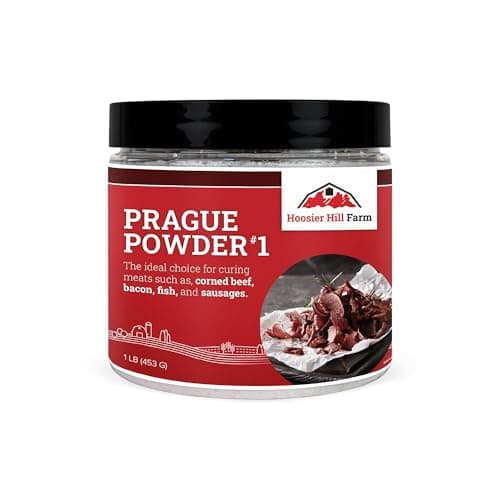
Best Cure #1
Hoosier Hill Farm Prague Powder No. 1 Curing Salt, 1 lb
The clearest-labeled Cure #1 we cover: the listing gives the dose by weight and by teaspoon and tells you to use a scale.
$12.99Amazon#ad · Price as of Sep 19, 2026 · Affiliate disclosure for the link to Hoosier Hill Farm Prague Powder No. 1 Curing Salt, 1 lb
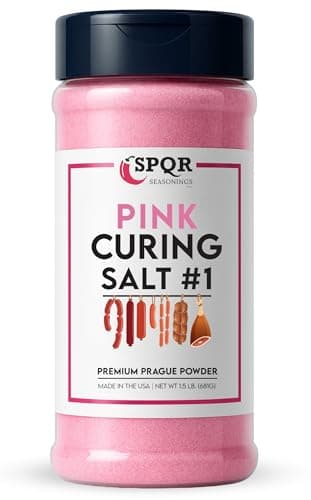
Biggest Cure #1 bottle
SPQR Seasonings Curing Salt No. 1, 1.5 lb Bottle
States its 6.25% sodium nitrite plainly and comes in a bigger bottle with a teaspoon cap. Ignore the listing's 'Salt Peter' line.
$13.85Amazon#ad · Price as of Sep 19, 2026 · Affiliate disclosure for the link to SPQR Seasonings Curing Salt No. 1, 1.5 lb Bottle
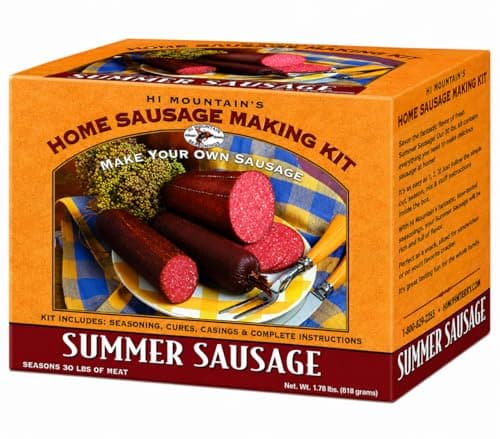
Best summer sausage kit
Hi Mountain Original Summer Sausage Kit
Seasoning, pre-portioned cure and ten 2.5 x 20 inch fibrous casings for up to 30 lb, with the steps printed.
$29.99Amazon#ad · Price as of Sep 19, 2026 · Affiliate disclosure for the link to Hi Mountain Original Summer Sausage Kit
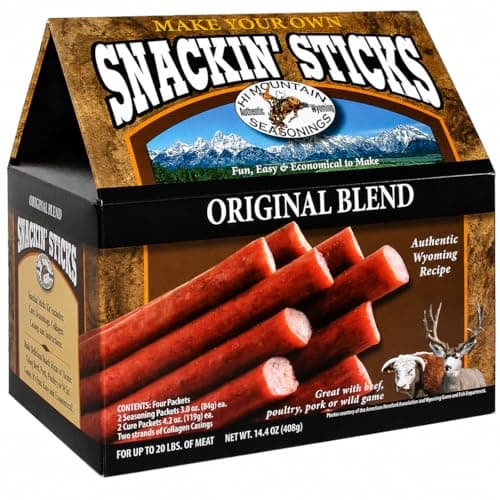
Best snack stick kit
Hi Mountain Original Snack Stick Kit (Makes 20 lb)
Seasoning, cure and four strands of 21 mm mahogany collagen casings for up to 20 lb of snack sticks.
$34.99Amazon#ad · Price as of Sep 19, 2026 · Affiliate disclosure for the link to Hi Mountain Original Snack Stick Kit (Makes 20 lb)
Curing salt for jerky
Cure helps jerky, but it doesn't replace the heat step. USDA's jerky guidance cites University of Georgia research on ground beef jerky made with and without a curing mix of salt and sodium nitrite: in both heated and unheated samples, jerky made with the curing mix had greater destruction of bacteria, and jerky with the mix that was also heated before drying had the highest destruction rate. USDA's recommendation stands regardless: heat meat to 160°F (poultry to 165°F) before dehydrating, then dry at a steady 130-140°F. NDSU puts it the same way: cure in the seasoning helps, but safety concerns are minimized by precooking to 160°F.
So a jerky cure-and-seasoning kit is a good idea, especially for ground-meat jerky, and it goes alongside the 160°F step, not instead of it. The full method is in how to make deer jerky, and drying temperatures are in jerky dehydrator time and temperature.
Storing and handling cure safely
- Store it cool and dry. Hoosier Hill Farm advises against refrigerating or freezing its cure.
- Label it and separate it. Keep cure in its original labeled package, away from table salt. Some kits use a dye-free cure (Bearded Butchers' summer sausage kit, for one), which loses the pink warning color, so labeling matters even more.
- Dissolve it for even mixing. Penn State recommends dissolving dry ingredients in water so the cure distributes evenly through the product.
- Cure cold. Penn State says the salt-curing process must stay cold enough, under 41°F, to prevent decomposition. Cured sausage rests about 24 hours in the refrigerator before smoking, per Mississippi State.
- Read proprietary blends carefully. Oregon State and WSU both warn that blends like Tender Quick are used at different rates and may not suit recipes written for Cure #1.
Where to use it next: venison summer sausage, the cured batch most hunters start with, and how to make venison sausage for when cure goes in and when it stays out.
Questions
Frequently asked
What is the difference between pink curing salt #1 and #2?
Is pink curing salt the same as Himalayan pink salt?
Can I use regular salt instead of curing salt?
Do you need curing salt for jerky?
How much Prague Powder #1 per pound of meat?
Is curing salt dangerous?
Keep going down the chain
Related
- Venison summer sausageThe cured batch most hunters start with
- How to make deer jerkyThe 160°F step, with or without cure
- How to make venison sausageWhen cure goes in, and when it stays out
- Best stuffers for snack sticksThe other cured sausage
- Jerky dehydrator time and temperatureDrying temps after the heat step
Receipts
Sources
- Oregon State University Extension — Making Cured Bacon at Home (PNW 784, Aug. 2025)
- Washington State University Extension — Homemade Meat, Poultry, and Game Sausages (EB1661) [PDF]
- Penn State Extension — Proper Processing of Wild Game and Fish
- Mississippi State University Extension — Making Sausage at Home (P2692)
- North Dakota State University Extension — The Art and Practice of Sausage Making (FN176, rev. Oct. 2022)
- USDA Food Safety and Inspection Service — Jerky and Food Safety
- Amazon listing, manufacturer-supplied copy — Hoosier Hill Farm Prague Powder No. 1
- Amazon listing, manufacturer-supplied copy — SPQR Seasonings Curing Salt No. 1
- Amazon listing, manufacturer-supplied copy — Hi Mountain Original Summer Sausage Kit
- Amazon listing, manufacturer-supplied copy — Bearded Butchers Old Fashioned Summer Sausage Kit
We haven't bench-tested this gear and we don't pretend to. Specs come from the maker's own pages, manuals and maker-supplied listing copy (labeled as such); food-safety figures from USDA and university extension publications; yield from the Ohio Division of Wildlife; prices live from Amazon. Where a figure isn't published, we say so. Read the full method.