Jerky ◆ Guide
How Long to Dehydrate Jerky, and at What Temperature
USDA and the extension services publish drying temperatures from 130°F to 155°F and times from about 4 hours to 24. Here's what each one says, why 160°F is a meat temperature rather than a dial setting, and how to tell when jerky is done.
We earn a commission if you buy through our links, at no extra cost to you. It never decides the ranking — the method is published · Affiliate disclosure
Dry jerky at 140°F, per NCHFP, or 145-155°F, per PNW Extension. NCHFP gives 10 to 24 hours for strips that weren't heated in marinade and says to start checking at 3 hours; pre-heated strips dry faster. PNW gives a minimum of 4 hours. Jerky is done when a cooled strip cracks but doesn't break. The 160°F figure is the meat temperature USDA wants, and you get there by pre-cooking or a 275°F post-bake, not by setting the dial to 160.
What each source says
These are the published settings and times from USDA and the extension services we checked, with the heating step each one pairs with drying.
| Source | Dryer temperature | 160°F heating step | Drying time given | Done when |
|---|---|---|---|---|
| USDA FSIS | Constant 130-140°F | Steam or roast to 160°F before drying | Not given | Not given |
| NCHFP (Univ. of Georgia) | 140°F, preheated | Boil in marinade 5 min, or 275°F oven 10 min after | 10-24 hours if not heated in marinade; faster if heated; check from 3 hours | Test piece cracks but doesn't break |
| PNW 632 (Idaho, Oregon State, Washington State) | 145-155°F, preheated 15-30 min | 275°F for 10 min after, or precook to 160°F | Minimum 4 hours; varies; precooked needs less | Bends like a green stick, cracks but doesn't break, no damp spots |
| Penn State Extension | 140°F | Bake at 325°F or simmer to 160°F before | 5-6 hours (after precooking); thinner strips less | Cooled 5 min, cracks but doesn't break, no moisture |
| Ohio State (Ohioline) | At least 145°F | Precook (325°F oven) or 275°F after | "Many hours"; start checking after about 3 hours | Cooled to room temperature, cracks slightly but doesn't break |
| K-State MF3173 | Constant 130-140°F; racks into a 140°F dryer | Boil in marinade 5 min, or 275°F for 10 min after | 10-24 hours if not heated in marinade; check from 3 hours | Cracks but doesn't break |
| NDSU Extension | 145-155°F | Strips added to marinade at a full rolling boil | Not given for the dehydrator | Cooled, cracks but doesn't break, no moist spots |
The pattern is clear. Every source dries between 130°F and 155°F, every one pairs drying with a separate 160°F step, and the published times run from a 4-hour minimum to 24 hours. Pre-cooked strips land toward the short end. The bend test, not the clock, decides when jerky is done.
At 155, 160 or 165°F: what's actually published
155°F is the top of the band PNW and NDSU give for drying, so it's a supported setting. None of the sources above gives a separate drying time for it.
160°F and 165°F. None of the extension or USDA sources we checked sets a dehydrator to 160°F or 165°F for the drying run, and none publishes a drying time at those settings. The only figure we found is a maker's. Presto's manual for its 06300, which runs at a fixed temperature of about 165°F, gives an average of 4 to 8 hours for jerky. It says to start checking at about 4 hours, then every 30 minutes (Presto 06300 manual). That's one maker's number for one fixed-temperature unit, not general guidance. K-State is explicit about the risk of going higher: "Do not rush the dehydrating process by raising the temperature during dehydration," because higher temperatures cause case hardening, which can trap moisture inside.
Why 160°F isn't the dial setting
USDA explains the physics. In a dehydrator or low oven, evaporating moisture absorbs most of the heat, so "the meat itself does not begin to rise in temperature until most of the moisture has evaporated." By the time a strip heats up, the bacteria on it have become more heat-resistant. That's why USDA wants the meat heated to 160°F before drying, and why NCHFP, PNW and K-State offer the after-drying bake of 10 minutes at 275°F instead. USDA also notes that lab-inoculated venison held E. coli through drying times of up to 10 hours at up to 145°F (USDA jerky guidance).
What changes the drying time
- Thickness. Penn State says thinner strips dry faster. NCHFP's post-bake timing is written for strips ¼ inch or less, and thicker strips need longer. See how to slice meat for jerky.
- Pre-cooking. NCHFP, PNW and Presto all say pre-heated strips dry faster.
- Load and come-up time. PNW found home dehydrators took anywhere from 30 minutes to 4 hours to reach temperature once loaded with meat. Presto adds that how full the trays are changes the time.
- Fat and meat type. Presto lists the type of meat and its fat content as factors.
- Humidity, room temperature and evenness. Presto's manual also lists humidity, air temperature and how even the pieces are among the reasons drying times vary.
- Dial accuracy. PNW found dials up to 40°F off. USDA explains why a steady temperature matters: the process "must be fast enough to dry food before it spoils."
Loading the trays and keeping the run going
Lay strips close together but not touching or overlapping (NCHFP). Ohio State suggests about 25 percent open space per tray and says to rotate trays at least every 2 hours in vertical-airflow units (Ohio State Extension). Presto's manual adds two rules that apply to any dehydrator. Don't add undried food to a partially dried load, because it adds moisture and lengthens drying. And don't unplug in the middle of a cycle to resume later, which Presto says "may result in poor quality and/or unsafe food." Pull strips that pass the bend test early and let the rest keep going.
Check the dehydrator with a thermometer
PNW says to use a thermometer to confirm that "the empty, operating dryer can deliver at least 145°F." Ohio State recommends the same empty-unit test with a bi-metallic stemmed thermometer. PNW also explains why the type of thermometer matters. Dial instant-read thermometers sense temperature over the bottom 2 inches of the stem, while digital instant-reads sense it over the bottom ½ inch. For thin strips, PNW calls a thin-tipped digital thermometer essential. It's also the tool for the 160°F check when you pre-cook.
Picks for this job
Thermometers and a dehydrator you can set to the degree
An instant-read thermometer for checking strips and the empty dryer, and a dehydrator with 1°F control up to 165°F.
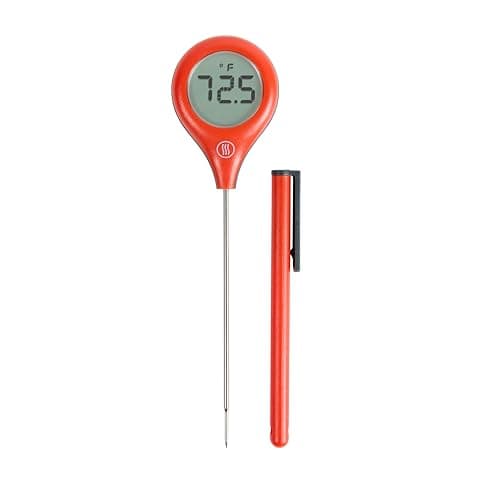
Best value thermometer
ThermoWorks ThermoPop 2 Instant-Read Thermometer
An instant-read thermometer for spot-checking strips during the 160°F step and the empty dryer's air.
$47.00Amazon#ad · Price as of Sep 19, 2026 · Affiliate disclosure for the link to ThermoWorks ThermoPop 2 Instant-Read Thermometer
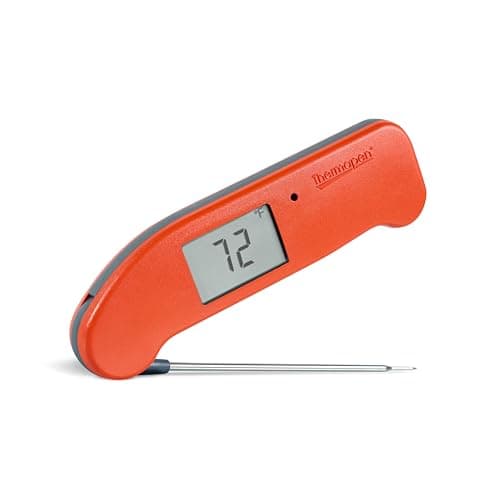
Best thermometer
ThermoWorks Thermapen ONE Instant-Read Thermometer
An instant-read thermometer for the same checks: strip temperature and the empty dryer's air.
$125.00Amazon#ad · Price as of Sep 19, 2026 · Affiliate disclosure for the link to ThermoWorks Thermapen ONE Instant-Read Thermometer
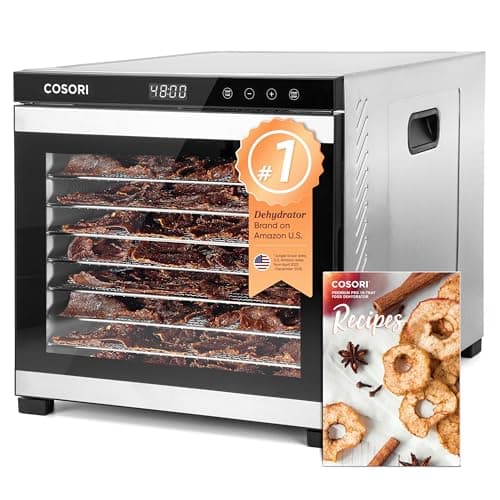
Most tray area
Cosori 10-Tray Stainless Steel Food Dehydrator
The most tray area on this page (16.2 sq ft), 1°F control up to 165°F and dishwasher-safe stainless trays.
$299.99Amazon#ad · Price as of Sep 19, 2026 · Affiliate disclosure for the link to Cosori 10-Tray Stainless Steel Food Dehydrator
Done: the bend test and conditioning
Pull a strip, let it cool, and bend it. Ohio State says to cool it to room temperature, and Penn State says about 5 minutes. It should crack but not break, and there should be no moist spots. PNW explains what the test stands in for. Shelf-stable jerky has a water activity of 0.85 or less, and 0.70 is recommended to prevent mold. PNW notes that home jerky makers often call it done while it's still above 0.85, and home cooks don't have a water-activity meter. So follow the bend test strictly, then condition the jerky. Pack it loosely two-thirds full in a covered container and shake it daily for 2 to 4 days. If moisture shows up on the lid, it goes back in the dryer.
The full process, from field to jar, is in how to make deer jerky. If you're still choosing between drying methods, see dehydrator vs smoker.
Questions
Frequently asked
How long does jerky take to dehydrate at 160°F?
What temperature is best for dehydrating jerky?
How long do you dehydrate jerky at 155°F?
Can you dehydrate jerky at 165°F?
How do you know when jerky is done?
Keep going down the chain
Related
Receipts
Sources
- USDA Food Safety and Inspection Service — Jerky and Food Safety
- National Center for Home Food Preservation (University of Georgia) — Jerky
- Pacific Northwest Extension PNW 632 — Making Jerky at Home Safely (University of Idaho, Oregon State University, Washington State University; rev. 2020)
- Penn State Extension — Drying Jerky (updated April 2024)
- Ohio State University Extension, Ohioline HYG-5362 — Food Preservation: Making Jerky
- Kansas State University Research and Extension MF3173 — Dehydrating Meat Safely at Home (rev. March 2026) [PDF]
- NDSU Extension — Wild Side of the Menu No. 3: Preservation of Game Meats and Fish (reviewed August 2022)
- Presto — Dehydro 06300 instruction manual [PDF]
We haven't bench-tested this gear and we don't pretend to. Specs come from the maker's own pages, manuals and maker-supplied listing copy (labeled as such); food-safety figures from USDA and university extension publications; yield from the Ohio Division of Wildlife; prices live from Amazon. Where a figure isn't published, we say so. Read the full method.