Jerky ◆ Guide
How to Slice Meat for Jerky: Thickness, Grain and Tools
Slice no thicker than ¼ inch. That's the ceiling in NCHFP and Ohio State guidance and the thickness the 275°F post-bake is written for. Here's how to hit it with a knife, a board or a slicer.
We earn a commission if you buy through our links, at no extra cost to you. It never decides the ranking — the method is published · Affiliate disclosure
Slice meat for jerky no thicker than ¼ inch, about 1 to 1½ inches wide and 4 to 10 inches long. Freeze it first until it's firm but not solid, and trim every bit of fat. Slice with the grain for chewy jerky or across it for tender jerky. A jerky board kit holds ¼ inch without a slicer. An electric slicer set to about 6.35 mm does the same, faster.
How thick: what five sources say
| Source | Thickness | Width | Length |
|---|---|---|---|
| NCHFP (Univ. of Georgia) | No thicker than ¼ in | Not given | Not given |
| Ohio State (Ohioline) | No more than ¼ in | About 1-1½ in | Not given |
| PNW 632 | About ⅛-¼ in | 1-1½ in | 4-10 in |
| Penn State Extension | ¼-⅜ in | 1-1½ in | 4-10 in |
| Presto 06300 manual (maker) | ¼ in | 1 in | 5-6 in |
Every source accepts ¼ inch, so that's the number to aim for. Only Penn State goes up to ⅜ inch, and its method cooks the strips to 160°F before drying. If you'll use the after-drying bake, stay at ¼ inch or under.
The width and length figures are about handling, not safety. Strips should lie close together on the tray without touching or overlapping (NCHFP), and consistent widths make trays easier to fill without gaps or overlaps. If you prefer thin jerky, PNW's range starts at ⅛ inch and the LEM board has an ⅛-inch side. Penn State notes that thinner strips take less time to dry, so check an ⅛-inch batch sooner.
Why thickness is a safety number
The National Center for Home Food Preservation says the thickness of the strips "will make a difference in the safety of the methods recommended." Its post-drying heat step of 10 minutes in a 275°F oven is written for strips "originally cut 1/4 inch thick or less," and it notes thicker strips may need longer to reach 160°F. Its boil-in-marinade step (5 minutes) says the same: if strips are more than ¼ inch thick, the time may need to increase (NCHFP jerky guidance). Cut thicker than the method assumes, and you're guessing on the one step that matters most.
Uniform thickness matters too. PNW 632 says to lay the strips flat and roll them with a rolling pin "so that they are uniform in thickness." Uneven strips dry unevenly. The thin end is done while the thick end is still wet, and a timed post-bake heats them unevenly too. PNW also notes that home jerky makers often call jerky done while it's still too moist to be shelf-stable. With uniform strips, the one you pull for the bend test actually speaks for the rest of the tray.
With the grain or across it
Every extension source agrees. NCHFP says to slice with the grain for chewy jerky and across the grain for jerky that's "more tender, brittle." Penn State and Ohio State say the same. LEM's jerky board instructions pick a side: cut with the grain "so when eating you are biting across the grain." Neither is safer. Choose the texture you like, and cut the whole batch the same way.
Firm, not frozen solid
NCHFP says to partially freeze meat to make slicing easier. PNW is more precise: freeze it in moisture-proof paper or plastic wrap "until it is firm but not solid." Presto's manual uses almost the same words. None of the sources gives a freezer time, because it depends on the size of the piece and your freezer, so check the meat rather than the clock. Firm meat holds its shape under the blade, which is the whole point.
Venison-specific prep
PNW says to remove visible fat and "any thick connective tissue and gristle" before slicing (PNW 632). On venison, that means the silverskin and the seams between muscles. NDSU's field-to-freezer guide notes that the leg muscles separate along their natural seams, so break a round into its individual muscles first and trim each one, rather than slicing across the seams. Keep the meat cold the whole time. USDA says to hold raw meat at 40°F or slightly below.
Step by step with a knife and board
- Trim. Remove visible fat, thick connective tissue and gristle (PNW). Fat turns rancid in dried meat (NCHFP). See the best cuts for jerky for which muscles need the least trimming.
- Firm it up until firm but not solid.
- Cut slabs at your target thickness. A jerky board sets this for you at ¼ or ⅛ inch (LEM) or ¼ or ⅜ inch (Hi Mountain).
- Cut strips 1 to 1½ inches wide, with or across the grain as you prefer.
- Flatten and check. Roll the strips to an even thickness (PNW) and trim any fat you missed.
Without a slicer: boards and cranks. With one: set 6.35 mm.
Board kits are the answer to "how do I cut jerky without a slicer." The board sets the depth and the knife runs across at that height. LEM's board flips between ¼ and ⅛ inch. Hi Mountain's offers ¼ and ⅜ inch; use the ¼ side if you'll post-bake. The Weston hand-crank slicer takes slabs up to 5 inches wide and 1¼ inches thick and cuts up to 15 quarter-inch strips per pass. LEM's grinder attachment does 14 per pass on a BigBite. All four are compared in our boards and slicers rankings.
Electric slicers are dialed in millimeters. An inch is 25.4 mm, so ¼ inch is 6.35 mm and ⅛ inch is about 3.2 mm. The VEVOR 10-inch dials 0 to 12 mm and the BESWOOD 250 dials 1 to 12 mm, so both cover the whole jerky range. Slice the whole firm block at one setting rather than adjusting mid-batch, so every strip on the trays matches. Use the food pusher, never your fingers, and see our meat slicer rankings for the rest.
Picks for this job
Three ways to hold ¼ inch
A board for small batches, a hand crank for bigger ones, and a 10-inch slicer with a millimeter dial for jerky every season.
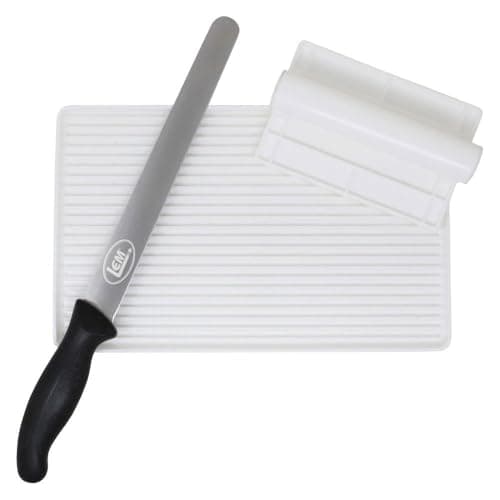
Best jerky board
LEM Jerky Knife and Board Kit
A double-sided board that sets ¼-inch or ⅛-inch slabs, a 10-inch knife, a pressing plate and a grip mat. It's one of the least expensive ways to get uniform jerky thickness.
$40.28Amazon#ad · Price as of Sep 19, 2026 · Affiliate disclosure for the link to LEM Jerky Knife and Board Kit
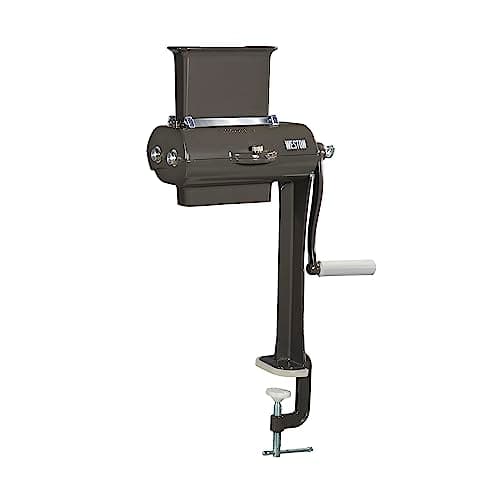
Best manual jerky slicer
Weston Manual Beef Jerky Slicer
A clamp-on crank with 32 stainless blades that cuts up to 15 quarter-inch strips per pass from slabs up to 5 inches wide and 1¼ inches thick.
$149.95Amazon#ad · Price as of Sep 19, 2026 · Affiliate disclosure for the link to Weston Manual Beef Jerky Slicer
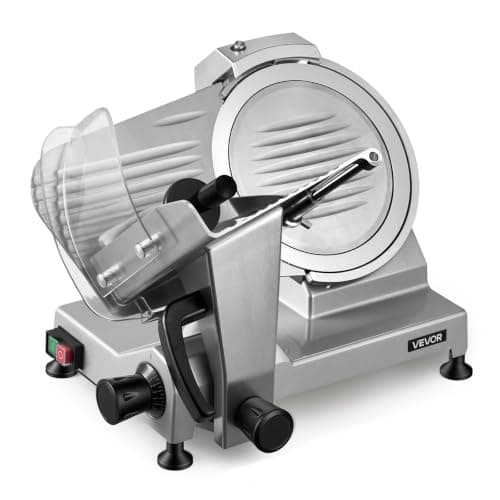
Best slicer for jerky
VEVOR 10-Inch Commercial Meat Slicer (240W)
A 10-inch blade with a built-in sharpener, a 0-12 mm thickness dial that covers ¼-inch jerky, and a listing that addresses frozen meat directly.
$259.90Amazon#ad · Price as of Sep 19, 2026 · Affiliate disclosure for the link to VEVOR 10-Inch Commercial Meat Slicer (240W)
Tenderizing and marinating after the cut
NCHFP says you can use a tenderizer according to the package directions, and marinate the strips for flavor and tenderness in the refrigerator for 1 to 2 hours or overnight. It warns that long marinades can make jerky saltier than some people like. LEM makes the case for uniform strips in its board description: they give "even cooking and marinating." If you'd rather tenderize mechanically, LEM's BigBite attachment includes a tenderizer roller for cuts up to 1¼ inches thick.
Five slicing mistakes that show up on the tray
- Cutting thicker than the heat step assumes. NCHFP's 275°F, 10-minute bake is for strips ¼ inch or less.
- Mixed thicknesses in one batch. Thin strips finish first and thick ones lag. Presto's manual says to pull pieces as they finish.
- Leaving fat on. It turns rancid in storage (NCHFP, PNW).
- Slicing soft meat. Every source says to firm it in the freezer first.
- Cutting raw meat on the board you'll use for finished jerky. PNW says to keep raw-meat surfaces separate from dried meat.
Clean up like it's raw meat, because it is
USDA's first jerky rules are clean hands and clean equipment: wash your hands thoroughly with soap and water before and after working with meat. PNW 632 is specific. Keep raw meat, its cutting surfaces and its tools apart from dried jerky and other ready-to-eat food. After washing boards, knives and slicer parts, sanitize them in 1 tablespoon of chlorine bleach per gallon of room-temperature water and let them air-dry. Removable slicer parts and dishwasher-safe boards make that easier.
Once the strips are cut, the rest of the process, including the 160°F step, is in how to make deer jerky.
Questions
Frequently asked
How thick should meat be sliced for jerky?
Should you cut jerky with or against the grain?
How do you slice meat for jerky without a slicer?
Should meat be frozen before slicing for jerky?
What setting should a meat slicer be on for jerky?
Keep going down the chain
Related
Receipts
Sources
- National Center for Home Food Preservation (University of Georgia) — Jerky
- Pacific Northwest Extension PNW 632 — Making Jerky at Home Safely (University of Idaho, Oregon State University, Washington State University; rev. 2020)
- Penn State Extension — Drying Jerky (updated April 2024)
- Ohio State University Extension, Ohioline HYG-5362 — Food Preservation: Making Jerky
- Presto — Dehydro 06300 instruction manual [PDF]
- USDA Food Safety and Inspection Service — Jerky and Food Safety
- NDSU Extension — Wild Side of the Menu No. 2: Field to Freezer (reviewed August 2022)
- LEM Products — Jerky Knife and Board Kit product page
- LEM Products — BigBite 2-in-1 Jerky Slicer/Tenderizer Attachment product page
- Amazon listing, manufacturer-supplied copy — Weston manual jerky slicer (07-3801-W-A)
- BESWOOD — BESWOOD-250 10-inch Electric Deli Meat Slicer product page
- Amazon listing, manufacturer-supplied copy — VEVOR 10-inch slicer (JK-250A)
We haven't bench-tested this gear and we don't pretend to. Specs come from the maker's own pages, manuals and maker-supplied listing copy (labeled as such); food-safety figures from USDA and university extension publications; yield from the Ohio Division of Wildlife; prices live from Amazon. Where a figure isn't published, we say so. Read the full method.