The Best Meat Slicers for Frozen Meat, and the Limit Nobody Admits
Two of the slicers we list say "frozen meat" in their own copy. None of them say "solid frozen block", and that distinction is the whole page. Here is what the makers will stand behind, and where a bandsaw takes over.
#ad · Prices come live from Amazon, last checked Sep 24, 2026; where we have no verified live price we show none. Scores are ours, compiled from published specs, manuals and warranty terms, not bench tests. Tap a row for the full write-up.
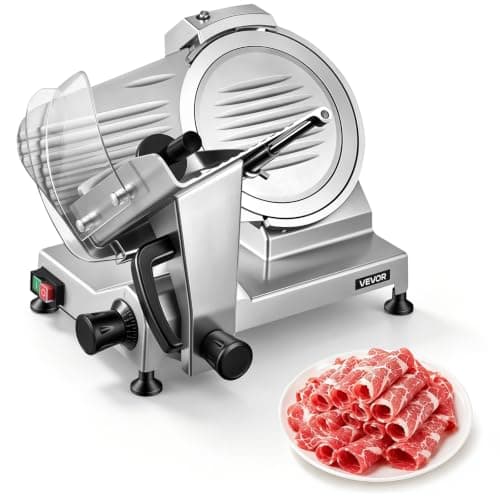
If you want a slicer for frozen meat, buy the VEVOR 12-inch: 320W, a 12 in carbon steel blade, and VEVOR's own copy says the blade “glides through frozen meat.” The VEVOR 10-inch makes the same claim for meaningfully less money on a 240W motor. But the honest headline of this page is the thing none of the makers will put in writing: no home slicer here is rated for a solid frozen block. The target is partially frozen, and that is not a compromise — it is what the food-safety literature tells you to do anyway.
Firm but not solid: the only honest target
The extension services that write the home-drying guidance are specific about this. Pacific Northwest Extension PNW 632 describes the state to slice meat in as “firm but not solid”. The National Center for Home Food Preservation gives the reason without dressing it up: partially frozen meat is easier to slice.
That is the condition every slicer on this page is actually for. Meat at that stage — roughly 30 to 60 minutes in a freezer for a venison roast, until the outside resists a thumb but a knife still goes in — cuts cleanly, holds its shape against the carriage, and does not overload the motor. A rock-solid block does none of those things, and feeding one to a 200W home slicer is how carriages bend and blades chip.
Which makers actually claim frozen meat
Slicer
Does the maker name frozen meat?
Exact basis
VEVOR 12 in
Yes
Blade “glides through frozen meat, steak, ham, carrots, potatoes, hard vegetables”
VEVOR 10 in
Yes
Listing says it handles frozen, raw and cooked meats
CUSIMAX 8.7 in
Yes
Frozen meat listed among the foods its two blades suit
BESWOOD 250
No
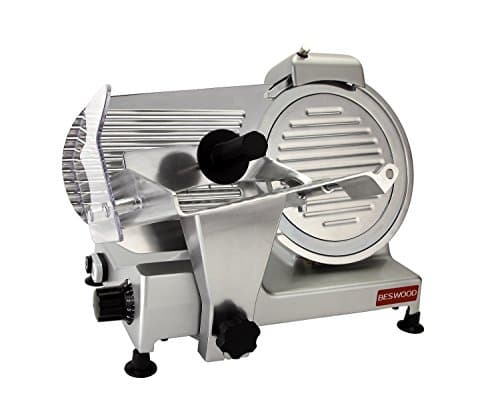
Neither BESWOOD's product page nor the listing mentions frozen meat
Chef's Choice 632
No
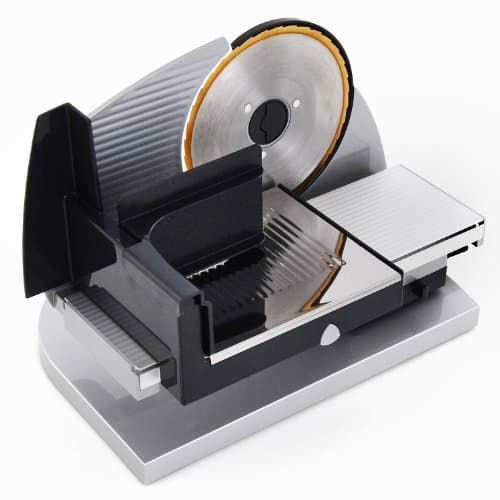
No frozen claim, and no motor wattage published either
Three yeses and two silences. Note that the best-documented machine on this site — the BESWOOD, which publishes blade speed, maximum cut size and a 12-month warranty — is one of the silences. That is worth respecting rather than reading past: a maker who publishes everything else and declines to claim frozen work has probably thought about it.
The five, side by side
Spec
VEVOR 12
VEVOR 10
BESWOOD 250
CUSIMAX
Chef's Choice 632
Motor (load)
320W
240W
240W (1/3 HP)
200W
Not published
Blade speed
Not published
350-400 rpm
282 rpm
Not published
Not published
Blade material
Carbon steel
45# carbon steel
Chrome-plated high-carbon
304 stainless
Surgical stainless
Drive
Not published
Not published
V-belt
Not published
Not published
Frozen claim
Yes
Yes
No
Yes
No
Built-in sharpener
Yes
Yes
Yes, two-stone
No
No
Weight
46.3 lb
34 lb
33 lb
10.8 lb
11 lb
What the wattage is really telling you
Wattage on a slicer is not a hardness rating. It is a proxy for how much resistance the motor can absorb before it slows, stalls or heats up. Firm venison offers more resistance than deli turkey, so more watts buys you margin — not permission to cut something harder.
The 320W VEVOR has the most margin here. Where it gets interesting is the middle of the table: the VEVOR 10 and the BESWOOD are both 240W, and the BESWOOD spins slower (282 rpm against 350-400). A slower blade takes bigger bites per revolution, which on firm meat is generally kinder to the motor — but BESWOOD still declines to claim frozen work, and VEVOR at the faster speed claims it. We are not going to resolve that from published specs, and we are not going to pretend we can.
The CUSIMAX at 200W is the one to think hardest about. It carries a frozen claim on the smallest motor on the page. For genuinely firm-but-not-solid venison it will very likely be fine; it has the least headroom if you misjudge how long the roast sat in the freezer.
Blade type matters more than you think
On firm meat the edge does the work, and the two blade families behave differently:
Carbon steel (both VEVORs) takes and holds a keener edge, which is what you want against resistance. It also rusts, so it has to be dried after every wash. Both VEVORs include a sharpening stone, which matters because firm meat dulls an edge faster than deli meat.
Stainless (CUSIMAX, Chef's Choice) is lower-maintenance and lower-hardness. The CUSIMAX includes a serrated blade as well as a plain one, and a serrated edge is genuinely useful on a firm surface because it bites rather than skates.
Chromium-plated high-carbon (BESWOOD) is the middle path: carbon steel's edge with a corrosion barrier over it.
If you are slicing firm venison regularly, the sharpener is not a nice-to-have. The three machines that include one are the three we would buy for this job.
Where a bandsaw takes over
There is a real piece of equipment for solid frozen meat, and it is not a slicer. A meat bandsaw is the tool whose makers do put frozen in writing — VEVOR's bandsaws are pitched at “hard bones and frozen meat” and explicitly not at boneless fresh meat, which is the exact inverse of a slicer. That is the clean way to think about the boundary:
State of the meat
Right tool
Why
Fresh, soft
Knife, or a slicer at a thin setting
Soft meat deforms against a carriage; a knife is faster
Firm but not solid
Electric slicer
Holds its shape, cuts clean, within motor margin
Solid frozen, boneless
Bandsaw, or thaw it to firm
No slicer here is rated for it; thawing to firm is free
Frozen with bone in
Bandsaw
A slicer blade is not a bone blade at any wattage
Our meat saw roundup covers the bandsaws and the hand saws, and bone saw vs band saw works out which of those two you actually need. For most people the answer to “I need to slice frozen meat” is: take it out an hour earlier.
Which of our slicer pages you want
Three slicer rankings, three deciding specs. Same hardware pool, different order:
+A 12 in blade clears the width of a whole pork belly in one pass
+Built-in sharpening stone, so the edge is maintainable without sending it away
+The only slicer on our list where the maker names frozen meat in its own blade claim
What it doesn't
−46 lb and nearly 22 in wide: this lives on the bench permanently
−Carbon steel blade, not stainless, so it has to be dried after every wash
−0.6 in maximum thickness, which is thinner than the 0.79 in the 8.7 in CUSIMAX reaches
Skip this if…
…you only slice jerky strips. A 12 in commercial blade is a lot of machine for 1/4 in venison strips, and the smaller slicers hit that thickness just as well.
+Two blades included, so a serrated edge for bread and crusts and a plain edge for meat
+20 mm (about 3/4 in) top thickness is the widest range on this page
+At 10.8 lb it can live in a cupboard between sessions
What it doesn't
−200W is the smallest motor here; the makers who claim hard frozen work publish 240-320W
−8.7 in blade is narrower than a whole pork belly, so a belly has to be halved
−The listing's marketing copy is heavy on styled unicode characters and light on a duty cycle
Skip this if…
…you slice partially frozen venison in volume. A 200W motor and an 8.7 in blade will do it, but the 10 in 240W machines are the ones the makers actually rate for it.
#ad · Price as of Sep 24, 2026 · Affiliate disclosure for the link to Chef's Choice 632 7-Inch Gourmet Electric Food Slicer
How we ranked these
On the same slicer rubric as the rest of the site: blade size and type (20), motor and partially frozen meat (25), thickness range (20), cleanup and guarding (20), value at the live price (15). On this page the motor column is the one doing the work, and a maker's willingness to name frozen meat is treated as evidence rather than marketing — because the alternative is us inventing a hardness rating nobody published.
We have not bench-tested any of these slicers and we have not fed frozen venison to any of them. Every figure is the maker's own published spec. Where a maker publishes nothing, the table says “not published” and the metric is scored neutral.
What we would buy
Slicing firm venison every season and have the bench space: VEVOR 12 in, for the 320W of margin. Want the frozen claim without the 46 lb: VEVOR 10 in. Want the best-documented machine and are willing to keep the meat properly firm rather than hard: BESWOOD 250 — it makes no frozen claim, and it tells you more about itself than anything else here.
One thing to notice in the scores: the BESWOOD outscores our top pick on the general slicer rubric, and it is still third here because it will not claim frozen work at all. That is deliberate and it is how every ranked page on this site works — the order answers the question in the title, and the score is the rubric's separate view of the product as a whole. Both are on the page so you can disagree with us.
How we picked
Units we claim to have bench-tested: none
Plenty of sites say they ground two hundred pounds through every grinder. We didn't, and we say so. What we do instead: read the maker's spec sheet, manual and warranty terms, record the figures that decide whether a machine keeps up with your season (size number, motor rating, rated pounds per minute, capacity, duty cycle, gearing), check parts availability, and score each pick on a published rubric. Then we show the season math — pounds per deer from the Ohio Division of Wildlife's yield study — so you can redo it with your own numbers.
Partially frozen, yes — that is what these machines are for. Solid frozen, no: not one maker on this page publishes a rating for a solid block, and a slicer blade is not a bone or block blade at any wattage. PNW Extension's target for slicing meat is “firm but not solid.”
How long should you freeze meat before slicing it?+
Long enough that the outside resists a thumb but a knife still goes in — roughly 30 to 60 minutes for a venison roast, though it depends on size and freezer. NCHFP's point is simply that partially frozen meat is easier to slice; there is no benefit to going past firm.
What wattage slicer do you need for frozen meat?+
More watts buys margin, not hardness. The machines here that claim frozen work run 200W to 320W. The 320W VEVOR has the most headroom; the 200W CUSIMAX carries the same claim with the least. Wattage is the only comparable number the makers publish — none of them publish a duty cycle for frozen work.
Do I need a bandsaw instead of a slicer?+
Only for solid frozen meat or anything with bone in it. That is the one category where the makers reverse themselves: VEVOR pitches its bandsaws at hard bone and frozen meat and specifically not at boneless fresh meat. See bone saw vs band saw.
Will slicing frozen meat dull or damage the blade?+
Firm meat dulls an edge faster than deli meat, which is why we would only buy a machine with a built-in sharpener for this job — the two VEVORs and the BESWOOD all have one. A genuinely solid block is what chips a blade and bends a carriage, and no maker here covers that.
We haven't bench-tested this gear and we don't pretend to. Specs come from the maker's own pages, manuals and maker-supplied listing copy (labeled as such); food-safety figures from USDA and university extension publications; yield from the Ohio Division of Wildlife; prices live from Amazon. Where a figure isn't published, we say so. Read the full method.