Skip to content
GRIND & CURE

Jerky Our picks

The Best Meat Slicers for Jerky and Home Use

A meat slicer earns its counter space when you cut jerky in 10-pound sessions. We compared blade, motor, thickness range and cleanup from maker data, plus one hand-crank option that needs no outlet.

By Mike M.Updated How we pick
#ad

We earn a commission if you buy through our links, at no extra cost to you. It never decides the ranking — the method is published · Affiliate disclosure

The short answer

Quick picks

#ProductBest forScorePrice
1
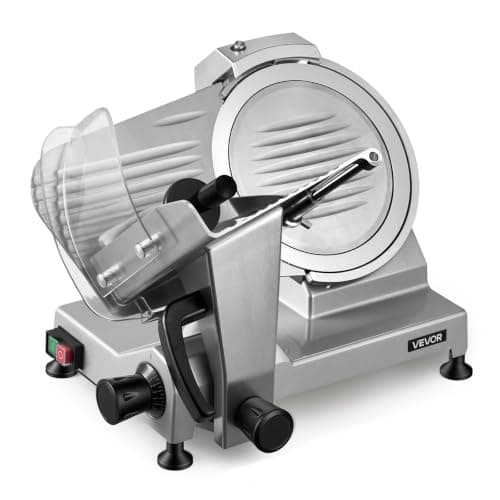
VEVOR VEVOR 10-Inch Commercial Meat Slicer (240W)
VEVOR 10-Inch Commercial Meat Slicer (240W)

A 10-inch blade with a built-in sharpener, a 0-12 mm thickness dial that covers ¼-inch jerky, and a listing that addresses frozen meat directly.

Best slicer for jerky8.4 /10$259.90Amazon
2
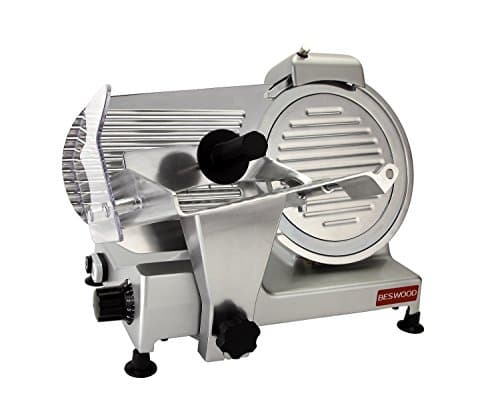
BESWOOD BESWOOD 10-Inch Electric Deli Meat Slicer (BESWOOD250)
BESWOOD 10-Inch Electric Deli Meat Slicer (BESWOOD250)

A chromium-plated high-carbon 10-inch blade, V-belt drive and a 1-12 mm thickness range. It's the deli-slicer pick with a published 12-month warranty.

Best-documented 10-inch8.1 /10$358.00Amazon
3
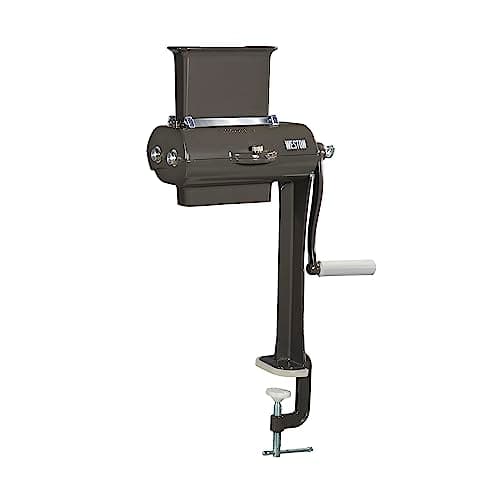
Weston Weston Manual Beef Jerky Slicer
Weston Manual Beef Jerky Slicer

A clamp-on crank with 32 stainless blades that cuts up to 15 quarter-inch strips per pass from slabs up to 5 inches wide and 1¼ inches thick.

No-motor alternative7.6 /10$149.95Amazon
4
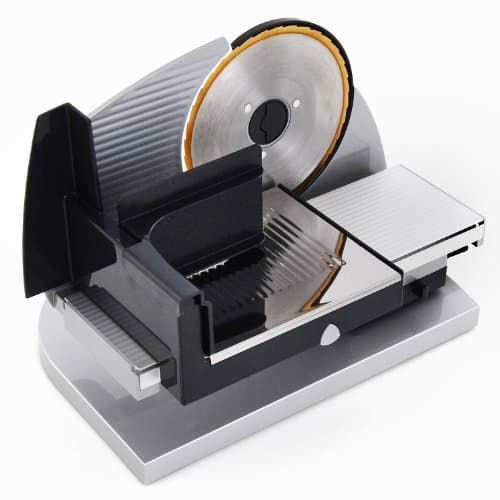
Chef's Choice Chef's Choice 632 7-Inch Gourmet Electric Food Slicer
Chef's Choice 632 7-Inch Gourmet Electric Food Slicer

A compact 7-inch home slicer that tilts for gravity feed. Its thickness range and motor rating aren't in the listing, so it's hard to rate for jerky.

Compact, thin spec sheet5.6 /10$199.99Amazon

#ad · Prices come live from Amazon, last checked Sep 19, 2026; where we have no verified live price we show none. Scores are ours, compiled from published specs, manuals and warranty terms, not bench tests. Tap a row for the full write-up.

For jerky, buy a 10-inch slicer whose thickness dial covers ¼ inch. Our pick is the VEVOR 10-inch: it has a 0-12 mm dial, a built-in sharpener, removable parts, and a listing that addresses frozen meat directly. Choose the BESWOOD 250 if you want the maker to publish its blade speed, cut capacity and warranty. If you make jerky from one deer or less a season, you probably don't need a motor at all. A jerky board or the Weston hand-crank slicer gets you the same ¼-inch strips.

We haven't run these slicers on a bench. The ranking comes from maker spec pages and listing copy, scored on blade, motor and partially frozen meat, thickness range for jerky, cleanup and guard, and value.

What a meat slicer actually does for jerky

A slicer's job in jerky is repeatable thickness. That matters for safety as well as texture. The National Center for Home Food Preservation says the thickness of the strips "will make a difference in the safety of the methods recommended." It tells you to slice no thicker than ¼ inch, and its 10-minute, 275°F post-drying heat step is written for strips cut ¼ inch thick or less. PNW Extension suggests ⅛ to ¼ inch. Strips that vary in thickness dry unevenly, and NCHFP notes that thicker strips may need longer heating to reach 160°F, so the thick parts of a batch are the ones a timed post-bake can leave short.

Both extension guides also say to slice meat partially frozen. PNW's wording is "firm but not solid." NCHFP's reason is simple: partially frozen meat is easier to slice.

Thickness: millimeters to jerky inches

Electric slicers are dialed in millimeters, and jerky guidance is written in inches. An inch is 25.4 mm, so:

Jerky thicknessMillimetersWho recommends itVEVOR (0-12 mm)BESWOOD (1-12 mm)Weston crank
⅛ in3.2 mmPNW 632 (low end)YesYesNo
¼ in6.35 mmNCHFP, Ohio State (maximum); PNW (high end)YesYesYes (fixed)
⅜ in9.5 mmPenn State (high end)YesYesNo

The Chef's Choice 632 is missing from that table because its listing doesn't publish a thickness range. It may well cut ¼ inch, but we won't claim a figure the maker's copy doesn't give. That gap is the main reason it ranks last.

Blade size and what fits the carriage

BESWOOD is the only maker here to publish carriage limits: a maximum cut of 210 mm (8¼ inches) long by 170 mm (6.7 inches) high. Anything bigger gets split before it goes on the carriage. The VEVOR's listing calls its blade an upgraded 45# carbon steel with a wider cutting surface and a built-in sharpening stone. The BESWOOD's blade is high-carbon steel with chromium plating, which BESWOOD says resists corrosion and doesn't need sharpening as often. It also has a top-mounted two-stone sharpener. The Chef's Choice runs a 7-inch surgical-stainless blade, which limits how wide a piece you can feed.

The Weston manual slicer works differently. It's a crank with 32 stainless blades that cuts up to 15 quarter-inch strips per pass, but the meat has to fit a chute up to 5 inches wide and 1¼ inches thick. In practice you cut a slab first, then crank it into strips.

Frozen, partially frozen and the motor

Both 10-inch slicers are rated at 240 watts. VEVOR gives 350-400 rpm and says the slicer handles "frozen meats, raw meats, cooked meats, and hams." BESWOOD gives 1/3 HP, a 282 rpm blade and a V-belt drive it says reduces noise and vibration. Its copy doesn't mention frozen meat either way. We scored VEVOR a notch higher on that basis, since it's the only one to address frozen meat in print. Neither maker publishes a duty cycle.

Whatever the listing promises, the extension guidance is the better target. PNW says freeze the meat "until it is firm but not solid," and NCHFP says partially freeze it. Aim for that condition whatever a listing says the machine can take.

Cleanup and the guard

On the VEVOR, the blade, food holder and food pusher all come off for cleaning. The pusher has raised spikes to grip the meat, and the machine sits on non-slip feet. The BESWOOD has a blade ring guard and slip-proof rubber feet. The Chef's Choice has a child-proof safety switch. After raw meat, washing isn't enough on its own. PNW 632 says to wash, then sanitize equipment in 1 tablespoon of chlorine bleach per gallon of room-temperature water and let it air-dry. Removable parts make that possible.

Trim before it touches the blade

A slicer cuts whatever you feed it, fat included. PNW 632 says to trim off visible fat and remove "any thick connective tissue and gristle" before slicing (PNW 632), and NCHFP says to trim and discard all fat because it goes rancid quickly. On a venison round, that means working the silverskin off each muscle while the meat is still pliable, then firming it in the freezer. The slicer won't trim for you. Our cuts guide covers which muscles need the least work.

Slicer safety over a long session

A 10-inch blade is sharp enough that the guard and pusher aren't optional. VEVOR's listing says its spiked food pusher "effectively protects your security while you work," and BESWOOD fits a blade ring guard. Use them on every pass and keep your free hand clear of the blade. Unplug the machine before you take anything apart, and follow the manual's disassembly order. PNW lists one more handling rule that applies at the slicer: keep raw meat, its cutting surfaces and its tools away from finished jerky and other ready-to-eat food.

Do you need a meat slicer at all?

Be honest about volume. A Hi Mountain kit seasons up to 15 lb of whole-muscle meat. Cutting 15 lb into even ¼-inch strips by hand is a lot of knife work, and a slicer turns it into feeding cold blocks. If that's your fall every year, the slicer earns its shelf space. If you jerk a few pounds from one deer, a jerky board kit holds ¼ inch just as well for far less money and storage. For a step-by-step on either approach, see how to slice meat for jerky. For which cuts to put on the carriage, see the best cuts for jerky.

In detail

The picks, in full

1
VEVOR VEVOR 10-Inch Commercial Meat Slicer (240W)

Best slicer for jerky

VEVOR 10-Inch Commercial Meat Slicer (240W)

8.4 /10

A 10-inch blade with a built-in sharpener, a 0-12 mm thickness dial that covers ¼-inch jerky, and a listing that addresses frozen meat directly.

Blade size and type
8.5
Motor and partially frozen meat
8.5
Thickness range for jerky
9
Cleanup and guard
8
Value
8

What it gets right

  • Thickness dial covers ⅛ to ¼ inch with room to spare
  • Listing says it handles frozen, raw and cooked meats
  • Removable blade and carriage parts for cleaning

What it doesn't

  • 34 lb and about 18 x 14 inches per the listing; it needs a permanent spot
  • No warranty term in the listing copy

Skip this if…

you make jerky once or twice a year. A knife-and-board kit cuts even ¼-inch slabs for a fraction of the money and storage space.

$259.90View on Amazon

#ad · Price as of Sep 19, 2026 · Affiliate disclosure for the link to VEVOR 10-Inch Commercial Meat Slicer (240W)

2
BESWOOD BESWOOD 10-Inch Electric Deli Meat Slicer (BESWOOD250)

Best-documented 10-inch

BESWOOD 10-Inch Electric Deli Meat Slicer (BESWOOD250)

8.1 /10

A chromium-plated high-carbon 10-inch blade, V-belt drive and a 1-12 mm thickness range. It's the deli-slicer pick with a published 12-month warranty.

Blade size and type
9
Motor and partially frozen meat
8
Thickness range for jerky
9
Cleanup and guard
7
Value
7

What it gets right

  • Maker publishes blade speed, cut capacity and warranty, which the other slicers here don't
  • Chromium plating resists corrosion, per BESWOOD
  • Blade ring guard and slip-proof feet

What it doesn't

  • Neither BESWOOD's page nor the listing says anything about frozen meat
  • 33 lb per the listing

Skip this if…

you want the lowest-cost 10-inch slicer. The VEVOR covers the same thickness range.

$358.00View on Amazon

#ad · Price as of Sep 19, 2026 · Affiliate disclosure for the link to BESWOOD 10-Inch Electric Deli Meat Slicer (BESWOOD250)

3
Weston Weston Manual Beef Jerky Slicer

No-motor alternative

Weston Manual Beef Jerky Slicer

7.6 /10

A clamp-on crank with 32 stainless blades that cuts up to 15 quarter-inch strips per pass from slabs up to 5 inches wide and 1¼ inches thick.

Build
8
Capacity / fit
8
Ease of use
7
Value
7

What it gets right

  • ¼ inch is the thickness NCHFP's 275°F post-heat step is written for
  • No motor to wear out and nothing to plug in
  • Aluminum body with stainless blades

What it doesn't

  • One thickness only
  • You still have to cut the meat into 1¼-inch slabs first

Skip this if…

you want thinner ⅛-inch jerky. The strip width is fixed at ¼ inch.

$149.95View on Amazon

#ad · Price as of Sep 19, 2026 · Affiliate disclosure for the link to Weston Manual Beef Jerky Slicer

4
Chef's Choice Chef's Choice 632 7-Inch Gourmet Electric Food Slicer

Compact, thin spec sheet

Chef's Choice 632 7-Inch Gourmet Electric Food Slicer

5.6 /10

A compact 7-inch home slicer that tilts for gravity feed. Its thickness range and motor rating aren't in the listing, so it's hard to rate for jerky.

Blade size and type
6
Motor and partially frozen meat
5
Thickness range for jerky
5
Cleanup and guard
6
Value
6

What it gets right

  • Small and light (11 lb per the listing)
  • Tilting gravity-feed design

What it doesn't

  • Thickness range and motor wattage not published in the listing
  • 7-inch blade limits how wide a slab you can run

Skip this if…

you need to confirm it cuts ¼-inch strips before you buy. The listing doesn't publish a thickness range.

$199.99View on Amazon

#ad · Price as of Sep 19, 2026 · Affiliate disclosure for the link to Chef's Choice 632 7-Inch Gourmet Electric Food Slicer

Buying a meat slicer for home use

Most people searching "meat slicer" want a deli-style machine for the kitchen. For a hunter, the same machine handles roasts and the jerky share of every deer. Here's what to check, in order.

  1. Thickness range in writing. The dial should cover at least 3 mm to 6.35 mm (⅛ to ¼ inch). Both 10-inch picks publish ranges that do.
  2. Blade diameter and carriage size. A 10-inch blade takes wider pieces than a 7-inch one. BESWOOD publishes a maximum cut of 8¼ by 6.7 inches; the others don't publish carriage limits.
  3. A sharpener on the machine. Both 10-inch picks have one built in, so you can keep the edge up between sessions without removing the blade.
  4. Parts that come off. You need to reach every surface raw meat touched in order to sanitize it.
  5. Weight and footprint. Per the listings, the VEVOR is about 34 lb and the BESWOOD about 33 lb. Neither is something you pull out of a cabinet for five minutes, so give it a permanent spot.
  6. Warranty and parts. BESWOOD publishes 12 months and sells blades, belts and sharpening stones on its site. VEVOR's listing copy doesn't state a warranty term.

A slicer for deer jerky: the season plan

At Ohio DNR's average of 52.19 lb of meat per deer, a three-deer season is about 157 lb. Most hunters grind most of that. The slicer's work is the share you set aside for jerky, plus whatever roasts and steaks you'd rather cut thin. If that share runs past a kit or two a season, buy the 10-inch. The dehydrator is the other half of the job, and our dehydrator rankings cover which units can dry that much.

How we scored slicers

Electric slicers were scored on blade size and type (20), motor and partially frozen meat handling (25), thickness range for jerky (20), cleanup and guard (15), and value at the live price (20). The Weston crank was scored on our jerky-tool rubric instead (build, capacity and fit, ease, value), because it has no motor to rate. Where a spec isn't published, as with the Chef's Choice 632's thickness range, we score it neutral and say so.
How we picked

Units we claim to have bench-tested: none

Plenty of sites say they ground two hundred pounds through every grinder. We didn't, and we say so. What we do instead: read the maker's spec sheet, manual and warranty terms, record the figures that decide whether a machine keeps up with your season (size number, motor rating, rated pounds per minute, capacity, duty cycle, gearing), check parts availability, and score each pick on a published rubric. Then we show the season math — pounds per deer from the Ohio Division of Wildlife's yield study — so you can redo it with your own numbers.

Scores are editorial judgments from that documented research, not lab results. Nobody pays for placement. The rubric and weights are on the How We Pick page.

Questions

Frequently asked

Is a meat slicer worth it for jerky?
It is if you regularly slice around 15 lb per session, the whole-muscle amount one Hi Mountain kit covers. Below that, a jerky board kit holds ¼ inch just as well for much less money and storage space.
What thickness should a meat slicer be set to for jerky?
¼ inch (about 6.35 mm) at most. That's the ceiling in NCHFP and Ohio State guidance and the thickness NCHFP's 275°F post-bake is written for. PNW Extension suggests ⅛ to ¼ inch (about 3.2 to 6.35 mm).
Can a meat slicer cut frozen meat?
VEVOR's listing says its 10-inch handles frozen meats. BESWOOD's copy doesn't address it. For jerky, the extension advice is to slice meat that is firm but not solid (PNW 632), and NCHFP says partially frozen meat is easier to slice.
What size meat slicer do I need for home use?
For jerky from big roasts, a 10-inch blade. BESWOOD publishes a maximum cut of 8¼ by 6.7 inches. A 7-inch slicer like the Chef's Choice 632 is smaller and lighter but takes narrower pieces.
How do I clean a meat slicer after raw meat?
Unplug it, take off the removable parts per the manual, and wash them. Then sanitize the way PNW 632 describes: 1 tablespoon of chlorine bleach per gallon of room-temperature water, followed by air drying.

Keep going down the chain

Receipts

Sources

We haven't bench-tested this gear and we don't pretend to. Specs come from the maker's own pages, manuals and maker-supplied listing copy (labeled as such); food-safety figures from USDA and university extension publications; yield from the Ohio Division of Wildlife; prices live from Amazon. Where a figure isn't published, we say so. Read the full method.