Electric Jerky Slicer vs Jerky Board: Which One Your Season Needs
Both produce an even quarter-inch strip. One costs ten times more than the other, takes a cupboard shelf, and pays for itself only above a certain number of pounds a year.
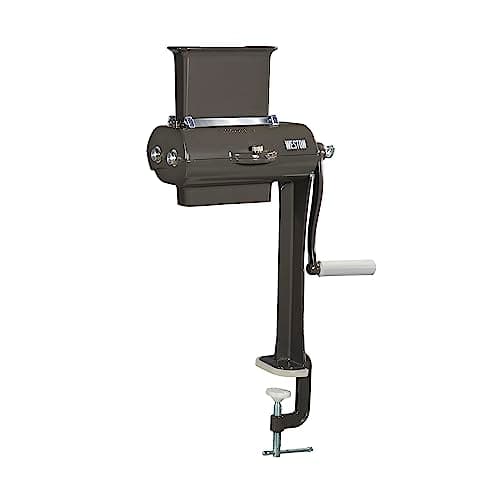
A clamp-on crank with 32 blades cutting up to 15 quarter-inch strips per pass from slabs up to 5 in. wide and 1-1/4 in. thick. No motor, far faster than a board.
#ad · Price as of November 4, 2026 · Affiliate disclosure for the link to Weston Manual Beef Jerky Slicer
Under about twenty pounds of jerky a season, buy a board and knife. Above it, buy an electric slicer with a thickness dial — and if you want the speed without the motor, the Weston crank slicer sits between them.
Both routes can hold the quarter-inch strip that jerky guidance is written around. The difference is not slice quality, it is throughput, repeatability and how much of your kitchen the tool occupies for the other eleven months.
Side by side
Electric slicer
Crank slicer
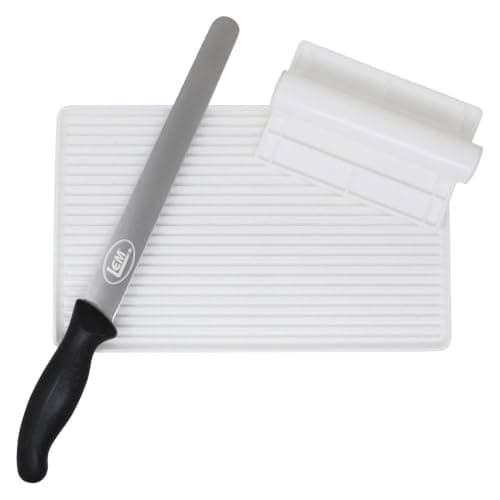
Board and knife
Thickness control
Dial, 1-20 mm on both picks here
Fixed 1/4 in.
Fixed by the board's slots
Strips per action
One per pass, continuous
Up to 15 per pass
One per knife stroke
Input size
Whole roast on the carriage
Slabs up to 5 in. wide x 1-1/4 in. thick
Whatever fits the board
Power
Mains
None
None
Parts to wash
Blade, carriage, guard, tray
32 blades, 2 combs, body
Board, knife
Storage
Cupboard shelf
Clamps off, shelf
Flat, in a drawer
Thickness: who actually controls it
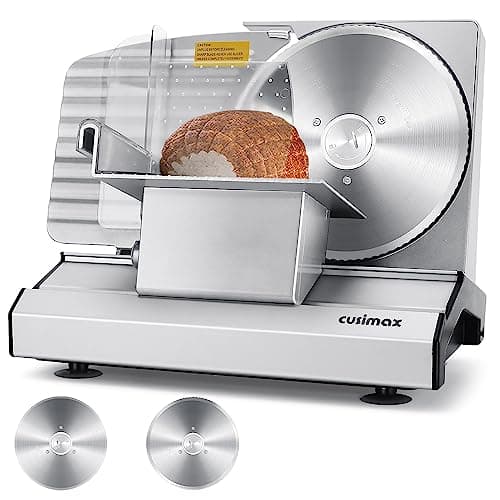
This is the real argument for an electric. A dial sets the thickness once and every strip off the carriage matches it — the VEVOR and the CUSIMAX both publish a 1-20 mm range. On a board, the slots set the thickness and your knife follows them, which is consistent but fixed; and on the Weston crank, the strip is fixed at a quarter inch by its 32 blades.
Why it matters: uneven strips dry unevenly, so a batch finishes at different times and you end up with some pieces leathery and some still wet. Our how to slice meat for jerky guide covers the thickness question and grain direction, and time and temperature shows how much thickness moves the drying time.
Volume per hour
A board is one stroke per strip. The Weston crank is up to fifteen quarter-inch strips per pass from a slab up to five inches wide — a step change, which is why it exists. An electric is continuous: you feed a chilled roast onto the carriage and the strips come off until it runs out.
The frozen-meat question
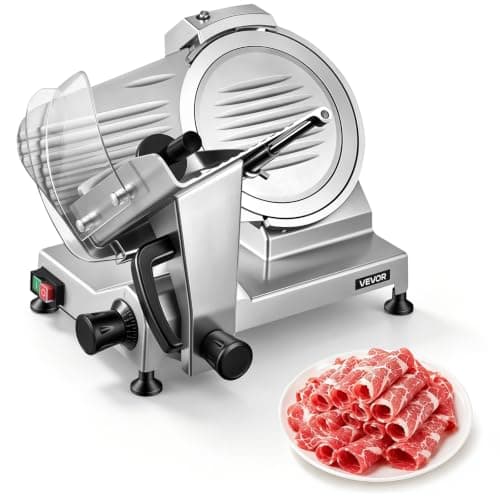
Jerky slices best when the meat is partly frozen — firm enough not to deform under the blade. That favours a machine that tolerates it. VEVOR states in its own copy that its slicer handles frozen meat; several makers do not make that claim at all, and running a hard block through a slicer that is not rated for it is how a carriage gets bent.
A board does not care. A knife through semi-frozen meat is just harder work. If you want the thinnest cuts of all, the dedicated frozen-block hand slicers in our hot pot slicer roundup go to 0.2 mm — thinner than jerky wants, but it shows where the hand tools win.
Cleanup and storage
A board and knife wash in a minute. The Weston crank has 32 blades and two anti-jam combs to clear, which is the tedious part of owning one. An electric slicer has a blade, a carriage, a guard and a tray, and the ones worth buying publish which parts come off — the CUSIMAX machines in our home slicer roundup list a dishwasher-safe blade and rail, and that is a real differentiator in this class.
Storage is the quieter cost. A 10-inch slicer is a permanent cupboard resident. A board goes flat in a drawer. For a household that makes jerky twice a year, that is not a small consideration.
Where the break-even sits
Three honest cases:
Under 20 lb of jerky a season: board and knife. You will not out-work it often enough to notice, and nothing about it can break.
20-40 lb, or you also want a slicer for bacon and deli meat: an electric. The dial is the reason, and the second use justifies the shelf.
You want speed with no motor and no dial: the Weston crank. Fifteen strips a pass, one fixed thickness, nothing to plug in.
+Two blades included, so a serrated edge for bread and crusts and a plain edge for meat
+20 mm (about 3/4 in) top thickness is the widest range on this page
+At 10.8 lb it can live in a cupboard between sessions
What it doesn't
−200W is the smallest motor here; the makers who claim hard frozen work publish 240-320W
−8.7 in blade is narrower than a whole pork belly, so a belly has to be halved
−The listing's marketing copy is heavy on styled unicode characters and light on a duty cycle
Skip this if…
…you slice partially frozen venison in volume. A 200W motor and an 8.7 in blade will do it, but the 10 in 240W machines are the ones the makers actually rate for it.
#ad · Price as of November 4, 2026 · Affiliate disclosure for the link to LEM Jerky Knife and Board Kit
The middle option
Weston Manual Beef Jerky Slicer
7.6 /10
A clamp-on crank with 32 blades cutting up to 15 quarter-inch strips per pass from slabs up to 5 in. wide and 1-1/4 in. thick. No motor, far faster than a board.
#ad · Price as of November 4, 2026 · Affiliate disclosure for the link to Weston Manual Beef Jerky Slicer
How we picked
Every pick, scored on the same published rubric
Each machine here is read end to end: the maker's spec sheet, the owner's manual and the warranty terms. We pull out the figures that decide whether it keeps up with your season — size number, motor rating, rated pounds per minute, capacity, duty cycle, gearing — confirm parts are still available, and score every pick on the same weighted rubric, so a score on one page means the same thing on the next. Then we show the season math, pounds per deer from the Ohio Division of Wildlife's yield study, so you can run it against your own freezer.
Above roughly twenty pounds of jerky a season, or if you also want to slice bacon and deli meat, yes — the thickness dial makes every strip match, which is what makes a batch dry evenly. Below that, a board and knife do the same job for a tenth of the money and no storage.
What thickness should jerky be sliced to?+
A quarter inch is the standard this equipment is built around — the Weston crank slicer is fixed at it, and the electric slicers here publish a 1-20 mm dial that covers it. See our slicing guide for grain direction and the thinner end.
Can you slice frozen meat on an electric slicer?+
Only if the maker says so. VEVOR states in its own copy that its 10-inch slicer handles frozen meat; many makers make no such claim, and a hard block in a machine not rated for it risks the carriage.
How many strips does a jerky board produce at once?+
One per knife stroke — the slots set the thickness, not the count. The Weston crank slicer, by contrast, cuts up to 15 quarter-inch strips in a single pass from a slab up to 5 in. wide and 1-1/4 in. thick.
Specs come from the maker's own pages, manuals and maker-supplied listing copy (labeled as such); food-safety figures from USDA and university extension publications; yield from the Ohio Division of Wildlife; prices live from Amazon. Where a figure isn't published, we say so. Read the full method.