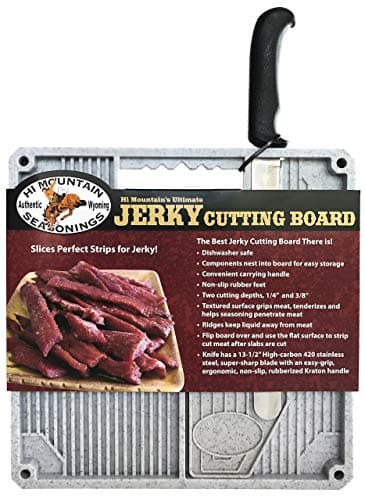
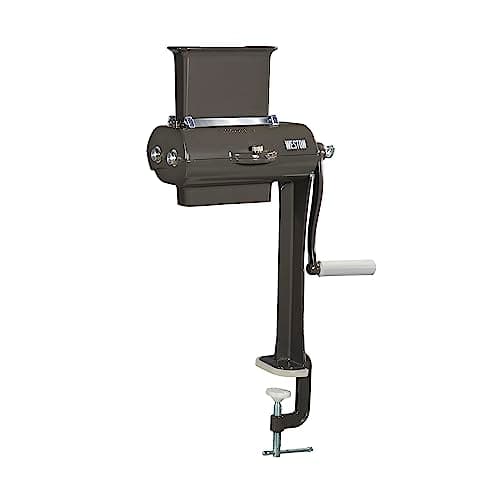
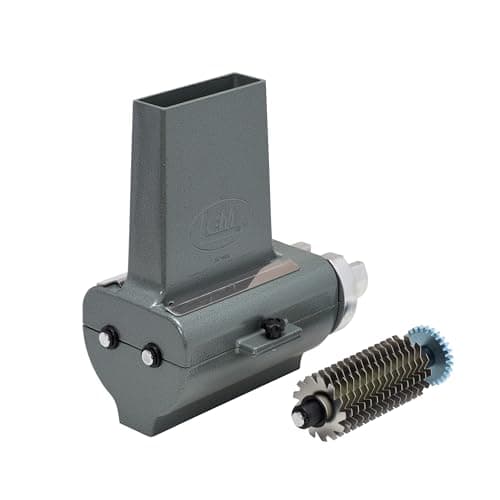
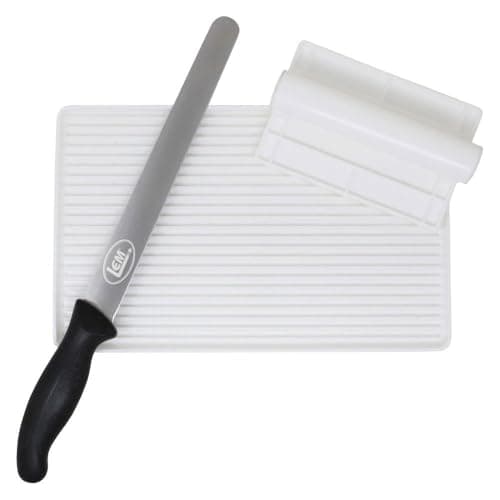
For most hunters, the LEM Jerky Knife and Board Kit is the right tool. It's a double-sided board that sets a ¼-inch or ⅛-inch slab, with a 10-inch knife, a pressing plate that keeps your hand off the blade, and a grip mat. The Hi Mountain kit has a longer serrated knife and ¼-inch and ⅜-inch settings. For bigger sessions, the Weston hand-crank slicer turns a slab into 15 quarter-inch strips per pass. If you own a LEM BigBite grinder, the 2-in-1 attachment does the same job under grinder power.
We haven't bench-tested these tools. Scores come from maker pages and listing copy, weighted on build (30), capacity and fit (25), ease of use (25), and value (20).
Why uniform thickness is a safety spec
It's tempting to treat thickness as a texture preference. The National Center for Home Food Preservation treats it as a safety variable: "The thickness of the meat strips will make a difference in the safety of the methods recommended." NCHFP says to slice no thicker than ¼ inch. Its post-drying heat step of 10 minutes at 275°F is written for strips "originally cut 1/4 inch thick or less," and it notes thicker strips may need longer to reach 160°F (NCHFP jerky guidance). PNW Extension goes as far as flattening strips with a rolling pin "so that they are uniform in thickness." A board or slicer that locks in the thickness does that work for you.
Uneven strips also dry unevenly. Presto's dehydrator manual warns that individual pieces may not all finish at the same time and says to pull the dry ones first. Uniform strips make that sorting job smaller.
Board, crank or attachment
| Tool | How it cuts | Thickness | Per pass | Power | Warranty |
|---|
| LEM Knife and Board Kit | Knife over a board that sets slab depth | ¼ or ⅛ in | One slab | You | 1 year |
| Hi Mountain Slicer Kit | 13½-in serrated knife over a board | ¼ or ⅜ in | One slab | You | Not published |
| Weston Manual Jerky Slicer | Crank drives meat through 32 blades | ¼ in, fixed | Up to 15 strips | Hand crank | Not in listing |
| LEM BigBite 2-in-1 | Slicer roller on a BigBite grinder | ¼ in, fixed | 14 strips | Grinder motor | 2 years |
The Hi Mountain's ⅜-inch setting is thicker than NCHFP and Ohio State's ¼-inch maximum. Penn State does allow ¼ to ⅜ inch, but that guidance pairs with cooking the strips to 160°F before drying. If you plan the 275°F post-bake, use the ¼-inch side.
The two-step workflow
Every tool here starts from a slab. On a board, the slab is the product: you cut it at the board's depth, then cut strips across it with the same knife. The Weston's chute takes meat up to 5 inches wide and 1¼ inches thick, and LEM's attachment chute is 1¼ by 4½ by 6 inches. With either one, you first cut the meat into slabs no thicker than 1¼ inches and no wider than the chute, then feed them through.
Firm meat makes both steps easier. LEM's own instructions say to freeze meat slightly before cutting, and PNW 632 says to freeze it until firm but not solid. For the full process from roast to rack, see how to slice meat for jerky.
Using a jerky board, step by step
- Firm the meat. LEM's instructions say to freeze it slightly. PNW says firm but not solid.
- Pick the depth. Flip the LEM board to its ¼-inch or ⅛-inch side. On the Hi Mountain, use the ¼-inch setting if you'll post-bake.
- Set the meat on the board and hold it with the pressing plate. LEM's ribbing and Hi Mountain's textured ridges are there to stop it sliding.
- Run the knife across at the board's set depth, keeping your free hand on the pressing plate and away from the cutting board, as LEM's instructions say.
- Cut the slab into strips 1 to 1½ inches wide (PNW, Ohio State), with or across the grain.
Strips per session
The tools differ most in how many strips each motion makes. A board gives you one slab at a time, and you cut the strips yourself. The Weston cuts up to 15 quarter-inch strips per pass from a slab up to 5 inches wide and 1¼ inches thick. LEM's attachment cuts 14 per pass through a 4½-inch-wide chute, driven by the grinder. None of these makers publishes pounds per hour, and we won't guess. What you can count on is that a crank or attachment replaces most of the knife strokes with one pass per slab.
Match that to your season. Ohio DNR's average deer yields 52.19 lb of meat, and a Hi Mountain kit seasons 15 lb of whole muscle. If you jerk one kit's worth a year, a board is plenty. If you run a kit from every deer in a three- to five-deer season, the crank starts to earn its clamp.
Grain direction
Every extension source we checked agrees on grain. In Penn State's words, jerky cut on the grain is chewy, and cutting across it makes it more tender. NCHFP adds that across-the-grain jerky is more brittle. LEM's board instructions favor with the grain "so when eating you are biting across the grain." A board lets you pick the direction strip by strip. With a crank or attachment, you set the grain when you cut the slab, so lay the slab so the grain runs the way you want the strips to.
Which muscle you start with matters as much as grain. The best cuts for jerky are lean, and our deer jerky guide covers the rest of the process.
What to look for in a jerky board or slicer
- Cut depths at or under ¼ inch. LEM's ¼ and ⅛ both qualify. On the Hi Mountain, the ¼-inch setting does. The Weston and LEM attachment are fixed at ¼ inch.
- Something between your hand and the blade. Both board kits use a pressing plate. The Weston includes stainless tongs and two anti-jam combs.
- Knife length and steel. Hi Mountain's 13½-inch serrated knife and LEM's 10-inch blade are both 420 stainless, per the listings.
- Mounting and grip. The Weston clamps to surfaces up to 2 inches thick. LEM includes a 12 x 18-inch non-skid mat, and Hi Mountain's board has rubber feet.
- Dishwasher-safe parts. The Hi Mountain kit is listed as dishwasher-safe. LEM's board and plate are, but its knife and mat are hand-wash.
- Fit (attachments only). The LEM 2-in-1 fits BigBite grinders only, and the motor isn't included.
- Storage. Hi Mountain says its board nests for storage and has a carrying handle. The Weston mounts with a built-in C-clamp, so it comes off the table between sessions.
Cleaning and cross-contamination
Anything that touched raw meat needs washing and sanitizing before it goes near finished jerky. PNW 632 says to keep raw meat, its cutting surfaces and its tools separate from dried meat and other ready-to-eat food. Sanitize washed equipment in 1 tablespoon of chlorine bleach per gallon of room-temperature water and let it air-dry (PNW 632). The Hi Mountain kit is listed as dishwasher-safe. LEM's board and plate are too, but its knife and grip mat are hand-wash only. The Weston's combs and tongs need the same treatment as its blades. LEM says its attachment comes apart without tools.
Which thickness for which jerky
Choose by the texture you want. Thin ⅛-inch strips sit at the bottom of PNW's ⅛-to-¼-inch range, and only the LEM board sets them. They dry faster, since Penn State notes that thinner strips take less time. Quarter-inch strips sit at the common ceiling, and they're what the Weston and the LEM attachment cut. The Hi Mountain's ⅜-inch setting is for cooks following Penn State's method, which brings strips to 160°F before drying. Whatever you choose, don't mix thicknesses on the same trays. The thin ones will be done while the thick ones are still wet.
On the attachment: LEM says it is "exclusively designed to fit BigBite grinders" and runs off the grinder's motor, which isn't included. If your grinder is another brand, the Weston crank is the closest equivalent without a motor.
When to step up to an electric slicer
A board kit is honest gear for a deer's worth of jerky. Once you're cutting full 15 lb kit batches from several deer, a 10-inch electric slicer with a millimeter dial is worth a look. Our meat slicer rankings cover that step. The LEM attachment is the in-between option: power slicing without a second machine, if you already own the grinder. See grinders for deer for how the BigBite line compares.
How we picked
Units we claim to have bench-tested: none
Plenty of sites say they ground two hundred pounds through every grinder. We didn't, and we say so. What we do instead: read the maker's spec sheet, manual and warranty terms, record the figures that decide whether a machine keeps up with your season (size number, motor rating, rated pounds per minute, capacity, duty cycle, gearing), check parts availability, and score each pick on a published rubric. Then we show the season math — pounds per deer from the Ohio Division of Wildlife's yield study — so you can redo it with your own numbers.
Scores are editorial judgments from that documented research, not lab results. Nobody pays for placement. The rubric and weights are on the How We Pick page.