Jerky ◆ Guide
How to Make Deer Jerky in a Dehydrator, Sliced or Ground
Venison jerky the way USDA and the extension services lay it out: lean meat, ¼-inch strips or a jerky gun, a 160°F heating step, then dry at 140-155°F until a strip cracks but doesn't break.
We earn a commission if you buy through our links, at no extra cost to you. It never decides the ranking — the method is published · Affiliate disclosure
Freeze lean venison until firm, slice it no thicker than ¼ inch, and cure or marinate it in the fridge. Then get it to 160°F: boil the strips in the marinade for 5 minutes before drying, or bake the dried strips for 10 minutes at 275°F. Dry at 140°F (NCHFP) to 145-155°F (PNW Extension) until a cooled strip cracks when bent but doesn't break.
That's the whole method. The rest of this guide explains each step and where its numbers come from: USDA FSIS, the National Center for Home Food Preservation, and extension bulletins from Pacific Northwest, Penn State, Ohio State and K-State.
Before the knife: start with a clean deer
Jerky dries at low heat, so it's less forgiving of dirty meat than a roast cooked through. USDA quotes researchers who found that venison "can be heavily contaminated with fecal bacteria," depending on the hunter's skill and the wound location. They also note that deer carcasses are often held at ambient temperature, while beef is chilled fast. NCHFP's advice is specific: if gut contents touched the meat while you were dressing it, don't make jerky from that meat. Use it only in dishes that get thoroughly cooked. Chill the carcass fast.
Chronic wasting disease is the other check. The CDC says to strongly consider having a deer tested for CWD before you eat it, not to eat meat from an animal that tests positive, and to check state wildlife and health department recommendations before you hunt (CDC on CWD). States also set their own carcass-transport rules, so check your state wildlife agency before moving a deer across a border. If you break down the deer yourself, our home processing guide covers the breakdown.
Pick and prep the meat
Lean is the rule. Fat goes rancid in dried meat. PNW 632 says venison makes excellent jerky and, because game is so lean, "any cut can be used, but the best cuts tend to be the loin, round, and flank." NDSU notes that the leg muscles separate along their natural seams into pieces you can use for roasts, jerky or steaks. Trim off visible fat, then remove thick connective tissue and gristle. We rank the options in the best cuts for jerky.
Parasites. NCHFP says that if you use pork or wild game, you should treat the meat for trichinella before slicing: freeze pieces 6 inches thick or less at 0°F or below for at least 30 days. PNW adds a caveat for bear, cougar and feral hog. Freezing doesn't kill every Trichinella species in game meat, but the heating steps below do, and PNW says the vinegar-soak method isn't recommended for game.
What you need
- A dehydrator with an adjustable dial that reaches at least 160°F. USDA asks for an adjustable dial, and PNW says not to use units with a fixed factory preset.
- A way to hold ¼ inch. A jerky board kit, a hand-crank slicer or an electric slicer (see boards and slicers).
- A jerky gun if you're making ground jerky.
- Cure and seasoning. A kit takes the guesswork out of the ratios. Hi Mountain's handle 15 lb of whole-muscle meat or 10 lb of ground.
- A thin-tipped digital thermometer. PNW calls one essential for checking the temperature of thin strips, and it's also how you verify the dehydrator.
Picks for this job
The deer jerky kit
A dehydrator that reaches 165°F, a board that sets ¼ inch, a gun for the ground path, and a cure kit blended for game.
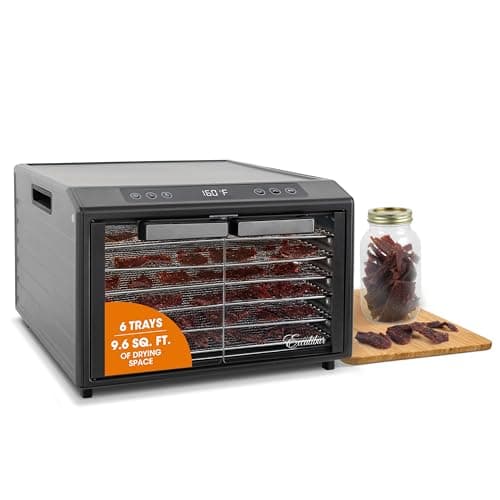
Best mid-size pick
Excalibur Select Series 6-Tray Food Dehydrator
9.6 sq ft, 85-165°F and horizontal airflow in a mid-size box: the sensible Excalibur for a hunter jerking part of one or two deer.
$157.99Amazon#ad · Price as of Sep 19, 2026 · Affiliate disclosure for the link to Excalibur Select Series 6-Tray Food Dehydrator
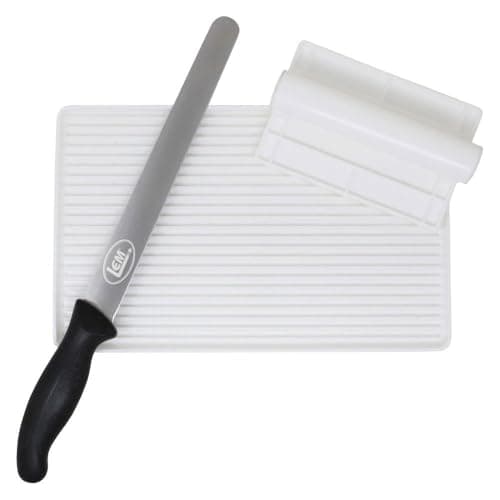
Best jerky board
LEM Jerky Knife and Board Kit
A double-sided board that sets ¼-inch or ⅛-inch slabs, a 10-inch knife, a pressing plate and a grip mat. It's one of the least expensive ways to get uniform jerky thickness.
$40.28Amazon#ad · Price as of Sep 19, 2026 · Affiliate disclosure for the link to LEM Jerky Knife and Board Kit
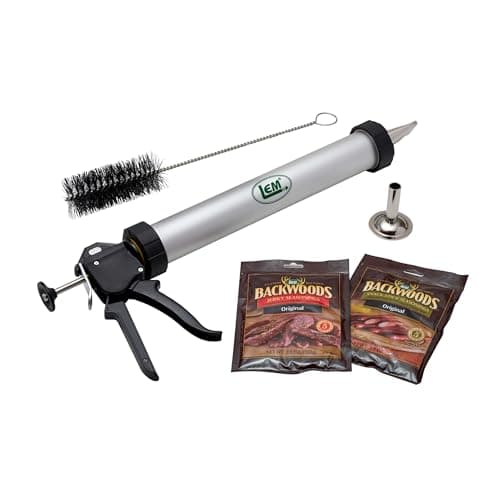
Best for ground venison
LEM Jerky Cannon
An anodized aluminum barrel that holds 1½ lb of ground meat, with stainless flat and snack-stick nozzles. It's the gun to buy if you make ground jerky more than once a season.
$59.99Amazon#ad · Price as of Sep 19, 2026 · Affiliate disclosure for the link to LEM Jerky Cannon
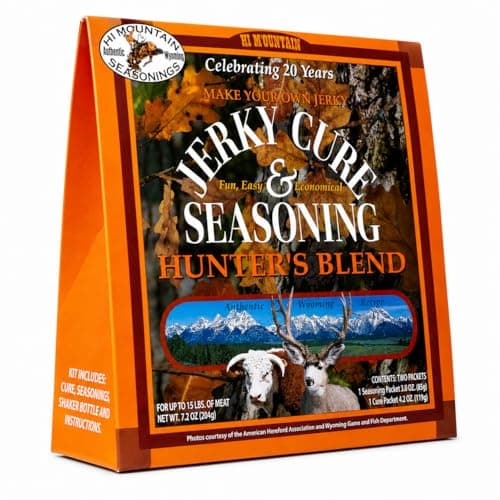
Best kit for deer jerky
Hi Mountain Hunter's Blend Jerky Seasoning and Cure Kit
Hi Mountain's wild-game blend, with seasoning, cure and a shaker for up to 15 lb of whole-muscle venison or 10 lb of ground.
$12.99Amazon#ad · Price as of Sep 19, 2026 · Affiliate disclosure for the link to Hi Mountain Hunter's Blend Jerky Seasoning and Cure Kit
Path 1: sliced (whole-muscle) deer jerky
- Firm it up. Freeze the trimmed muscle "until it is firm but not solid" (PNW).
- Slice. No thicker than ¼ inch (NCHFP). PNW gives ⅛ to ¼ inch, 1 to 1½ inches wide and 4 to 10 inches long. Slice with the grain for chewy jerky or across it for tender jerky.
- Even it out. Lay the strips flat and roll them to a uniform thickness with a rolling pin (PNW).
- Season and cure in the fridge. NCHFP gives 1 to 2 hours or overnight, and warns that long marinades can get salty. USDA says don't save marinade to reuse. If you're using a kit, follow its cure measurements exactly.
- Do the 160°F step before drying, or plan to do it after (see below).
- Load the trays. Lay strips close together but not touching or overlapping (NCHFP). Ohio State suggests about 25 percent open space per tray.
- Dry, test, finish. Dry until the bend test passes, then post-bake if you didn't pre-heat.
Path 2: ground venison jerky
Ground jerky uses more of the deer and less knife work, but NCHFP warns that disease-causing microorganisms "are more difficult to eliminate in ground meat than in whole meat strips." So the rules tighten.
- Grind lean. Use meat that's at least 93% lean (PNW, Ohio State). Don't add the fat you'd use for burger.
- Mix in cure and seasoning following the package directions. Salt helps bind ground meat so it holds its shape (PNW). The research USDA cites found cured ground jerky had greater bacterial destruction than uncured.
- Shape it. Use a jerky gun, or press the meat into a jellyroll pan ¼ inch thick and cut strips (PNW). LEM's Jerky Cannon holds 1½ lb per load. See our jerky gun rankings.
- Dry, then heat. K-State says to put dried ground jerky on a baking sheet and heat it for 10 minutes in an oven preheated to 275°F.
The 160°F step: pick one method
USDA's recommendation is to heat meat to 160°F before drying, "as measured with a food thermometer." Evaporation keeps strips in a dehydrator cool until they're nearly dry, and by then surviving bacteria are more heat-resistant. The extension services give four ways to do it:
| Method | How | Source | Trade-off |
|---|---|---|---|
| Boil in marinade | Bring strips and marinade to a boil; boil 5 minutes; drain; dry | NCHFP | Dries faster; color and texture differ from traditional jerky |
| Dip in boiling marinade | Add unmarinated strips to simmering marinade, 1½-2 minutes, until they reach 160°F | PNW 632 | Tender jerky; ground jerky may break apart |
| Bake before drying | 325°F oven until strips read 160°F on a thin-tipped thermometer | PNW 632, Penn State | Start drying immediately after |
| Bake after drying | 10 minutes in an oven preheated to 275°F, strips cut ¼ inch or less | NCHFP, PNW 632, K-State | Most traditional texture; PNW calls it the easiest |
Drying: temperature, time and the bend test
NCHFP dries at 140°F and gives 10 to 24 hours for strips not heated in marinade. It says to start checking at 3 hours, and pre-heated strips dry faster. PNW has you preheat the dryer to 145-155°F and dry for a minimum of 4 hours, noting that times vary. Don't turn the heat up to hurry it. K-State warns that higher temperatures cause case hardening, which traps moisture inside. Every one of those settings, with the timing each source gives, is in our jerky time and temperature guide.
Done looks like this: pull a strip, let it cool, and bend it. It should crack but not break (NCHFP, PNW, Penn State). PNW describes the texture as bending "like a green stick" without snapping like a dry one, with no damp spots.
Conditioning, yield and storage
Condition first. PNW says to pack cooled jerky loosely in containers about two-thirds full, cover them tightly, and shake daily for 2 to 4 days so moisture evens out. If moisture forms on the lid, the jerky goes back in the dryer.
Yield. USDA says a pound of meat makes about four ounces of jerky. A full Hi Mountain kit of 15 lb whole-muscle venison works out to roughly 3¾ lb of finished jerky. For scale, Ohio DNR's average deer yields 52.19 lb of meat.
Storage. The sources vary, so plan for the shortest. NCHFP says properly dried jerky keeps two weeks at room temperature in a sealed container. Ohio State says up to two weeks at room temperature and three to six months refrigerated. USDA gives 1 to 2 months for home-dried jerky. NCHFP lists vacuum packaging as a good option, and refrigerating or freezing extends shelf life. If you're sealing jerky alongside the rest of the deer, see our vacuum sealers for wild game.
Questions
Frequently asked
How long do you dehydrate deer jerky?
Do you have to cook deer jerky before dehydrating?
Can you make deer jerky from ground meat?
How thick should deer jerky be sliced?
How long does homemade deer jerky last?
Should I freeze venison before making jerky?
Keep going down the chain
Related
Receipts
Sources
- USDA Food Safety and Inspection Service — Jerky and Food Safety
- National Center for Home Food Preservation (University of Georgia) — Jerky
- Pacific Northwest Extension PNW 632 — Making Jerky at Home Safely (University of Idaho, Oregon State University, Washington State University; rev. 2020)
- Penn State Extension — Drying Jerky (updated April 2024)
- Ohio State University Extension, Ohioline HYG-5362 — Food Preservation: Making Jerky
- Kansas State University Research and Extension MF3173 — Dehydrating Meat Safely at Home (rev. March 2026) [PDF]
- NDSU Extension — Wild Side of the Menu No. 2: Field to Freezer (reviewed August 2022)
- US Centers for Disease Control and Prevention — About Chronic Wasting Disease (updated Jan. 21, 2026)
- Ohio Department of Natural Resources, Division of Wildlife — Venison Meat Yield (115 deer, 2017 gun season) [PDF]
- Amazon listing, manufacturer-supplied copy — Hi Mountain Hunter's Blend jerky seasoning and cure kit
- LEM Products — Jerky Cannon product page
We haven't bench-tested this gear and we don't pretend to. Specs come from the maker's own pages, manuals and maker-supplied listing copy (labeled as such); food-safety figures from USDA and university extension publications; yield from the Ohio Division of Wildlife; prices live from Amazon. Where a figure isn't published, we say so. Read the full method.