Jerky ◆ Guide
How Long Does Homemade Jerky Last? It Depends on Two Things
Homemade jerky is not a commercial product and should not be stored like one. How long it keeps comes down to how dry you got it and how much air is left in the bag.
We earn a commission if you buy through our links, at no extra cost to you. It never decides the ranking — the method is published · Affiliate disclosure
Homemade jerky is best treated as a short-shelf-life food: a week or two in a sealed container at room temperature, a few weeks refrigerated, and months in the freezer. It is not a pantry staple, and the reason is that you cannot measure how dry it is.
Commercial jerky survives on a shelf because its water activity is measured and controlled in a lab. Yours is dried until it looks and bends right. That is a perfectly good way to make jerky and a poor basis for a twelve-month shelf claim, so the safe approach is cold storage and short windows.
The two variables
Residual moisture. Under-dried jerky is a moist, protein-rich food at room temperature, which is exactly what spoilage organisms want. Properly dried jerky cracks when bent but does not snap; if it is pliable and damp in the middle, it belongs in the fridge or back in the dehydrator.
Air. Oxygen drives the rancidity you taste as cardboard before you ever see mould — and lean venison, with little intramuscular fat, is not immune to it. The less air in the bag, the longer the flavour holds.
Where to store it
| Where | Container | Treat it as |
|---|---|---|
| Pantry, room temperature | Airtight jar or sealed bag, dark and cool | Days to a couple of weeks |
| Refrigerator | Airtight, 40 °F or below | A few weeks |
| Freezer | Vacuum sealed, 0 °F or below | Months; quality is the limit, not safety |
| In a daypack | Single-serving sealed portions | That day — then eat it or chill it |
The freezer line is the one worth internalising. Food stored constantly at 0 °F stays safe; what degrades is quality — the same principle our freezer burn page works through for whole cuts. Jerky freezes well and thaws in minutes, so there is no good reason to keep a big batch at room temperature.
Why vacuum sealing changes the answer
Removing the air removes the oxidation. For jerky, that mostly buys flavour rather than safety — but flavour is the whole point of making it, and rancid jerky gets thrown away just as surely as spoiled jerky.
One caveat to carry: vacuum packaging slows deterioration but is not a substitute for refrigeration or freezing. A vacuum-sealed bag of under-dried jerky left in a warm cupboard is still a bag of moist meat in the dark. Seal it and chill it.
Jars are the underrated option here. A jar sealer pulls the air out of a mason jar, which is reusable, keeps the strips from crushing, and lets you open and reseal the same container through a season.
Picks for this job
Storing a batch properly
Get the air out, then get it cold. A sealer handles long-term portions; a jar sealer handles the one you are working through.
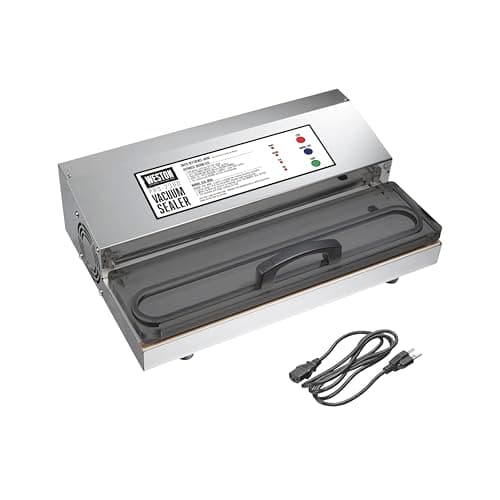
Best for wide cuts
Weston Pro-2300 Vacuum Sealer
A fan-cooled sealer with a double-piston pump rated to 28 in. Hg and bags up to 15 in. wide. Its manual asks for at least 20 seconds with the lid open between cycles.
$474.45Amazon#ad · Price as of November 4, 2026 · Affiliate disclosure for the link to Weston Pro-2300 Vacuum Sealer
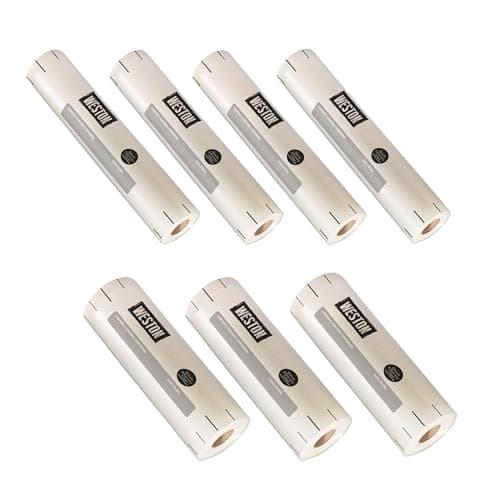
Best two-width roll pack
Weston 3 mil Vacuum Sealer Rolls, 7-Pack
The rolls to feed it: cut each bag to the portion, so there is no excess air volume to pull out in the first place.
Check price · Amazon#ad · Price as of November 4, 2026 · Affiliate disclosure for the link to Weston 3 mil Vacuum Sealer Rolls, 7-Pack
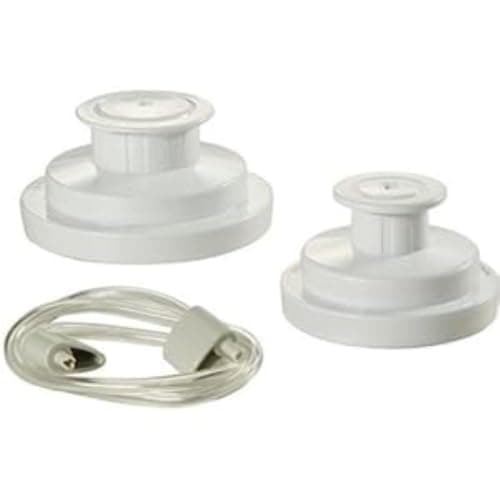
Best jar sealer overall
FoodSaver Jar Sealer with Accessory Hose (Regular and Wide Mouth)
Pulls the air out of a regular-mouth mason jar - reusable, no crushed strips, and you can reseal the same jar each time you open it.
$19.99Amazon#ad · Price as of November 4, 2026 · Affiliate disclosure for the link to FoodSaver Jar Sealer with Accessory Hose (Regular and Wide Mouth)
The signs it has gone
- Any mould at all. Not a trim-and-use situation on a dried product — discard the batch.
- Off or rancid smell. A sharp, oily, crayon-like note is fat oxidation. It will taste the way it smells.
- Slimy or sticky surface. Moisture has migrated back to the surface; it was not dry enough.
- Condensation inside the bag. The same problem, caught earlier. Refrigerate it and eat it soon, or dry it further.
Cool it before you bag it
The most common homemade-jerky storage mistake is bagging a warm batch. Warm strips give off steam, the steam condenses inside the sealed bag, and the moisture you spent eight hours removing goes straight back onto the surface.
Let the batch come to room temperature on a rack, then bag it. If the bag fogs after an hour, it went in too warm or too wet — open it, dry the strips a little longer, and start again.
Why store-bought lasts longer
Three reasons, none of which you can replicate at home: measured water activity, oxygen absorbers in the pack, and in some cases a nitrogen flush. A commercial pack is engineered for a shelf life; a homemade batch is engineered for taste.
That is not a reason to buy it. It is a reason to make smaller batches more often, and to use the freezer as the default rather than the fallback. If you are setting up to do that, our sealer picks and bag picks cover the hardware, and how to make deer jerky the batch itself.
Questions
Frequently asked
How long does homemade jerky last at room temperature?
Does vacuum sealing make jerky last longer?
Can you freeze homemade jerky?
Why is there condensation in my jerky bag?
Can you cut mould off jerky?
How do you know jerky is dry enough?
Keep going down the chain
Related
Receipts
Sources
- USDA Food Safety and Inspection Service — Jerky and Food Safety
- National Center for Home Food Preservation (University of Georgia) — Jerky recipes and drying guidance
- Penn State Extension — Drying Jerky (safe drying practice)
- Oregon State University / PNW Extension — Making Jerky at Home Safely (PNW 632)
- Kansas State University Research and Extension (MF3173) — Dry Meat Safely at Home [PDF]
- FoodSafety.gov — Cold Food Storage Charts
- USDA Food Safety and Inspection Service — Freezing and Food Safety
- Amazon listing, manufacturer-supplied copy — Weston Pro-2300 vacuum sealer (65-0220-W)
- Amazon listing, manufacturer-supplied copy — Weston vacuum sealer roll 7-pack (30-2001-W)
- Amazon listing, manufacturer-supplied copy — FoodSaver regular-mouth jar sealer
Specs come from the maker's own pages, manuals and maker-supplied listing copy (labeled as such); food-safety figures from USDA and university extension publications; yield from the Ohio Division of Wildlife; prices live from Amazon. Where a figure isn't published, we say so. Read the full method.