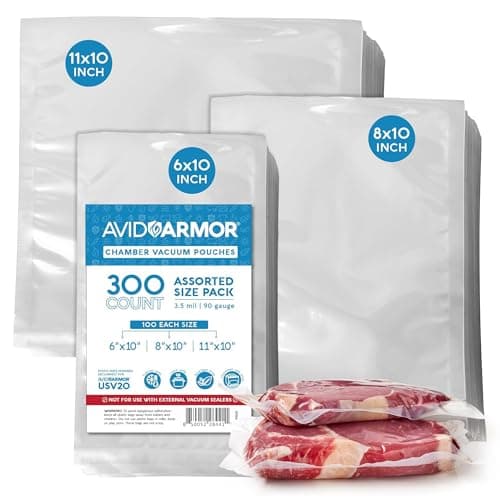
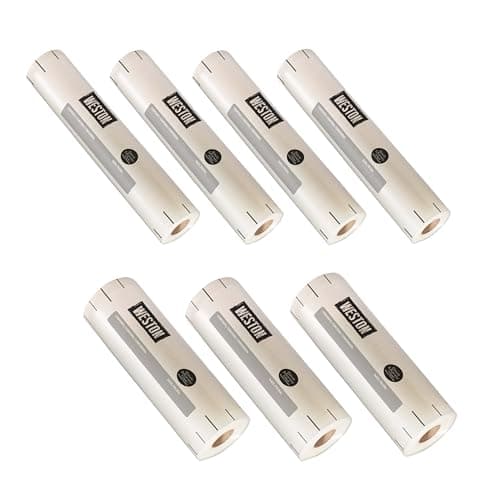
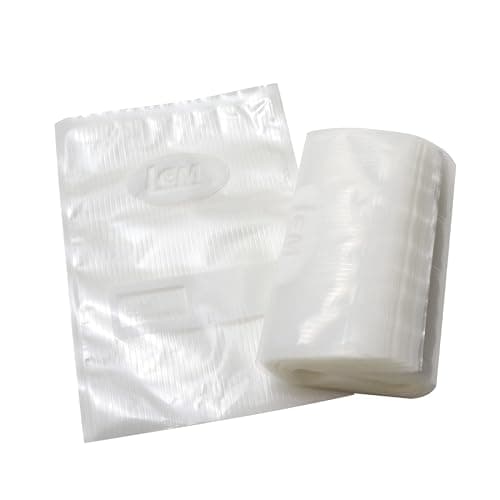
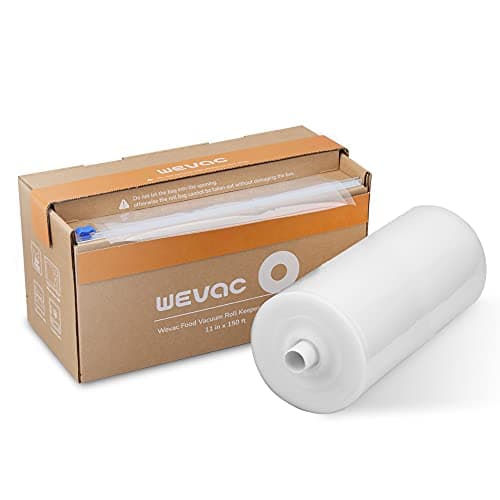
For an external (suction) sealer, the Wevac 11-inch x 150-foot roll is our pick: embossed, boxed with a cutter, and at a 12-inch cut it yields about 150 bags, nearly three deer of one-pound packages. For a chamber sealer, buy Avid Armor's 3.5 mil chamber pouches instead; they're pre-cut in three sizes and Avid says smooth pouches cost less per seal. If you want two widths in one box, the Weston 3 mil roll pack. If you want pre-cut bags with a label panel that work in either machine type, LEM's MaxVac quart bags.
We ranked bags on four things, weighted per our rubric: stated thickness (30%), fit to your machine type (25%), size options (20%) and value (25%). We haven't run puncture or freezer-burn tests. Thickness here means the figure each maker prints, and where a maker doesn't print one, we say so and score it neutral.
Embossed or smooth: the one rule you can't break
External sealers need embossed bags. The textured channels give the pump a path to pull air out of the bag once the mouth is clamped. Avid Armor's pouch page states the rule from the other side: its smooth chamber pouches will not work in a FoodSaver or any other external suction sealer, because a suction machine needs an embossed bag to draw air through and a smooth pouch gives it nothing to grip.
Chamber sealers are more forgiving. The whole chamber is evacuated, so the bag needs no channels, but embossed bags still work: LEM says its MaxVac bags fit most vacuum sealers and chamber sealers, and Wevac says its embossed cutter rolls suit both. So if you own a chamber machine, you can use up a stash of old roll bags; if you own a suction machine, a case of chamber pouches is a case of nothing. If you're weighing a switch, read chamber vs external vacuum sealer before you buy bags for either.
Rolls or pre-cut bags
A roll lets you cut every bag to the cut: a short bag for a pound of burger, a long one for a backstrap. NESCO's manual gives the working rule for length: pull enough material to hold the item plus an additional 3 inches. The cost is an extra seal. Every roll bag needs its bottom sealed before you fill it, then the vacuum-and-seal to close it, so a deer's worth of roll bags is about 104 seals instead of 52. On a sealer whose manual asks for a rest between seals, that's real time; see the duty-cycle table in our vacuum sealer rankings for wild game.
Pre-cut bags flip the trade: one seal per package and a fixed size. The fixed size is fine when the cut matches it. LEM's own advice is to choose the bag size closest to your food item's size, and a quart bag at 8 x 12 inches is right for a pound of ground venison and short for a roast. A lot of processors end up running both: pre-cut bags for the burger, where the count is highest, and a roll for everything else.
Mil thickness, and what bones do to a bag
Here is what each maker prints for wall thickness:
| Bag | Stated thickness | Type |
|---|
| Avid Armor chamber pouches | 3.5 mil (90 gauge) | Smooth, pre-cut, chamber only |
| LEM MaxVac quart bags | 3.14 mil on LEM's page; 3.4-3.5 mil in the Amazon copy | Channeled, pre-cut |
| Weston roll 7-pack | 3 mil, 2-ply | Embossed rolls |
| Wevac 11 in. x 150 ft roll | Not stated for this roll (Wevac lists its 8 in. x 150 ft roll at 3 mil) | Embossed roll |
The spread is narrow, 3 to 3.5 mil where it's published, and no maker here publishes a puncture test, so thickness is a proxy, not a promise. What actually tears bags is bone and sharp edges, and the manuals agree on the fix. Avid Armor's says to pack sharp edges with a bone protector sheet or double-bag the item; FoodSaver's says to wrap sharp items in soft cushioning such as a paper towel; NESCO's says to cushion sharp edges with paper towels and not to seal things with sharp points at all. For deer, that mostly means bone-in shanks, neck roasts and ribs. Bone out what you can and pad the rest.
How far a box goes
At the Ohio DNR average of 52.19 lb of venison per deer, one-pound packages means about 52 bags per deer. Here's how far each pack stretches at that rate, with roll bags cut at 12 inches:
- Wevac roll: 150 ft × 12 in ÷ 12 in = 150 bags, about 2.9 deer.
- Weston 7-pack: three 20-ft rolls plus four 16-ft rolls is 124 ft, so 124 bags, about 2.4 deer.
- LEM quart bags: 100 bags, about 1.9 deer.
- Avid Armor pouches: 300 pouches, about 5.8 deer.
What that costs per deer changes with the price of the box, so we don't print it here. The bag cost per season page divides each live price by these counts and multiplies out to one, two, five and eight deer.
Which bag for the sealer you own
Start from the machine on your counter. This table pairs each sealer we cover with the bag types its maker says it takes and the widest material it accepts, then the pick from this page that fits.
| Your sealer | Takes | Widest bag | Our bag pick |
|---|
| FoodSaver V4400 | Embossed rolls and pre-cut bags | 11 in. rolls | Weston 3 mil pack (8 and 11 in.) or the Wevac roll |
| NESCO VS-12 or VS-22LB | Embossed rolls and pre-cut bags | Stores an 11 in. roll | Wevac 11 in. roll |
| LEM MaxVac 250 | Embossed rolls and pre-cut bags | 11 in. | Wevac roll; LEM quart bags for burger |
| LEM MaxVac 500 | Embossed rolls and pre-cut bags | 14 in. | Wevac roll; LEM quart bags for burger |
| Weston Pro-2300 | Embossed rolls and pre-cut bags | 15 in. | Wevac or Weston rolls |
| Avid Armor USV20 (chamber) | Smooth pouches; embossed bags also work in chambers | Pouches up to 11 x 10 in. | Avid Armor 3.5 mil pouches |
If you run both kinds of machine, the only bags that cross over are embossed ones, which LEM and Wevac say work in chambers too. Chamber pouches never go the other way. And if you only ever seal ground meat, the pre-cut quart bag is the simplest answer: one seal, one pound, a label panel, done.
Sizing bags to cuts
Width is set by the machine; length is set by the cut. The common widths are 8 and 11 inches (FoodSaver's V4400 takes both; the Weston pack gives you both). An 8-inch bag suits ground meat pressed flat and small steaks; 11 inches suits roasts, backstrap sections and anything bone-in. Avid's pouch pack covers 6 x 10, 8 x 10 and 11 x 10 inches, which matches the USV20's 11 x 10 maximum.
Two habits save bags. Press ground meat flat in the bag before sealing so it freezes fast and stacks well (USDA's FSIS says a food 2 inches thick should freeze completely in about 2 hours, and to freeze packages in a single layer before stacking). And leave the headspace your manual asks for; a bag that's too short to clamp is a bag you throw away.
Check your machine before you buy a case
- Maximum bag width. Weston Pro-2300: 15 in. LEM MaxVac 500: 14 in. LEM MaxVac 250: 11 in. Both NESCOs store an 11-inch roll. Avid USV20: pouches up to 11 x 10 in.
- Machine type. Suction sealers need embossed bags; chamber sealers take smooth pouches or embossed bags.
- Your warranty. An earlier edition of the FoodSaver V4400 manual tied its warranty to FoodSaver-brand bags and rolls. The current owner's manual on Newell Brands' site doesn't include that condition. Check the manual that came in your box before you switch to generic rolls.
Handling and labeling
Keep the roll clean. A cutter box like Wevac's keeps the material off a wet bench, and NESCO's manual warns that wet bags may be difficult to seal, so don't let the open end touch anything wet. Label every package with the cut, the date and which deer it came from; LEM's quart bags have a label panel for exactly that, and on roll bags a freezer marker on the outside works. Dated packages are what let you eat the oldest first, which matters more than any bag spec once you read how long vacuum-sealed meat lasts.
If you're packaging a whole season, our guide to packaging deer meat for the freezer covers portion sizes and wrap choices cut by cut.
How we picked
Units we claim to have bench-tested: none
Plenty of sites say they ground two hundred pounds through every grinder. We didn't, and we say so. What we do instead: read the maker's spec sheet, manual and warranty terms, record the figures that decide whether a machine keeps up with your season (size number, motor rating, rated pounds per minute, capacity, duty cycle, gearing), check parts availability, and score each pick on a published rubric. Then we show the season math — pounds per deer from the Ohio Division of Wildlife's yield study — so you can redo it with your own numbers.
Scores are editorial judgments from that documented research, not lab results. Nobody pays for placement. The rubric and weights are on the How We Pick page.