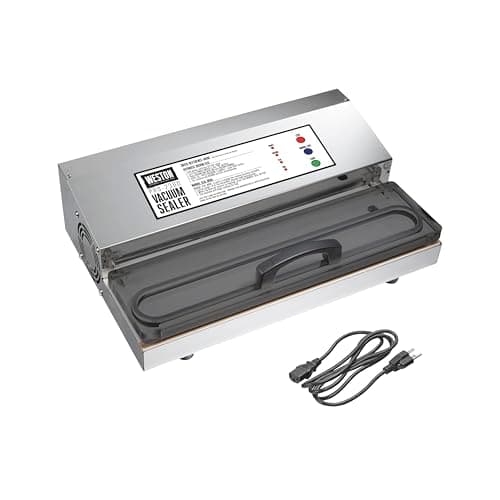
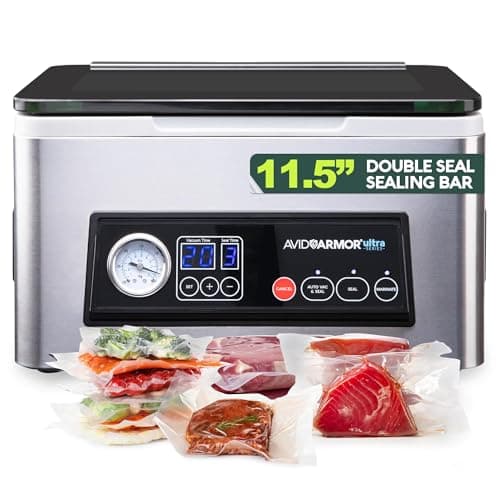
Buy a chamber sealer if your trim is wet or you seal enough deer to care about bag cost. It evacuates the whole chamber, so juice isn't pulled toward the pump, and it takes smooth pouches that are cheaper per seal, per Avid Armor. Buy a heavy external sealer if you want wide bags (the Weston Pro-2300 takes 15 inches) and a machine that doesn't care how big the cut is.
Our picks on each side are the Avid Armor USV20 (chamber) and the Weston Pro-2300 (external). We haven't tested either; everything below comes from the makers' manuals, spec pages and listing copy, linked on the product cards.
Chamber vs external at a glance
| | Chamber: Avid Armor USV20 | External: Weston Pro-2300 |
|---|
| How the air comes out | The whole chamber is evacuated with the bag inside | Pulled out through the clamped mouth of the bag |
| Wet meat and liquids | Seals liquids; the liquid is never pulled toward the suction port (Avid) | Manual says use Manual Seal for liquids and freeze meat 1-2 hours first |
| Bags | Smooth chamber pouches; embossed bags also work | Embossed or channeled bags only |
| Largest bag | Pouches up to 11 x 10 in. | Bags up to 15 in. wide |
| Pump | Dry double-piston, no oil | Double-piston, up to 28 in. Hg |
| Between cycles | Can run continuously; 1-minute cool-down advised for best results | At least 20 seconds with the lid open; thermal cutoff, about 20 minutes to recover |
| One deer, 52 one-pound packages | About 72 minutes at factory defaults with every advised pause | 17 minutes of required rest, plus cycle time Weston doesn't publish; roll bags double the seals |
The Weston's rest figures come from the Pro-2300 manual written for the earlier 65-0201 model; Weston hasn't posted one for the current 65-0220-W that we could fetch, and the current listing sells it as fan-cooled for continuous, repetitive use. We show both so you can weigh them.
How each one pulls a vacuum, and why it matters for venison
An external sealer clamps the open end of an embossed bag against a seal bar and pumps air out through the channels in the bag. Whatever is loose inside moves toward that exit, which on a bench full of fresh trim means blood and juice. The makers' workarounds are all about stopping that flow: FoodSaver and Weston say to freeze meat for 1-2 hours before sealing, NESCO says to partially freeze meats, and FoodSaver adds a folded paper towel between the meat and the seal area as a fallback. It works, but it adds a step and freezer space to every processing day.
A chamber sealer puts the whole bag inside a box, pulls the air out of the box, seals the bag, then lets air back in. Because the pressure drops evenly inside and outside the bag, there's no stream of air dragging liquid toward the seal. That's why Avid can say the USV20 seals soups, brines and marinades, and why it takes smooth pouches that the external machine can't use. Avid's pouch page says those pouches run cheaper per seal because they need no embossed channels; our bag cost per season page checks that against live prices.
The chamber's limit is the chamber. The USV20 caps pouches at 11 x 10 inches in a chamber 3 inches high, so a whole backstrap or a thick bone-in roast gets cut to fit. The Weston has no box to fit inside; the bag just has to be 15 inches wide or less.
Dry pump vs oil pump
This question only comes up with chamber sealers, and it's a maintenance decision more than a performance one. The USV20 uses a dry double-piston pump; Avid's help center says it needs no vacuum pump oil. LEM's MaxVac Pro chamber sealer is also listed as maintenance-free with no oil. Oil-pump machines, like the VEVOR DZ-260C, have to be filled before first use (its manual specifies 46 or 68 vacuum pump oil) and must never be run dry. Avid, which sells oil machines too, says to check the oil level regularly, run a pump conditioning program to clear moisture from the oil, and change the oil about every six months or when it goes cloudy (Avid Armor's oil sealer tips).
We couldn't find published data showing an oil pump outlasting a dry pump in home use, so we don't treat oil as an upgrade. If you process a heavy season and like servicing equipment, an oil machine is fine. If the sealer lives in a closet for nine months a year, dry is the pump you won't neglect. All three chamber machines are compared in our best chamber vacuum sealers roundup.
Choose a chamber sealer if
- Your trim comes off the bench wet, or you want to seal stock, chili or marinated meat without freezing it first.
- You seal three or more deer a season and want the cheaper pouch format working for you on every bag.
- You'd rather not pre-freeze and paper-towel every package.
- Your largest routine package fits an 11 x 10 inch pouch.
Choose an external sealer if
- You seal big roasts, bone-in cuts or whole backstraps and want bags up to 14-15 inches wide.
- You process one or two deer and a pre-freeze routine is no hardship.
- You want a lighter machine you can put away; the USV20 alone weighs 17.55 lb on Avid's spec sheet.
- You already own a stack of embossed rolls.
If you land on external, the budget-friendlier heavy option is the LEM MaxVac 250, rated by LEM for 250+ consecutive seals; it's ranked alongside the Weston in our best vacuum sealers for wild game.
What neither machine fixes
Three problems follow you whichever type you buy. Bones puncture bags in both: Avid Armor's manual says to pad sharp edges with a bone protector sheet or double-bag, and FoodSaver's says to wrap sharp items in something soft like a paper towel. Warm food misbehaves in both: the USV20 manual says high temperatures create vapors that inflate the pouch, and NESCO's guide says hot liquids bubble up and over the top of the bag. Seal everything cold. And sealing isn't preserving: the FoodSaver, Weston and Avid Armor manuals all say vacuum packaging is not a substitute for refrigeration or freezing. A sealed package of venison still belongs in a 0°F freezer the same day, spread in a single layer until it's frozen solid, as USDA's Food Safety and Inspection Service advises.
By season tier
Light (1-2 deer, 52-104 one-pound packages): external. The volume doesn't justify a chamber, and a pre-freeze routine handles the wet trim. Moderate (3-5 deer, 157-261 packages): either, and this is where the chamber starts paying off if your trim is wet. Heavy (6+ deer, 313+ packages): a chamber sealer for the bulk of the packaging, or a heavy external machine with a published long-run rating if you need wide bags. Package counts are at the Ohio DNR average of 52.19 lb of venison per deer; yours will vary with the deer. For the wet-meat routine that makes an external sealer work, see how to vacuum seal wet meat.