Commercial Chamber Vacuum Sealers: What the Word Actually Buys
Every chamber sealer under a thousand dollars calls itself commercial. Three specs tell you whether a machine is built for back-to-back work, and only one of them appears in the title.
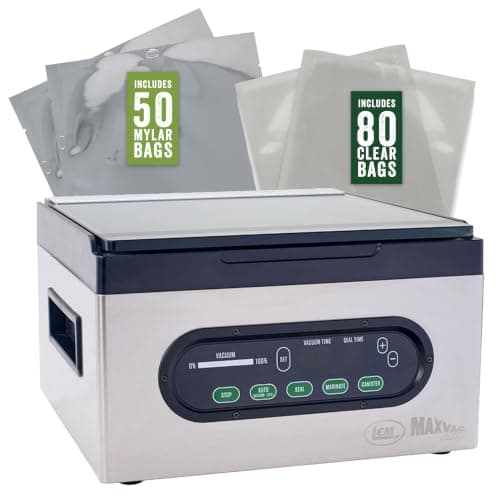
The longest, deepest chamber here on LEM's published dimensions, stainless construction, an oil-free pump pulling -0.95 bar, and a two-year warranty - the longest term of the three.
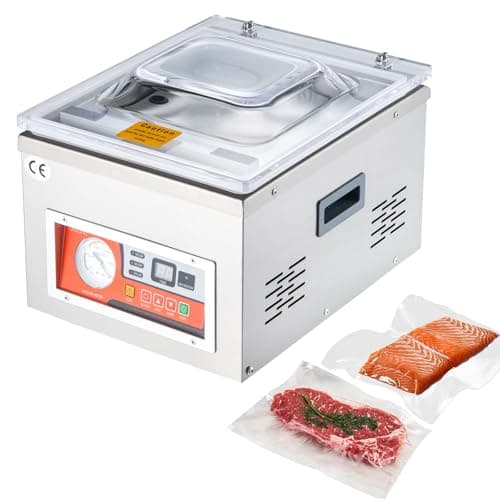
The only machine here on an oil pump, which is the design commercial units use: 180 W, 6.5 cubic metres an hour, with VEVOR suggesting an oil change after 800 hours of continuous work.
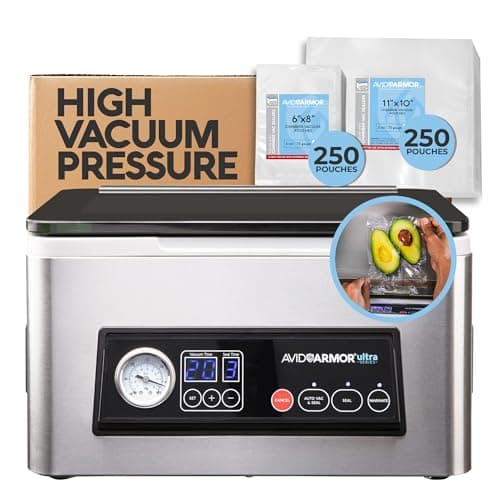
The only unit whose maker says it can run continuously, asking only a one-minute cool-down between cycles for best results - and it arrives with 500 pouches.
#ad · Prices come live from Amazon, last checked November 4, 2026; where we have no verified live price we show none. Scores are ours, compiled from published specs, manuals and warranty terms, not bench tests. Tap a row for the full write-up.
Of the chamber sealers we cover, the LEM MaxVac Pro is the one built closest to commercial: stainless construction, the longest and deepest chamber on published dimensions (11.24 x 11.81 x 3.93 in.), an oil-free pump that pulls -0.95 bar from a 180 W motor, and a two-year warranty.
If “commercial” means an oil pump to you, that is the VEVOR DZ-260A — the only machine here with one. And if what you actually need is back-to-back cycles for an hour, the Avid Armor USV20 is the only unit whose maker says it can run continuously, asking a one-minute cool-down between cycles for best results.
None of the three is a commercial machine in the sense a butcher shop would use the word. That is worth saying plainly before the table, and we come back to it at the end.
What “commercial” means on these listings
In marketplace copy, almost nothing. It is not a certification, not a duty rating and not a construction standard. In food service, commercial equipment usually implies an NSF/ANSI listing for sanitation and cleanability — none of the chamber sealers in this price class carries one in its listing copy.
So substitute three specs you can actually check:
Pump type. Oil pumps are the commercial design: more vacuum, serviceable, and they want maintenance. Dry pumps are the consumer answer: no oil, less service, generally less ultimate vacuum.
Published duty or rest interval. Whether the maker will tell you how long it may be run and what it needs between cycles.
Warranty term. The closest thing to a maker's own statement about how hard it expects the machine to be worked.
The three machines, side by side
Spec
LEM MaxVac Pro
VEVOR DZ-260A
Avid Armor USV20
Pump
Maintenance-free, no oil; 180 W, -0.95 bar
Oil pump, 180 W, 6.5 m³/h
Dry double-piston, no oil
Seal bar
11.42 in., dual 2.5 mm seals
10.2 in. (260 mm), 8 mm strip
11.5 in., two sealing wires
Chamber
11.24 x 11.81 x 3.93 in.
About 13.0 x 10.6 x 2.0 in.
12.25 x 8.5 x 3 in.
Rest interval published
No
No
Yes — continuous, 1-minute cool-down advised
Warranty
2 years + lifetime support
Not published
1 year (excludes seal tape, bar, gaskets)
Construction
Stainless
201 stainless shell and chamber
Compact, clear glass lid
Max pouch
11 in. wide
10.2 in. seal length
11 x 10 in.
Oil pump vs dry pump
An oil pump is the design a commercial chamber machine uses, and the VEVOR is honest about what that costs you. Its manual says to fill the oil window to between half and three-quarters with 46 or 68 vacuum pump oil before first use, strictly prohibits starting the pump without oil, and suggests changing the oil after 800 hours of continuous work.
Eight hundred hours is a lot of sealing for a household — which is the point. The oil pump is specified for a machine expected to run every day. Buying one for four processing weekends a year means taking on the maintenance without using the capability, and that is the honest argument for the oil-free machines.
Our chamber vs external comparison covers the dry-pump-versus-oil-pump question alongside the bigger chamber-versus-suction decision.
Duty cycle: the spec that is missing
This is where the commercial claim collapses. Neither LEM nor VEVOR publishes a rest interval, a seal count or a duty figure for its chamber machine, which is why our scoring marks both neutral on duty cycle rather than guessing. Avid Armor does publish something — can run continuously, with a one-minute cool-down between cycles advised for best results — and that single sentence is the most commercially useful statement any of the three makes.
If you are sealing a deer in one session, this is the number you care about and not the chamber dimensions. A machine with no published duty figure is one you have to work conservatively.
Sizing it to real volume
At the Ohio Division of Wildlife average of about 52 lb of venison per deer, a three-deer season is roughly 157 lb and six deer about 313 lb. Packaged in one-pound portions, a six-deer season is somewhere over 300 seals — and because none of these chambers takes a pouch wider than about 11 inches, long cuts get cut down rather than sealed whole.
That is the real reason a lot of heavy-season processors keep an external sealer alongside a chamber: the external takes the 15-inch bag for a whole backstrap, and the chamber takes the wet trim and the liquids. Our heavy-use roundup covers the external side of that pairing.
Pouch cost is the running cost
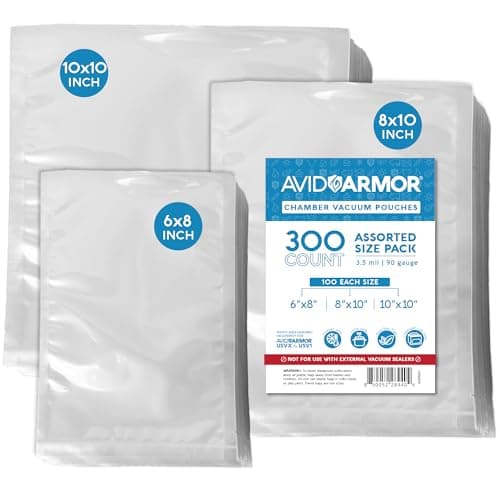
Chamber machines take smooth pouches, not the embossed bags an external sealer needs — and Avid says smooth pouches run cheaper per seal than embossed ones, which is the quiet economic case for a chamber if you seal in volume.
The trade is that smooth pouches only work in a chamber. Avid's own page is explicit that its 3.5 mil pouches will not work in a FoodSaver-style suction sealer. So the pouch stock is not interchangeable, and a household running both machine types ends up buying both kinds. Work it out on your own volume with our bag cost per season page.
Where the real commercial class starts
Above everything here. A genuinely commercial chamber sealer has a seal bar measured in the high teens of inches, a chamber that takes a full case pack, an industrial oil pump with a published service schedule, and usually an NSF listing — and it is priced accordingly, which is why it is out of scope for a site about home processing.
What the three machines above are is chamber sealers, which is the capability most people actually want when they search for a commercial one: sealing wet meat, bloody trim and liquids without pulling juice toward the pump. If that is the goal, read our best chamber vacuum sealers roundup for the home-buyer framing of the same field, and how to vacuum seal wet meat for the technique that makes it work.
One standing caveat from University of Maine Cooperative Extension, which applies to every machine on this page: vacuum packaging slows deterioration but is not a substitute for refrigeration or freezing.
In detail
The picks, in full
1
Closest to commercial
LEM MaxVac Pro Chamber Vacuum Sealer
7.4 /10
The longest, deepest chamber here on LEM's published dimensions, stainless construction, an oil-free pump pulling -0.95 bar, and a two-year warranty - the longest term of the three.
#ad · Price as of November 4, 2026 · Affiliate disclosure for the link to LEM MaxVac Pro Chamber Vacuum Sealer
2
The commercial-design pump
VEVOR DZ-260A Chamber Vacuum Sealer
6.8 /10
The only machine here on an oil pump, which is the design commercial units use: 180 W, 6.5 cubic metres an hour, with VEVOR suggesting an oil change after 800 hours of continuous work.
#ad · Price as of November 4, 2026 · Affiliate disclosure for the link to VEVOR DZ-260A Chamber Vacuum Sealer
3
Best for continuous short runs
Avid Armor USV20 with 500 Pouches
7.6 /10
The only unit whose maker says it can run continuously, asking only a one-minute cool-down between cycles for best results - and it arrives with 500 pouches.
#ad · Price as of November 4, 2026 · Affiliate disclosure for the link to Avid Armor Chamber Pouches, 3.5 mil, 300-Count Assorted
What we judged them on
Duty cycle as published by the maker (weighted highest, and marked neutral where nothing is published rather than inferred); wet-meat handling, which is the whole reason to buy a chamber; bar width and maximum pouch size; pouch cost per season; and build as described by the maker. These are judgments compiled from published specifications, manuals and warranty terms — not test results. We do not run a bench and claim no hands-on testing of any machine here.
We also did not award a point for the word “commercial” appearing in a title. Nothing in these listings backs it with a certification, and saying so is more useful than ranking on it.
How we picked
Every pick, scored on the same published rubric
Each machine here is read end to end: the maker's spec sheet, the owner's manual and the warranty terms. We pull out the figures that decide whether it keeps up with your season — size number, motor rating, rated pounds per minute, capacity, duty cycle, gearing — confirm parts are still available, and score every pick on the same weighted rubric, so a score on one page means the same thing on the next. Then we show the season math, pounds per deer from the Ohio Division of Wildlife's yield study, so you can run it against your own freezer.
In food service, usually an NSF/ANSI listing and an industrial oil pump with a published service schedule. None of the chamber sealers in this price class carries an NSF listing in its copy, so the word in a marketplace title is marketing rather than a standard — check pump type, published duty interval and warranty instead.
Is an oil pump better than a dry pump?+
For daily, all-day use, yes — it is the commercial design and generally pulls deeper vacuum. It also needs oil: VEVOR's manual says to fill before first use, prohibits running the pump dry, and suggests changing the oil after 800 hours of continuous work. For four weekends a year, the oil-free machines avoid the maintenance without losing capability you would use.
Can a chamber sealer run back to back for a whole deer?+
Avid Armor is the only maker here that publishes an answer: the USV20 can run continuously, with a one-minute cool-down between cycles advised for best results. LEM and VEVOR publish no rest interval for their chamber machines, so work those conservatively.
What size bags do commercial chamber sealers take?+
All three machines here cap out around 11 inches of seal width — the LEM at 11.42 in., the Avid at 11.5 in. and the VEVOR at 10.2 in. A whole backstrap has to be cut down, which is why many heavy-season processors keep an external sealer that takes a 15-inch bag alongside the chamber.
Are chamber pouches cheaper than vacuum sealer bags?+
Avid Armor says its smooth chamber pouches run cheaper per seal than embossed bags. The catch is that smooth pouches only work in a chamber machine — Avid's own page says they cannot be evacuated by a FoodSaver-style suction sealer.
Specs come from the maker's own pages, manuals and maker-supplied listing copy (labeled as such); food-safety figures from USDA and university extension publications; yield from the Ohio Division of Wildlife; prices live from Amazon. Where a figure isn't published, we say so. Read the full method.