Vacuum Sealers ◆ Guide
Avid Armor USV20 Review: The Chamber Sealer Built Around Wet Meat
A dry-pump chamber machine at roughly a third of commercial chamber money. It seals bloody trim without a thought, on pouches that cost less than embossed bags — and it caps out at an 11 by 10 inch pouch, which decides whether it fits your season.
We earn a commission if you buy through our links, at no extra cost to you. It never decides the ranking — the method is published · Affiliate disclosure
The Avid Armor USV20 is the machine we point hunters at when they tell us their suction sealer keeps pulling blood into the seal. It is a chamber sealer — the bag sits inside a chamber and the whole chamber is evacuated, so nothing is being sucked toward a port — in a case small enough to live on a kitchen counter, with a dry pump that has no oil to change. It is also the #1 pick on our best chamber vacuum sealers roundup, and this page is the long version of why, including the two things about it we would change.
What the USV20 actually is
Chamber sealers used to mean a 60 lb commercial box with an oil pump that needed servicing. The USV20 is the category of machine that appeared when makers shrank that idea for households: a 12.25 by 8.5 by 3 inch chamber under a clear lid, an 11.5 inch seal bar, and a dry double-piston pump with no oil to change.
That dry pump is the single most important thing about it for a home user. An oil pump pulls a deeper vacuum and lasts longer under commercial duty, and it also means checking a sight glass and changing oil on a schedule. Avid Armor publishes a separate guide for its oil-pump machines precisely because that is a maintenance routine. The USV20 has no such routine. For a machine that runs hard for two weekends in November and sits the rest of the year, no-maintenance is worth more than a deeper pull.
If you are still deciding between a chamber and an external sealer at all, that argument is its own page: chamber vs external vacuum sealer. This review assumes you have already decided on a chamber.
The specs that decide it
| Spec | Avid Armor's figure | What it means for you |
|---|---|---|
| Chamber | 12.25 x 8.5 x 3 in. | Three inches of depth is the real constraint: tall, bulky packages do not fit |
| Seal bar | 11.5 in. | Wide enough for a one to two pound package laid flat, not for a long cut |
| Maximum pouch | 11 x 10 in. | Hard ceiling. Backstraps and loins get portioned rather than sealed whole |
| Pump | Dry double-piston, no oil | Nothing to service between seasons |
| Vacuum time | Adjustable 15-60 s | Short cycles for dry packages, long ones for liquid |
| Seal time | Adjustable 3-9 s | Lets you dial in a thicker pouch instead of hoping |
| Marinate cycle | Included | Pulls and releases vacuum to drive marinade into meat |
| Between cycles | Can run continuously; manual advises a 1-minute cool-down for best results | The figure that sets your real throughput, covered below |
| Warranty | 1 year, excluding seal tape, seal bar and gaskets | The wear parts are the excluded parts |
Sources: Avid Armor USV20 product page and the USV20 user manual.
The two adjustable timers are more useful than the spec sheet makes them sound. On an external sealer you get one automatic cycle and a "pulse" button to interrupt it. Here you set the vacuum to 15 seconds for dry burger and 45 or more for a pouch with liquid in it, set the seal to suit the pouch thickness, and then stop thinking about it for the rest of the session.
Why it handles bloody trim without a fight
This is the whole reason to own one. A suction sealer evacuates the bag through its open mouth, so any liquid in the package travels toward the seal bar and the pump. Juice in the seal means a weak seal; juice in the pump means a repair. The standard workaround is to pre-freeze packages on a tray for an hour before sealing, which works and costs you an hour and a tray.
A chamber machine evacuates the air around the bag instead. The liquid has nowhere to migrate to, because there is no pressure differential pulling it toward an opening. Bloody trim, brines, marinades and soups all seal cold and straight off the cutting board. Our how to vacuum seal wet meat page covers the workarounds for people who are sticking with an external machine; the USV20 makes most of them unnecessary.
One thing a chamber does not fix: warm meat. Seal it cold. Vacuum lowers the boiling point inside the chamber, and a warm, wet package can bubble during a long vacuum cycle — which looks alarming and is really just physics telling you to chill the meat first.
Cycle time and the cool-down rule
Avid Armor's manual says the USV20 can be run continuously, and then advises a one-minute cool-down between cycles for best results. Those two statements sit together awkwardly, and we read them the conservative way: plan around the one minute. It is the difference between a machine that keeps up with a butchering session and one that sets the pace of it.
At the manual's factory defaults — 20 seconds of vacuum plus 4 seconds of seal, so 24 seconds a cycle — the sealing itself is fast. The waiting is not.
What one deer actually takes
That is the honest ceiling on this machine, and it is why our 6+ deer setup treats a chamber sealer as a deliberate choice rather than an upgrade: you are buying wet-meat capability and cheaper pouches, not speed. If raw throughput across a long session is the problem you are solving, read best vacuum sealers for heavy use, where the comparison is against machines that publish consecutive-seal figures.
The practical workaround most people land on is to seal in blocks: cut and package a batch, run the sealer through it while you break down the next primal, and let the gaps between cycles happen naturally instead of standing over the machine.
Pouch sizes and what pouches actually cost
Chamber machines take smooth pouches rather than the embossed, channeled bags an external sealer needs. The embossing is what gives a suction machine somewhere for air to travel; a chamber does not need it, and smooth pouches are cheaper to make. Avid Armor sells its own in a 300-count assorted pack — 100 each at 6 x 10, 8 x 10 and 11 x 10 inches, in 3.5 mil.
The assorted pack is the right first purchase even though a single size looks cheaper per pouch, because package sizes genuinely vary: burger and stew meat in the 6 x 10, steaks and chops in the 8 x 10, roasts and double packages in the 11 x 10. Putting a one-pound package in an oversized pouch wastes more material than buying three sizes does.
We keep a live per-package cost table — pouches against rolls, chamber against external, priced off whatever the current retail price is rather than a number we typed — on vacuum sealer bag cost per season. That page, not this one, is where to settle whether the pouch savings pay back the machine. The short version: the gap per package is small, and it only turns into real money across several deer a year.
The ceiling: 11 by 10 inches
Here is the specification that disqualifies the USV20 for some people, stated plainly: the largest pouch it takes is 11 by 10 inches, inside a chamber only three inches deep. A whole venison backstrap does not fit. A whole beef tenderloin does not fit. A spatchcocked bird does not fit.
If you portion everything into one and two pound packages anyway — which most people processing for a chest freezer do, because that is how you actually cook it — the ceiling never comes up. If part of why you seal is to store long cuts whole, this is the wrong machine and the honest alternative is an external sealer with a wider bar. The Weston Pro-2300 in our catalog takes 15 inch bags, and the trade you make is going back to pre-freezing wet packages. We put the two side by side in Avid Armor vs FoodSaver and in best vacuum sealers for wild game.
The warranty, and what it leaves out
The USV20 manual states a one-year warranty that excludes seal tape, the seal bar and the gaskets. Read that twice, because on a chamber sealer those three items are the parts that wear. The lid gasket takes a vacuum cycle every time; the seal bar and its tape take the heat.
We are not calling it a bad warranty — consumables being excluded is normal across the category, and the parts are inexpensive and user-replaceable. But a one-year term is short next to the LEM MaxVac Pro's two years, and it is a fair point against the machine in a review that is supposed to tell you the downsides. Treat gaskets and seal tape as scheduled spares, the same way you treat grinder knives and plates.
Standalone, or the 500-pouch bundle
Avid Armor sells the same machine bundled with 500 pre-cut pouches — 250 at 11 x 10 and 250 at 6 x 8 inches. At 52 one-pound packages per deer, 500 pouches is well over eight deer of packaging, so for most households the bundle is several seasons of supply bought up front.
Our read: take the bundle if you are starting from nothing, because you will buy pouches anyway and the two sizes cover most of what comes off a deer. Take the standalone machine if you already have chamber pouches, or if you would rather buy the 300-count assorted pack and get the 8 x 10 middle size the bundle skips. Both are the identical sealer — same chamber, same bar, same pump — so this is purely a question of how you want to buy consumables.
Picks for this job
The USV20, the bundle, and the pouches
Prices come from our daily refresh against the live listing; a button with no price means Amazon is not publishing one right now.
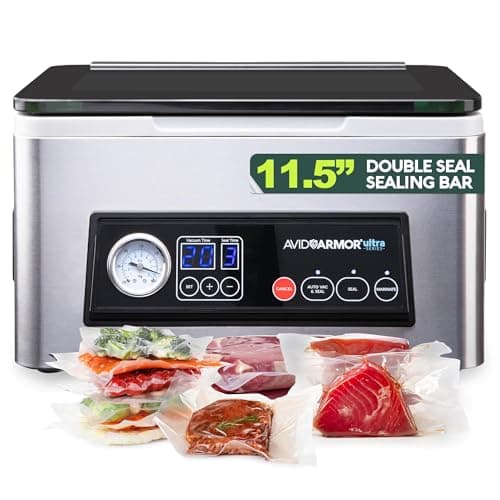
Best for wet meat
Avid Armor USV20 Chamber Vacuum Sealer
The machine on its own. Right call if you already keep chamber pouches on the shelf.
$319.00Amazon#ad · Price as of November 4, 2026 · Affiliate disclosure for the link to Avid Armor USV20 Chamber Vacuum Sealer
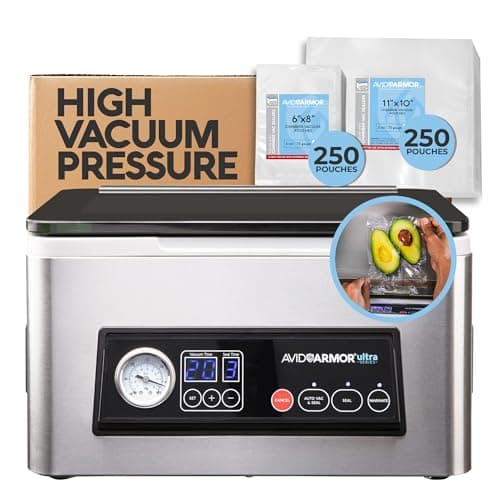
Best chamber starter bundle
Avid Armor USV20 with 500 Pouches
Same sealer with 500 pouches in two sizes — several seasons of packaging if you are starting from scratch.
Check price · Amazon#ad · Price as of November 4, 2026 · Affiliate disclosure for the link to Avid Armor USV20 with 500 Pouches
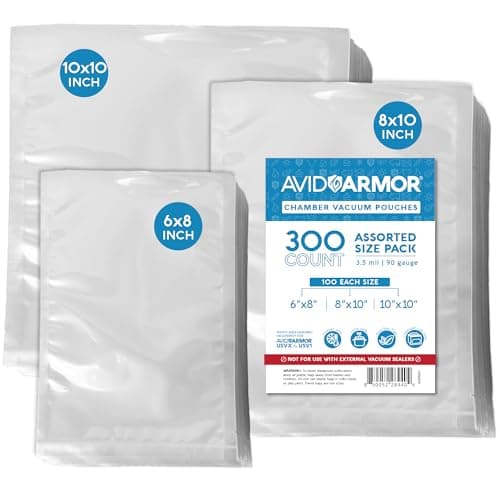
Best for chamber sealers
Avid Armor Chamber Pouches, 3.5 mil, 300-Count Assorted
The 300-count assorted pack: 100 each at 6 x 10, 8 x 10 and 11 x 10 in. The size spread the bundle leaves out.
Check price · Amazon#ad · Price as of November 4, 2026 · Affiliate disclosure for the link to Avid Armor Chamber Pouches, 3.5 mil, 300-Count Assorted
Who should buy it
Buy the USV20 if you process one to six deer a year or split bulk beef, you package in one and two pound portions, and wet meat is the thing that has been going wrong. It is the least fussy way into a chamber: nothing to oil, two dials to set, and pouches that cost less per package than embossed bags.
Skip it if any of three things are true. You seal long cuts whole, and the 11 by 10 inch ceiling is a non-starter. You are sealing a very heavy season against the clock, where the advised one-minute cool-down between cycles sets a pace you cannot live with. Or you already own an external sealer that works fine for dry packages and you only occasionally deal with liquid, in which case the pre-freeze trick is cheaper than a second machine.
For the full field — including the LEM MaxVac Pro's deeper stainless chamber and the cheapest oil-pump route into a chamber — see best chamber vacuum sealers. For how long the packages you seal will actually keep, see how long vacuum-sealed meat lasts.
Questions
Frequently asked
Is the Avid Armor USV20 worth it?
Does the Avid Armor USV20 need oil?
What size bags does the USV20 take?
How long does it take to seal a deer with the USV20?
Can the USV20 seal a whole backstrap?
Avid Armor USV20 or the 500-pouch bundle?
Keep going down the chain
Related
Receipts
Sources
- Ohio Department of Natural Resources, Division of Wildlife — Venison Meat Yield (115 deer, 2017 gun season) [PDF]
- Avid Armor — USV20 Chamber Vacuum Sealer product page
- Avid Armor Ultra Series USV20 user manual (PDF linked from Avid Armor's help center)
- Amazon listing, manufacturer-supplied copy — Avid Armor USV20
- Amazon listing, manufacturer-supplied copy — Avid Armor USV20 + 500 pouches bundle
- Avid Armor — USV20 Chamber Vacuum Pouches, 300-count assorted (product page)
- Amazon listing, manufacturer-supplied copy — Avid Armor chamber pouches, 300-count assorted
- Avid Armor — Oil Chamber Vacuum Sealer Tips & Tricks (Guide Series GS41 / GS53)
- USDA Food Safety and Inspection Service — Freezing and Food Safety (includes the 0 °F freezer storage chart)
Specs come from the maker's own pages, manuals and maker-supplied listing copy (labeled as such); food-safety figures from USDA and university extension publications; yield from the Ohio Division of Wildlife; prices live from Amazon. Where a figure isn't published, we say so. Read the full method.