Vacuum Sealers ◆ Guide
How Long Vacuum-Sealed Deer Meat Lasts in the Freezer
Safe and good are two different clocks. USDA's freezer chart gives the second one by cut; sealer makers print longer numbers. Here's how to read both.
We earn a commission if you buy through our links, at no extra cost to you. It never decides the ranking — the method is published · Affiliate disclosure
Kept at a steady 0°F, vacuum-sealed deer meat is safe indefinitely; USDA's freezer times are for quality only. For quality, USDA's chart lists uncooked wild game at 8 to 12 months, uncooked steaks, chops and roasts at 4 to 12 months, and uncooked ground meat at 3 to 4 months. Vacuum sealing doesn't change the safety rule. What it does is keep air off the meat, and air is what causes freezer burn.
USDA freezer times by cut
These are from the freezer storage chart at the end of USDA's Freezing and Food Safety fact sheet, which is headed "Freezer storage is for quality only. Frozen foods remain safe indefinitely." Where the HHS-run FoodSafety.gov cold storage chart gives a different range, we show it.
| Item (at 0°F) | USDA FSIS quality time | FoodSafety.gov chart |
|---|---|---|
| Wild game, uncooked | 8 to 12 months | Not listed separately |
| Steaks or chops, uncooked | 4 to 12 months | 4 to 12 months (fresh beef, veal, lamb, pork) |
| Roasts, uncooked | 4 to 12 months | 4 to 12 months |
| Ground meat, uncooked | 3 to 4 months | 3 to 4 months |
| Bacon and sausage | 1 to 2 months | Raw sausage 1 to 2 months; bacon 1 month |
| Cooked meat | 2 to 3 months | Cooked meat leftovers 2 to 6 months |
| Soups and stews | 2 to 3 months | 2 to 3 months |
USDA doesn't split ground venison out from "wild game, uncooked," so a package of ground deer sits under two rows: 8 to 12 months for wild game, 3 to 4 months for ground meat. We plan ground venison on the shorter clock and eat it first. That's our call, not USDA's; it's the conservative reading of their chart.
Safe vs good: two different clocks
FSIS is unambiguous on safety: food stored constantly at 0°F will always be safe, and only the quality suffers with lengthy storage. Freezing to 0°F inactivates bacteria, yeasts and molds; it doesn't kill them. Once the meat thaws, they become active again and grow at about the same rate as on fresh food, so a thawed package is handled like any fresh perishable.
One exception worth knowing for game: FSIS says home freezing cannot be relied on to destroy trichina and other parasites, because the sub-zero conditions that do it require strict government-supervised control. Thorough cooking destroys all parasites. If you process any game that can carry them, the freezer is not the safeguard; the cooking is.
Quality is where time matters. FSIS says to check the odor after thawing and discard food that has developed a rancid or off odor, and that some long-frozen foods won't look perfect but may still be fine for soups or stews.
What vacuum sealing actually changes
Freezer burn is the quality problem sealing addresses. FSIS describes it as grayish-brown leathery spots caused by air contacting the surface of the food, and says it does not make food unsafe, merely dry in spots; cut the burned areas away before or after cooking. Proper packaging helps prevent it. FSIS's packaging advice is to overwrap store packaging for long storage, and to freeze unopened vacuum packages as is. A tight vacuum seal is the same idea taken further: no air pocket against the meat.
The corollary: a sealed package is only as good as its seal. A pinhole from a bone, or a seal made through a film of blood, lets air back in, and that package is on the same clock as a poorly wrapped one. That's why the bag and the seal matter as much as the machine; see how to vacuum seal wet meat for getting clean seals on processing day.
What sealer makers claim, and how to read it
Sealer makers print much longer numbers. An earlier edition of FoodSaver's V4400 manual lists beef, pork and lamb in a FoodSaver bag in the freezer at 2-3 years and ground meat at 1 year, and the V4400's listing says meat can last up to 3 years. The current owner's manual is more careful: it says it's difficult to predict how long food keeps its top quality, because that depends on the food's age and condition on the day it was sealed. Weston's Pro-2300 manual lists large cuts of meat at 6 months normally versus 2-3 years vacuum packed, and ground meat at 4 months versus 1 year. Weston's own chart carries the line "Only use information in the following chart as a guideline."
These are the makers' quality claims, not USDA figures, and USDA doesn't publish a separate vacuum-sealed column. Our approach: plan the season around USDA's quality windows, and treat a sealed, never-thawed package past them as a quality check at thaw time, not a safety question. At 0°F it was safe the whole time.
Vacuum-sealed meat in the refrigerator
This is where sealing doesn't buy much time. The FoodSafety.gov chart gives raw ground meat 1 to 2 days in the refrigerator, raw steaks, chops and roasts 3 to 5 days, and raw sausage 1 to 2 days, at 40°F or below. There's no longer vacuum-sealed column there either, and every sealer manual we read says vacuum packaging is not a substitute for refrigeration or freezing. FoodSaver's adds that anaerobic bacteria such as Clostridium botulinum can grow without air and sometimes can't be detected by smell or taste.
What keeps a package good for the full window
- A freezer that actually holds 0°F. FSIS recommends a free-standing freezer set at 0°F or below for long-term storage, with an appliance thermometer inside to check it. A refrigerator's freezer compartment that can't hold zero, or gets opened constantly, is for short-term storage.
- Fast freezing. FSIS says rapid freezing prevents large ice crystals that make meat "drip" and lose juiciness on thawing. Freeze new packages in a single layer and stack them only once frozen solid; a food 2 inches thick should freeze completely in about 2 hours.
- Sound seals and padded bones. Check every seal before it goes in the freezer; pad sharp bone edges or double-bag, as the Avid Armor and FoodSaver manuals advise.
- Dates on every package. The chart only helps if you know how old the package is.
- Room to spread out. At the Ohio DNR average of 52.19 lb of venison per deer, one deer takes roughly 2.1-2.6 cubic feet at realistic packing (Good Meat Project, 20-25 lb per cubic foot). The full math is in how much freezer space a deer takes.
Picks for this job
A sealer and a roll that cover a season
A sealer with a published long-run rating, and a roll you can cut to fit each cut so there's no air pocket to start freezer burn.
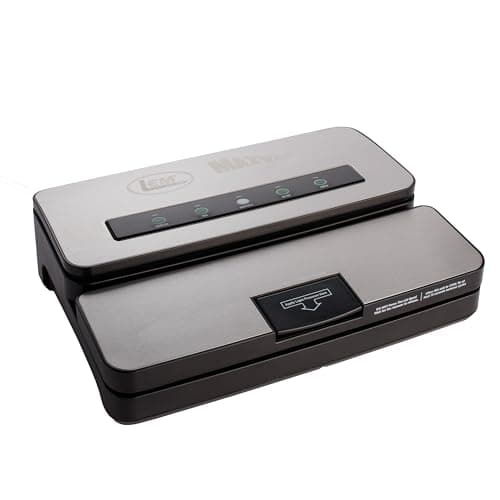
Best for 3-5 deer
LEM MaxVac 250 Vacuum Sealer
LEM rates it for 250+ consecutive seals, about five deer of one-pound packages in one run.
$219.99Amazon#ad · Price as of Sep 19, 2026 · Affiliate disclosure for the link to LEM MaxVac 250 Vacuum Sealer
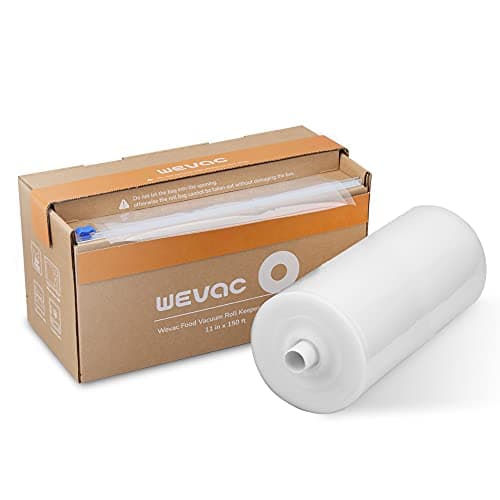
Best roll for external sealers
Wevac Vacuum Sealer Roll, 11 in. x 150 ft
About 150 twelve-inch bags from one embossed roll, cut to the length each cut needs.
$31.99Amazon#ad · Price as of Sep 19, 2026 · Affiliate disclosure for the link to Wevac Vacuum Sealer Roll, 11 in. x 150 ft
Thawing and refreezing
FSIS lists three safe ways to thaw: in the refrigerator (small items overnight, most foods a day or two), in cold water in a leak-proof bag with the water changed every 30 minutes and the food cooked immediately after, or in the microwave, again cooking immediately. An intact vacuum bag is a leak-proof bag, which makes the cold-water method easy. Never thaw on the counter, in the garage or outdoors.
Meat thawed in the refrigerator can be refrozen without cooking, though it loses some quality from the moisture lost in thawing. Cooked meat made from previously frozen raw meat can be frozen again. Don't refreeze anything that has been out of the refrigerator longer than 2 hours, or 1 hour above 90°F.
If the power goes out
FSIS says a full freezer will usually keep food about 2 days with the door shut, a half-full one about a day. If food still has ice crystals or is at 40°F or colder when the power returns, it's safe to refreeze or use; discard anything that's been above 40°F for more than 2 hours. A full chest freezer is also the most forgiving one, which is one more reason to size it to your season; see our best chest freezers for meat.
Questions
Frequently asked
How long does vacuum-sealed deer meat last in the freezer?
Is two-year-old vacuum-sealed venison safe to eat?
How long does vacuum-sealed meat last in the fridge?
Is freezer-burned venison safe?
Can I refreeze vacuum-sealed meat after thawing it?
Keep going down the chain
Related
- How much freezer space a deer takesCubic feet per deer, from the yield data.
- How to package deer meat for the freezerPortions, wraps and labels.
- How to vacuum seal wet meatClean seals are what make the freezer times hold.
- Best chest freezers for meatFreezers sized to your season.
- Freezer paper vs vacuum sealingHow the two wraps compare for long storage.
Receipts
Sources
- USDA Food Safety and Inspection Service — Freezing and Food Safety (includes the 0 °F freezer storage chart)
- FoodSafety.gov (U.S. Department of Health & Human Services) — Cold Food Storage Chart
- FoodSaver V4400 Series owner's manual (Sunbeam / Newell Brands PDF)
- FoodSaver V4400 series User Manual & Recipe Book (earlier edition, PDF hosted on Amazon)
- Amazon listing, manufacturer-supplied copy — FoodSaver V4400
- Weston Pro-2100 / Pro-2300 owner's manual (models 65-0101 / 65-0201), PDF hosted on Amazon — the most recent Pro-2300 manual we could fetch
- Avid Armor Ultra Series USV20 user manual (PDF linked from Avid Armor's help center)
- NESCO VS-12 Deluxe Vacuum Sealer Care/Use Guide (PDF)
- Ohio Department of Natural Resources, Division of Wildlife — Venison Meat Yield (115 deer, 2017 gun season) [PDF]
- Good Meat Project — Freezer Space (pounds of meat per cubic foot)
We haven't bench-tested this gear and we don't pretend to. Specs come from the maker's own pages, manuals and maker-supplied listing copy (labeled as such); food-safety figures from USDA and university extension publications; yield from the Ohio Division of Wildlife; prices live from Amazon. Where a figure isn't published, we say so. Read the full method.