Freezers & Storage ◆ Guide
How Much Freezer Space Does a Deer Take? The Math, Deer by Deer
One published yield figure, one published packing range, and a division you can redo for your own deer. Then a second number that matters as much: how fast a freezer can actually freeze what you bring home.
We earn a commission if you buy through our links, at no extra cost to you. It never decides the ranking — the method is published · Affiliate disclosure
One average deer needs about 2.1-2.6 cubic feet of freezer space. That is the Ohio DNR's 52.19 lb average venison yield divided by the Good Meat Project's realistic 20-25 lb of meat per cubic foot. Two deer need 4.2-5.2 cu ft, so a 5 cu ft chest is already full. Three need 6.3-7.9, five need 10.4-13.1 and six need 12.5-15.7. Your deer may differ, and the steps below let you redo the math for yours.
This is arithmetic from two published sources, not a measurement of our own freezer. We show every step so you can swap in your own numbers: your deer's weight, your packaging, your freezer.
Step 1: How much meat comes out of a deer
The best public number we have found comes from the Ohio Division of Wildlife. For the 2017 gun season, wildlife staff recorded the field-dressed weight of 115 deer, butchered each one and weighed the venison. Their Venison Meat Yield report gives the averages:
| Ohio DNR sample | Average field-dressed weight | Average meat yield | Yield |
|---|---|---|---|
| Antlered (bucks) | 129.69 lb | 62.51 lb | 48.20% |
| Antlerless (does and button bucks) | 92.27 lb | 45.05 lb | 48.83% |
| All 115 deer | 107.56 lb | 52.19 lb | 48.52% |
The report is clear about what moves the number. Shot placement is a big one: a shot behind the shoulder blade leaves more meat than one through it, which can badly cut the front-quarter yield. How much effort and skill go into the butchering matter too. So 52.19 lb is a planning average for Ohio whitetails, not a promise. If you know your deer run bigger or smaller, use your number in Step 3. The full yield breakdown is in how much meat you get from a deer.
Step 2: How many pounds fit in a cubic foot
This is the number where published figures disagree most. The Good Meat Project says one impeccably organized cubic foot would hold about 30 lb of meat, then says 20 to 25 lb is more likely, depending on how well you organize frozen roasts and awkward packages of bones. Meat does not come in standard shapes.
Sources disagree here, and you should know that. The University of Maine's freezer-beef bulletin works from about 35-40 lb per cubic foot for boxed beef. That is the right figure for neatly cut, boneless, flat packages. It is the wrong one for a deer that comes home as a pile of roasts, steaks, trim bags and a few bone-in cuts. We plan on the Good Meat Project's realistic 20-25 lb, never the perfect-pack figure, because a freezer that turns out to be too big costs you a little floor space, while one that turns out too small costs you a deer.
Your packaging moves you around inside that range. Flat, vacuum-sealed 1 lb packs of ground meat stack tight. Rolled roasts and bone-in shanks leave gaps. The National Center for Home Food Preservation says to remove as many bones as possible before freezing because they take up freezer space.
Step 3: Divide
To run it for your own deer, weigh the finished packages from one deer (or use your processor's take-home weight), then divide by 25 and by 20. The two answers bracket what that deer will take.
Freezer space for 1 to 6 deer
The same division for a season, at the Ohio DNR average. "Fits alone" means the smallest common chest size that holds that many deer with nothing else in it.
| Deer | Venison at the Ohio average | At 25 lb/cu ft | At 20 lb/cu ft | Fits alone in |
|---|---|---|---|---|
| 1 | 52 lb | 2.1 cu ft | 2.6 cu ft | 5 cu ft chest |
| 2 | 104 lb | 4.2 cu ft | 5.2 cu ft | 7 cu ft (a 5 is full) |
| 3 | 157 lb | 6.3 cu ft | 7.9 cu ft | 8.6-10 cu ft |
| 4 | 209 lb | 8.4 cu ft | 10.5 cu ft | 10-12 cu ft |
| 5 | 261 lb | 10.4 cu ft | 13.1 cu ft | 12-14 cu ft |
| 6 | 313 lb | 12.5 cu ft | 15.7 cu ft | 14-16.2 cu ft |
The pattern that matters: a season adds roughly 2.1-2.6 cu ft per deer, so the step from a 7 to a 14 cu ft chest is the step from a two-deer season to a five-or-six-deer season. That lines up with the season tiers we use across the site: 1-2 deer is a light season, 3-5 moderate, 6 or more heavy. The 1-2 deer setup and the 3-5 deer setup build the rest of the kit around those freezer sizes.
Bucks, does and your deer
Ohio's antlered deer averaged 62.51 lb of venison; antlerless deer 45.05 lb. Run the same division:
If you hunt a region with bigger-bodied deer than Ohio, or you trim hard and keep only clean muscle, your numbers will move. That is the point of showing the steps: swap in your own weight and the answer follows.
Already own a freezer? Here it is in deer
Run the division backward and you can read any freezer's capacity in deer. Rated cubic feet × 20-25 lb gives pounds; divide by the Ohio average for the herd you actually shoot. This is venison only, with nothing else in the freezer.
| Freezer size | Venison it holds | Average deer (52.19 lb) | Bucks (62.51 lb) | Does (45.05 lb) |
|---|---|---|---|---|
| 5 cu ft | 100-125 lb | 1.9-2.4 | 1.6-2 | 2.2-2.8 |
| 7 cu ft | 140-175 lb | 2.7-3.4 | 2.2-2.8 | 3.1-3.9 |
| 10 cu ft | 200-250 lb | 3.8-4.8 | 3.2-4 | 4.4-5.5 |
| 12 cu ft | 240-300 lb | 4.6-5.7 | 3.8-4.8 | 5.3-6.7 |
| 14 cu ft | 280-350 lb | 5.4-6.7 | 4.5-5.6 | 6.2-7.8 |
| 16.2 cu ft | 324-405 lb | 6.2-7.8 | 5.2-6.5 | 7.2-9 |
The buck and doe columns are why two hunters with the same freezer argue about whether it's big enough. A doe hunter fits three or nearly four deer in a 7 cu ft chest; a buck hunter fits a little over two.
How fast a freezer can freeze a deer
Here is a second number that matters as much as storage space. A freezer's storage capacity is not its freezing capacity. NDSU Extension says not to overload a freezer with unfrozen food: add only what will freeze within 24 hours, usually 2 or 3 lb per cubic foot of storage space, because food that freezes too slowly loses quality.
This is a quality guideline, not a safety line, but it changes how you work. Three practical fixes, all from the agency guidance:
- Pre-chill. NDSU suggests setting the freezer to -10°F about 24 hours before a big load.
- Freeze flat, then stack. The USDA says a 2-inch-thick package should freeze completely in about two hours, and to spread new packages in one layer and stack them only after they are frozen solid. NDSU says to put them against the freezing plates or coils with space between them, then pack them close once frozen.
- Process in batches. Wrap and freeze a day's worth, not the whole deer, when the freezer is small.
It is also the quiet argument for buying one size up. A 14 cu ft chest can take a deer in a day or two; a 5 cu ft chest needs most of a week.
What the table leaves out
- Everything else in the freezer. The table assumes venison only. If the same chest holds groceries, the turkey and ice for the cooler, count that space first.
- Carryover. Last season's roasts are still in there. USDA's chart gives uncooked wild game 8-12 months at 0°F for best quality and ground meat 3-4 months, so a freezer that is still half full in October has a rotation problem, not a size problem.
- Uprights. The Good Meat Project says an upright holds slightly less than a chest of the same size. It doesn't put a number on "slightly," so plan on the low end of the range.
- Beef. A side of beef is a different animal in every sense; the numbers are in freezer size for half a cow.
- Packaging. Loose store wrap and odd bundles pull you toward 20 lb per cubic foot. Flat vacuum packs push you toward 25. The National Center for Home Food Preservation also says to package in meal-size portions, which keeps each package small, flat and easy to stack.
Before any of it: check your state's carcass-transport and CWD rules if you are bringing a deer home from another state or zone. Rules on moving carcasses and parts vary by state, and they can decide whether you debone in the field before any of this math applies.
Freezers sized for each season
With the numbers in hand, here are three chest freezers that line up with the tiers, each chosen from the maker's published capacity. Full rankings and every alternative are in the best chest freezers for meat.
Picks for this job
Freezers sized to your season
Capacity at 20-25 lb per cubic foot against the Ohio DNR average of 52.19 lb per deer.
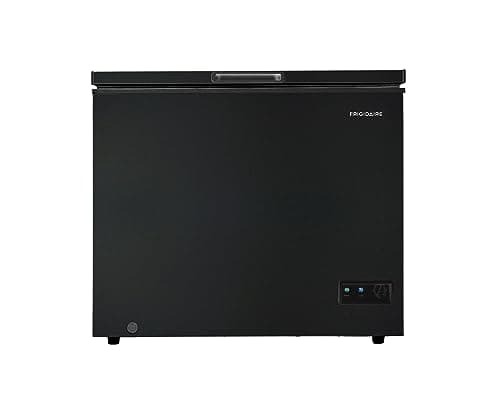
Best for 1-2 deer
Frigidaire EFRF7003 7.0 Cu. Ft. Chest Freezer
1-2 deer: holds about 140-175 lb, so two average deer (104 lb) fit with room to spare.
$381.78Amazon#ad · Price as of Sep 19, 2026 · Affiliate disclosure for the link to Frigidaire EFRF7003 7.0 Cu. Ft. Chest Freezer
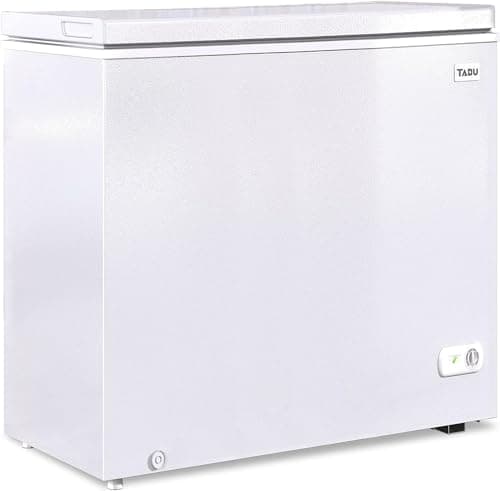
Best for 3-5 deer on a budget
TABU 12.0 Cu. Ft. Chest Freezer
3-5 deer on a budget: about 240-300 lb, or 4.6-5.7 average deer. No published energy figure.
$429.99Amazon#ad · Price as of Sep 19, 2026 · Affiliate disclosure for the link to TABU 12.0 Cu. Ft. Chest Freezer
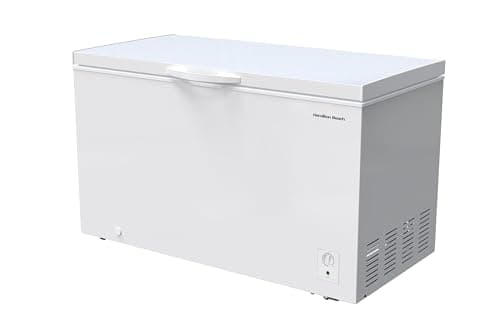
Best for 5-6 deer
Hamilton Beach 14 Cu. Ft. Chest Freezer (HBFRF1497)
5-6 deer, garage-rated 0°F to 110°F: about 280-350 lb, or 5.4-6.7 average deer.
$743.66Amazon#ad · Price as of Sep 19, 2026 · Affiliate disclosure for the link to Hamilton Beach 14 Cu. Ft. Chest Freezer (HBFRF1497)
The same yield math sizes the rest of the kit. Our guide to meat grinder sizes runs the Ohio DNR average through grinder throughput, so the grinder and the freezer end up matched to the same season.
Questions
Frequently asked
How much freezer space do I need for a whole deer?
How much freezer space do I need for 2 deer?
How many deer fit in a 7 cubic foot freezer?
Can I freeze a whole deer at once?
How many pounds of meat per cubic foot of freezer?
Keep going down the chain
Related
- How much meat from a deerThe Ohio DNR yield data in full
- Best chest freezers for meatSeven chests ranked by the deer they hold
- Best small chest freezers5-7 cu ft for one or two deer
- Meat grinder sizes explainedThe same yield math, applied to grinders
- Setup for 1-2 deerThe light-season kit
- Setup for 3-5 deerThe moderate-season kit
Receipts
Sources
- Ohio Department of Natural Resources, Division of Wildlife — Venison Meat Yield (115 deer, 2017 gun season) [PDF]
- Good Meat Project — Freezer Space (pounds of meat per cubic foot)
- NDSU Extension (FN614) — Food Freezing Basics: Packaging, Loading the Freezer and Refreezing
- USDA Food Safety and Inspection Service — Freezing and Food Safety
- National Center for Home Food Preservation (University of Georgia) — Freezing Meats
- University of Maine Cooperative Extension, Bulletin #1071 — What To Expect When Buying A Freezer Beef
We haven't bench-tested this gear and we don't pretend to. Specs come from the maker's own pages, manuals and maker-supplied listing copy (labeled as such); food-safety figures from USDA and university extension publications; yield from the Ohio Division of Wildlife; prices live from Amazon. Where a figure isn't published, we say so. Read the full method.