Freezers & Storage ◆ Guide
What Size Freezer for Half a Cow? Sizing From the Hanging Weight
A state extension bulletin takes a steer from the hoof to boxed cuts. Run its take-home weight through a realistic packing range and you get a freezer size you won't regret on delivery day.
We earn a commission if you buy through our links, at no extra cost to you. It never decides the ranking — the method is published · Affiliate disclosure
Plan on 11.2-14 cubic feet for a half beef. University of Maine Extension's worked example, a 1,200 lb grass-fed steer, ends at 560 lb of boneless cuts for the whole animal, or 280 lb for a half. At the Good Meat Project's realistic 20-25 lb per cubic foot, 280 lb needs 11.2-14 cu ft. UMaine's own denser packing figure puts it at 8 cu ft, so treat 8 as the floor and 14 as the safe buy.
We don't estimate beef yields. Every weight below comes from the University of Maine bulletin or the Good Meat Project, both linked, and the arithmetic is shown so you can rerun it with the hanging weight your farmer quotes you.
From the hoof to the box
UMaine Extension Bulletin #1071 walks one steer through every weight you'll hear on the phone with a farmer. Live weight is the animal on the hoof. Hanging weight (hot carcass weight) is the freshly slaughtered carcass. Cold carcass weight is what's left after the carcass cools and ages. Boneless cuts are what goes in your freezer.
That 46.5% is worth sitting with. Less than half the animal comes home, and the hanging weight you pay on is not the weight you store. The same chain, with more on cuts and cost, is in how much meat you get from a half cow.
Quarter, half and whole: the freezer table
| Share (UMaine example) | Boneless take-home | UMaine's figure (35-40 lb/cu ft) | At 25 lb/cu ft | At 20 lb/cu ft |
|---|---|---|---|---|
| Quarter | 140 lb | 4 cu ft | 5.6 cu ft | 7 cu ft |
| Half | 280 lb | 8 cu ft | 11.2 cu ft | 14 cu ft |
| Whole | 560 lb | 15 cu ft | 22.4 cu ft | 28 cu ft |
The Good Meat Project gives a smaller quarter: about 75-100 lb of take-home packaged meat in its text, with a chart that shows roughly 75-125 lb and about 4.5 cu ft of chest space. That reflects a smaller animal or a different cut list than UMaine's example, which is exactly why you should ask your farmer for the hanging weight rather than trusting any single chart. Its rule of thumb for a quarter beef, a half hog and ten chickens together is a medium 12-18 cu ft freezer.
Why the two sources disagree on space
UMaine plans on about 35-40 lb per cubic foot; the Good Meat Project says 30 lb is a perfect pack and 20-25 is realistic. Both are describing something real. A butcher who cuts to order and vacuum-packs flat steaks and 1 lb ground-beef bricks can get close to UMaine's number. A share that arrives as big roasts, soup bones and odd-shaped packages won't.
Our advice is to plan on the Good Meat Project range, because the failure modes aren't symmetrical. A freezer with a few spare cubic feet costs you a little floor space. A freezer that is 3 cu ft short on delivery day means a cooler of beef on the porch and a phone call to a neighbor.
Your animal will differ
UMaine's bulletin lists what moves the numbers:
- The national average live weight for finished cattle going to the processor is 1,350 lb, heavier than the example steer.
- Dressing percentages run 58-64% depending on the animal.
- Grass-fed cattle dress out about 5% lower than grain-fed.
- Dairy-genetics animals, such as Holstein crosses, dress 3-5% lower because of their larger bone structure.
- Cull cows often dress at only about 50%.
- Heavy external fat that has to be trimmed lowers the boneless yield further.
So get the hanging weight for your share, then run UMaine's chain: divide by 1.04 for cooler shrink, divide by 1.175 for bone, and divide by 25 and by 20 for the freezer range. A bigger grain-fed steer will push you toward the top of the range, or past it.
Five questions to ask before the beef arrives
- What is the hanging weight of my share, and am I paying on hanging or take-home weight? Hanging weight is where the whole calculation starts, and the two weights are very different numbers.
- Bone-in or boneless? UMaine counts 15-20% of the cold carcass as bone. Bone-in cuts take more space per pound, and the National Center for Home Food Preservation notes that bones take up freezer space.
- How much will be ground? Ground beef packs flat and tight, but the USDA chart gives uncooked ground meat only 3-4 months of best quality at 0°F, against 4-12 months for roasts and steaks.
- How is it packaged? Flat vacuum packs push you toward UMaine's denser figure; paper-wrapped roasts toward the Good Meat Project's.
- Will it be frozen at pickup? If not, your freezer has to freeze it, which takes days (see below).
A half beef plus a deer season
This is the case most of our readers are actually in: the beef share arrives in October, and so does deer season.
That is more than any single chest we list (the largest is 16.2 cu ft). Plan on two freezers, or a chest in the Good Meat Project's "large" 18-25 cu ft class. The venison side of the math, deer by deer, is in how much freezer space a deer takes, and the full heavy-season kit is in the setup for 6+ deer.
Delivery day: frozen or fresh?
The Good Meat Project says having the butcher freeze your bulk meat is the ideal option, because their walk-in freezers work like blast chillers with lots of air movement and very low temperatures. That matters for more than quality. If a half beef comes home fresh, your freezer has to freeze it, and NDSU Extension says to add only what will freeze in 24 hours, usually 2-3 lb per cubic foot. Even a 16.2 cu ft chest manages 32.4-48.6 lb a day at that rate, so 280 lb takes 5.8-8.6 days. Ask for it frozen.
For storage time, UMaine says beef keeps well for 6-12 months in the freezer, with ground beef shorter. The USDA chart gives uncooked roasts and steaks 4-12 months at 0°F for best quality, and uncooked ground meat 3-4 months. Plan to eat the ground beef first.
Freezers that fit a half beef
A half beef needs a mid-size or large chest. The Good Meat Project also notes that an upright holds slightly less than a chest, which is one more reason to go chest for bulk beef (see chest vs upright). These three cover the range:
Picks for this job
Chest freezers for a side of beef
A half beef at UMaine's example weight (280 lb) needs 11.2-14 cu ft at 20-25 lb per cubic foot.
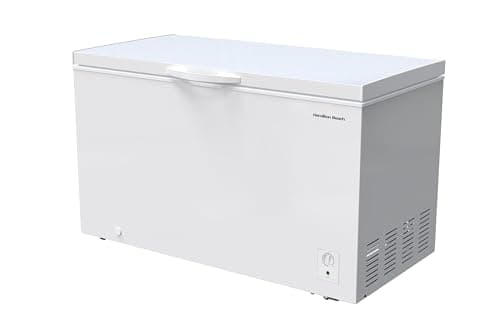
Best for 5-6 deer
Hamilton Beach 14 Cu. Ft. Chest Freezer (HBFRF1497)
14 cu ft holds 280-350 lb: a half beef fits even at looser packing, with little room left. Garage-rated 0°F to 110°F.
$743.66Amazon#ad · Price as of Sep 19, 2026 · Affiliate disclosure for the link to Hamilton Beach 14 Cu. Ft. Chest Freezer (HBFRF1497)
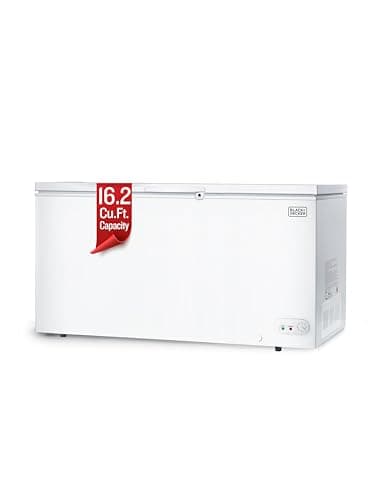
Best for 6+ deer or a half beef
BLACK+DECKER 16.2 Cu. Ft. Chest Freezer (BCF1620E)
16.2 cu ft holds 324-405 lb: a half beef with room for a couple of deer. Keep it indoors (not designed below 55°F).
$869.99Amazon#ad · Price as of Sep 19, 2026 · Affiliate disclosure for the link to BLACK+DECKER 16.2 Cu. Ft. Chest Freezer (BCF1620E)
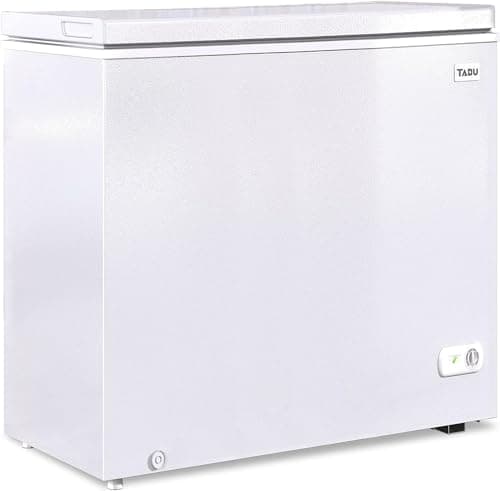
Best for 3-5 deer on a budget
TABU 12.0 Cu. Ft. Chest Freezer
12 cu ft holds 240-300 lb: enough for a quarter beef and a deer season, tight for a half.
$429.99Amazon#ad · Price as of Sep 19, 2026 · Affiliate disclosure for the link to TABU 12.0 Cu. Ft. Chest Freezer
All seven chests we rank, with capacity tables and EnergyGuide figures, are in the best chest freezers for meat.
Questions
Frequently asked
How much freezer space do I need for half a cow?
What size freezer do I need for a quarter cow?
How much meat do you get from half a cow?
Will half a cow fit in a 7 cubic foot freezer?
Keep going down the chain
Related
Receipts
Sources
- University of Maine Cooperative Extension, Bulletin #1071 — What To Expect When Buying A Freezer Beef
- Good Meat Project — Freezer Space (pounds of meat per cubic foot)
- Ohio Department of Natural Resources, Division of Wildlife — Venison Meat Yield (115 deer, 2017 gun season) [PDF]
- NDSU Extension (FN614) — Food Freezing Basics: Packaging, Loading the Freezer and Refreezing
- USDA Food Safety and Inspection Service — Freezing and Food Safety
- National Center for Home Food Preservation (University of Georgia) — Freezing Meats
We haven't bench-tested this gear and we don't pretend to. Specs come from the maker's own pages, manuals and maker-supplied listing copy (labeled as such); food-safety figures from USDA and university extension publications; yield from the Ohio Division of Wildlife; prices live from Amazon. Where a figure isn't published, we say so. Read the full method.