Home Processing ◆ Guide
How Much Meat Comes From Half a Cow, and How Much Freezer It Takes
Five university extension services worked the numbers from live steer to wrapped packages. Here's what half a beef looks like at each step, and what shrinks it.
We earn a commission if you buy through our links, at no extra cost to you. It never decides the ranking — the method is published · Affiliate disclosure
Half a beef usually comes home as about 190 to 280 pounds of packaged meat in the university extension examples we checked, from a side that hangs at roughly 300 to 380 pounds. Boneless cuts, a fat animal and heavy trimming push it toward the low end or below; bone-in cuts push it higher. Most of the gap between hanging and take-home weight is bone, fat and moisture.
We're a deer-processing site, but a lot of our readers fill the freezer with a half beef too, and the math is the same kind: pounds in, pounds out, cubic feet to hold it. Every figure below comes from an extension publication we read and link.
Hanging weight vs take-home weight
Three weights matter when you buy a side of beef, and the price is usually quoted on the middle one:
- Live weight. The animal on the hoof. The University of Maine gives 1,350 lb as the national average for finished cattle going to the processor.
- Hanging (hot carcass) weight. What's left after slaughter and dressing. For fed beef that's usually 62-64% of live weight per SDSU Extension; Penn State gives 63% as a typical average. Oklahoma State and Missouri both say the price you pay is based on hanging weight.
- Take-home (cut and wrapped) weight. What goes in your freezer after cooler shrink, bone, fat trim and cutting losses. Oklahoma State puts cutting and trimming losses at about 25% for a yield grade 3 carcass, and 24-45% across yield grades.
Maine's worked example shows every step. A 1,200 lb grass-fed steer at a 57% dressing percentage is 684 lb hanging. Allow 3-5% cooler shrink and it's about 658 lb cold. The cold carcass is about 15-20% bone, which leaves about 560 lb of boneless cuts, and less still if the animal carries more than 1/4 inch of external fat that has to be trimmed away. Halve it and a half of that steer is 342 lb hanging and about 280 lb boneless.
Five extension examples, halved
| Source | Their example | Whole: hanging to take-home | Half (÷ 2) |
|---|---|---|---|
| Oklahoma State | Average carcass, yield grade 3 | about 600 lb to about 450 lb | just over 300 lb to about 225 lb |
| Univ. of Maine | 1,200 lb grass-fed steer | 684 lb to 560 lb boneless | 342 lb to 280 lb |
| SDSU | 750 lb carcass (1,200 lb fed steer) | 750 lb to 490 lb boneless, trimmed | 375 lb to 245 lb |
| Univ. of Missouri | 1,100 lb steer, 62% dressing | 682 lb to 385 lb (35% of live weight) | 341 lb to about 193 lb |
| Penn State | 756 lb carcass, yield grade 3 | 756 lb to 378 lb boneless, or 544 lb bone-in | 378 lb to 189 lb boneless, or 272 lb bone-in |
Figures as published by each extension service; the half column is simple division. The Missouri take-home figure is its rule of thumb of 35% of live weight.
The spread isn't sloppiness. The examples use different animals (grass-fed versus fed), different cut styles (boneless versus bone-in) and different trim levels, and each of those moves the answer by dozens of pounds. That's the most useful thing to take from the table: when a farm or butcher quotes you "about 200 pounds," ask which of those choices it assumes.
What moves the number
- Boneless or bone-in. The biggest lever you control. In Penn State's table, the same 756 lb yield grade 3 carcass yields 378 lb boneless or 544 lb bone-in. Penn State also tells of a family that received nearly 500 lb of beef one year and only 350 lb from a similar-sized animal the next, after asking for boneless cuts. Bone-in isn't more meat, just more weight in the package.
- Fat. SDSU says retail yield runs from about 55% to 75% of the carcass depending on the animal's fatness and muscling and the cuts produced. Penn State's boneless figures for that 756 lb carcass run from 415 lb at yield grade 1 down to 340 lb at yield grade 5.
- The animal. Maine notes that grass-fed cattle dress out about 5% lower than grain-fed, dairy breeds 3-5% lower than beef cattle, and cull cows at about 50%.
- Aging and trim. Oklahoma State notes processors often age beef for 10 days, and that "when fat and bone are removed the percent retail yield decreases." Ask your butcher how their aging and trim choices change the weight you take home.
How much of half a beef is ground
SDSU's breakdown is the most detailed we found. From a 750 lb carcass it gets 490 lb of boneless, trimmed beef, 150 lb of fat trim and 110 lb of bone, and it says that when a carcass is cut mostly into boneless steaks and roasts, "the highest percentage of carcass weight, or 20-25%, actually ends up as lean trim" that would likely be packaged as ground beef. Here's its example split, with the half alongside:
| Product | Whole (SDSU example) | Half |
|---|---|---|
| Lean trim / ground beef | 185 lb | 92.5 lb |
| Chuck roasts and steaks | 90 lb | 45 lb |
| Round roasts and steaks | 85 lb | 42.5 lb |
| Rib and loin steaks | 80 lb | 40 lb |
| Other cuts (brisket, flank, short ribs, skirt) | 50 lb | 25 lb |
| Total boneless, trimmed | 490 lb | 245 lb |
Source: SDSU Extension, "How Much Meat Can You Expect from a Fed Steer?"
Oklahoma State offers a coarser rule of thumb for carcass beef: 25% waste, 25% ground beef and stew meat, 25% steaks and 25% roasts. Either way, plan on something like a third or more of your packages being ground, which matters for how you use it and for whether you want a say in the fat ratio.
Freezer space for half a beef
Here the sources disagree, and it's worth seeing why. Oklahoma State, Maine and Missouri all use a rule of 1 cubic foot per 35-40 lb of cut and wrapped meat; Maine works it out to 8 cu ft for half a beef. The Good Meat Project is more conservative: about 30 lb per cubic foot only if the space is "very impeccably organized," and 20-25 lb "more likely." Oklahoma State itself adds that you should allow more space for odd-shaped packages.
| Half-beef take-home | At 35-40 lb/cu ft (extension rule) | At 20-25 lb/cu ft (Good Meat Project) |
|---|---|---|
| 190 lb | 4.8 to 5.4 cu ft | 7.6 to 9.5 cu ft |
| 225 lb | 5.6 to 6.4 cu ft | 9 to 11.3 cu ft |
| 245 lb | 6.1 to 7.0 cu ft | 9.8 to 12.3 cu ft |
| 280 lb | 7.0 to 8.0 cu ft | 11.2 to 14 cu ft |
We plan on the conservative column, because it's the one that doesn't leave a box of roasts on the garage floor. Vacuum-sealed steaks and roasts are exactly the odd shapes Oklahoma State warns about, and the freezer rarely holds only beef. On that basis a half beef on its own needs about 8 to 14 cu ft depending on its take-home weight, so a 14 cu ft chest covers every example here, and a half beef plus a deer season wants 16 cu ft or a second freezer. Our freezer size for half a cow guide takes the storage side further, including chest versus upright.
Picks for this job
Freezers and a trim grinder sized to half a beef
Two chest freezers that hold a half beef on the conservative math, and a #12 grinder sized to a half's worth of lean trim.
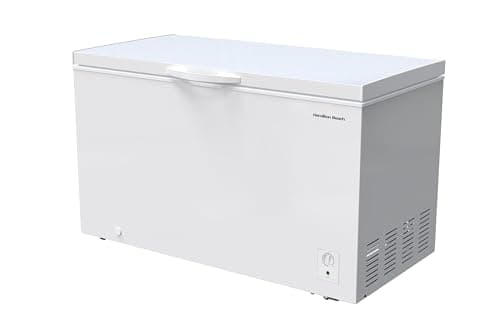
Best for 5-6 deer
Hamilton Beach 14 Cu. Ft. Chest Freezer (HBFRF1497)
14 cu ft, about 280 to 350 lb at realistic packing: a 280 lb half beef fits; its listing calls it garage-ready.
$743.66Amazon#ad · Price as of Sep 19, 2026 · Affiliate disclosure for the link to Hamilton Beach 14 Cu. Ft. Chest Freezer (HBFRF1497)
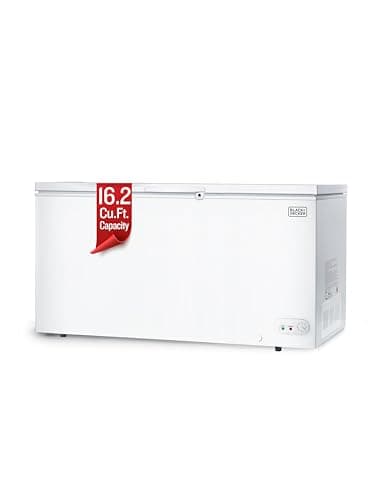
Best for 6+ deer or a half beef
BLACK+DECKER 16.2 Cu. Ft. Chest Freezer (BCF1620E)
16.2 cu ft, about 324 to 405 lb: a half beef plus a deer, with two removable baskets.
$869.99Amazon#ad · Price as of Sep 19, 2026 · Affiliate disclosure for the link to BLACK+DECKER 16.2 Cu. Ft. Chest Freezer (BCF1620E)
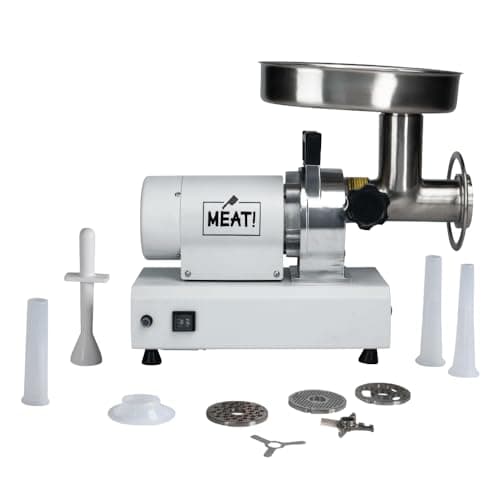
Best for 3-5 deer
MEAT! Your Maker #12 Pro-Grade Meat Grinder (.75 HP)
Rated 7-10 lb a minute by MEAT!: a half's roughly 92 lb of lean trim is about 9-13 minutes of feed time.
$579.99Amazon#ad · Price as of Sep 19, 2026 · Affiliate disclosure for the link to MEAT! Your Maker #12 Pro-Grade Meat Grinder (.75 HP)
Is buying half a cow worth it?
The honest answer is a calculation only you can finish, because it needs local quotes. What the extension services give you is the conversion. Oklahoma State's formula: the cost per pound of wrapped meat is the price per pound of hanging weight divided by the edible percentage. Since you pay on hanging weight but eat take-home weight, every hanging-weight price gets multiplied:
| Take-home as a share of hanging weight | Multiply the hanging-weight price by |
|---|---|
| 60% | 1.67 |
| 65% | 1.54 |
| 70% | 1.43 |
| 75% | 1.33 |
| 80% | 1.25 |
Then add the processing fee, compare the result with what you pay for the same mix of cuts at the store, and remember that roughly a third of it will be ground beef. Things that tip it toward yes: you have the freezer space already, you like knowing the farm, and your household eats enough ground beef to use a third of a side. Things that tip it toward no: you'd need to buy a freezer just for this, or your family mostly eats steaks.
If a half is more than you want, the way the carcass is split matters as much as the weight. Oklahoma State explains that a hindquarter, which includes the round, loin and flank, "will give more steaks and roasts, but will cost more per pound than a side or carcass," while a forequarter (chuck, rib, brisket, plate and full flank) "has more of the less tender cuts." If you buy a quarter, ask whether it can be made up of front and back pieces so you don't end up with all of one or the other. At roughly half the half-beef figures above, a quarter is also a size many households can fit in the freezer they already own.
Do you need a grinder for half a beef?
Usually not. Most butchers grind the trim for you. A grinder earns its place if you want to set your own fat ratio, grind fresh in small batches, or turn trim into sausage. If so, size it honestly: SDSU's split puts about 92 lb of lean trim in a half beef, less than two average deer. A #12 rated at 7-10 lb a minute handles that in about 9 to 13 minutes of feed time, and our best meat grinders for home use covers the class. If the beef lands on top of a six-deer season, step up to the 6+ deer setup, which is built for the combined volume.
Questions
Frequently asked
How much meat do you get from half a cow?
What is the difference between hanging weight and take-home weight?
How much freezer space do I need for half a cow?
How much ground beef is in half a cow?
How much meat is in a quarter cow?
Keep going down the chain
Related
- Freezer size for half a cowThe storage math for bulk beef, in depth.
- The 6+ deer setupGear for big deer seasons and the half-beef household.
- Best chest freezers for meatChest freezers ranked by capacity per season.
- Chest vs upright freezerWhich layout packs more beef.
- How much meat from a deerThe same yield math for venison.
Receipts
Sources
- Oklahoma State University Extension — Buying Beef for Home Freezers (AFS-3401), F.K. Ray
- University of Maine Cooperative Extension — Bulletin #1071, What To Expect When Buying A Freezer Beef, C.W. Knight
- SDSU Extension — How Much Meat Can You Expect from a Fed Steer? (updated July 13, 2022)
- Penn State Extension — Understanding Beef Carcass Yields and Losses During Processing, J.A. Campbell (updated Nov. 25, 2025)
- University of Missouri Extension — MX3001, Buying Meat Direct From the Farm, J. Lutes
- Good Meat Project — Freezer Space (pounds of meat per cubic foot)
- Amazon listing, manufacturer-supplied copy — Hamilton Beach HBFRF1497 14 cu ft chest freezer
- Amazon listing, manufacturer-supplied copy — BLACK+DECKER BCF1620E 16.2 cu ft chest freezer
- Amazon listing, manufacturer-supplied copy — MEAT! .75 HP #12 (1159178)
We haven't bench-tested this gear and we don't pretend to. Specs come from the maker's own pages, manuals and maker-supplied listing copy (labeled as such); food-safety figures from USDA and university extension publications; yield from the Ohio Division of Wildlife; prices live from Amazon. Where a figure isn't published, we say so. Read the full method.