Home Processing ◆ Guide
Buying Half a Cow: How to Fill In the Cut Sheet
The cut sheet is where a side of beef becomes your freezer. Four decisions on it change the weight, the number of packages and how much of the animal arrives as ground.
We earn a commission if you buy through our links, at no extra cost to you. It never decides the ranking — the method is published · Affiliate disclosure
Four decisions on the cut sheet move everything else: bone-in or boneless, steak thickness, roast size, and how much of the animal you send to ground. Get those right and the rest of the sheet is preference. Get them wrong and you end up with forty identical roasts and no freezer space.
One number to carry in before you start: SDSU Extension says that when a carcass is cut mostly into boneless steaks and roasts, “the highest percentage of carcass weight, or 20-25%, actually ends up as lean trim” that would likely be packaged as ground beef. A quarter of your side is going to be ground, whether you plan for it or not.
The four decisions
- Bone-in or boneless. Bone-in is not more meat, just more weight in the package — and more freezer volume per pound of edible beef. Boneless maximises usable meat per cubic foot; bone-in gives better roasts and the bones for stock.
- Steak thickness. This sets the number of steaks, not the weight. Three-quarters of an inch gives you more packages of thinner steaks; an inch and a half gives fewer, better ones.
- Roast size. Match it to your household, not the animal. A 2 lb roast feeds four; a 5 lb roast commits you to leftovers every time you cook one.
- How much goes to grind. The lever nobody realises they have. Chuck and round can be cut as roasts and steaks or sent to grind, and that single instruction can shift fifty pounds of a side from one column to the other.
What a side actually breaks into
SDSU's example is the most detailed breakdown we found. From a 750 lb carcass it gets 490 lb of boneless, trimmed beef, 150 lb of fat trim and 110 lb of bone — and splits the boneless beef like this. The right-hand column is your half:
| Cut group | Whole carcass | Half |
|---|---|---|
| Lean trim / ground beef | 185 lb | 92.5 lb |
| Chuck roasts and steaks | 90 lb | 45 lb |
| Round roasts and steaks | 85 lb | 42.5 lb |
| Rib and loin steaks | 80 lb | 40 lb |
| Other cuts (brisket, flank, short ribs, skirt) | 50 lb | 25 lb |
Read that table as a budget. The rib and loin — the steaks everybody pictures — are the smallest group after “other”. Most of a side is chuck, round and trim, which is why how you handle those three decides whether the freezer is interesting.
Our how much meat from a half cow page carries the full set of extension examples and the hanging-versus-take-home arithmetic behind these numbers.
The ground beef question
Ninety-odd pounds of ground beef from half an animal is a lot if you do not eat much of it, and not enough if you do. Two instructions on the sheet control it:
- Send chuck to grind and you trade pot roasts for burger. Chuck is the best-tasting grind on the animal and the obvious candidate.
- Send round to grind and you trade lean roasts and sandwich steaks for leaner burger. Round roasts are the cuts first-time buyers most often report never cooking.
Also specify the package size: 1 lb packages make themselves useful, 2 lb packages suit a family that cooks in bulk, and a mix of both is the common answer. And ask what lean-to-fat ratio the grind is being made at — it is a choice, and it is yours.
Steak thickness and package size
Thickness is a cooking decision disguised as a butchering one. Thin steaks (about 3/4 in.) are quick and forgiving on a weeknight; thick ones (1-1/2 in.) are what you want for a reverse sear and they are far harder to overcook. Most people order about an inch and regret neither direction strongly.
Steaks per package is the more practical question. Two per pack suits a couple; four suits a family; and singles, while wasteful of bag, mean you can take one out. On a vacuum-sealed order you are also deciding how many seals the butcher makes, which some charge for.
Bones, fat and the things you can ask for
Most of what gets thrown away is available if you ask on the sheet. Soup bones and marrow bones; fat trim, if you render tallow; the heart and liver, if the plant handles them. SDSU's example accounts for 150 lb of fat trim and 110 lb of bone on a whole carcass — a share of that is yours if you want it, and it is free or close to it.
Two cautions. Bones and fat take freezer space you have already allocated to meat, so decide before you order rather than at pickup. And check with the processor: not every plant returns offal, and rules vary.
Freezer space before you order
This is the step people do last and should do first. At the realistic packing density we use site-wide — 20 to 25 lb per cubic foot, with about 30 lb for a perfectly packed one — a 200 lb half beef needs roughly 8 to 10 cubic feet, and a 250 lb half needs about 10 to 12.5.
Bone-in cuts pack worse than boneless, so take the high end of the range if you ordered bone-in. And if the same freezer also holds a deer season — about 104 lb for two deer at the Ohio DNR average — add that before you shop.
Picks for this job
What a half beef needs at home
Freezer first: order the beef after you know it fits. The grinder is for the roasts you decide, a year later, you would rather have as burger.
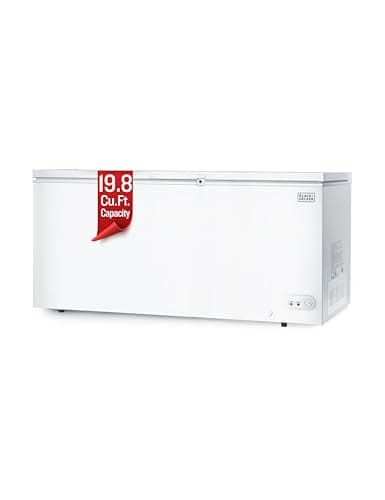
Best for 6+ deer or a half beef
BLACK+DECKER 19.8 Cu. Ft. Chest Freezer (BCF1980E)
The biggest chest we list at 19.8 cu ft - a half beef with most of the cabinet still free, with two baskets and compressor parts covered through year five. Its manual says it is not designed to run below 55 F, so keep it indoors.
$1,099.00Amazon#ad · Price as of November 4, 2026 · Affiliate disclosure for the link to BLACK+DECKER 19.8 Cu. Ft. Chest Freezer (BCF1980E)
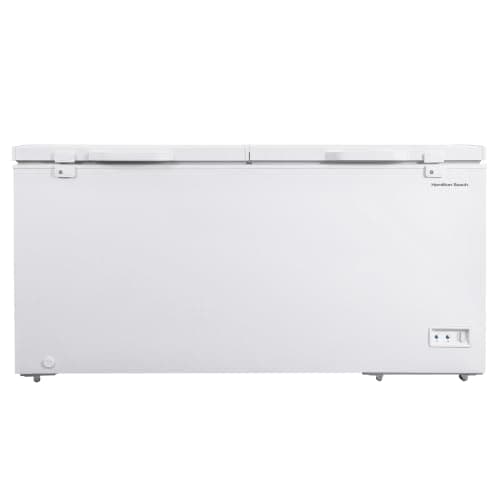
Best for 6+ deer
Hamilton Beach 17 Cu. Ft. Chest Freezer (HZ9471)
17 cu ft with Hamilton Beach's own garage-ready bullet and an exterior defrost drain. Needs 70 in. of wall.
Check price · Amazon#ad · Price as of November 4, 2026 · Affiliate disclosure for the link to Hamilton Beach 17 Cu. Ft. Chest Freezer (HZ9471)
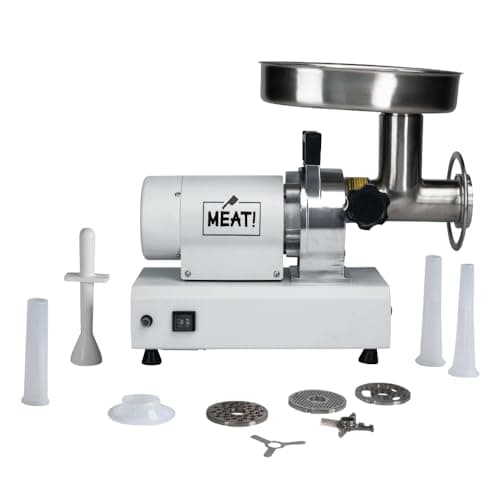
Best for 3-5 deer
MEAT! Your Maker #12 Pro-Grade Meat Grinder (.75 HP)
A #12 head for turning unused roasts into the burger you actually wanted. Bulk beef trim is easier work than venison sinew.
$384.99Amazon#ad · Price as of November 4, 2026 · Affiliate disclosure for the link to MEAT! Your Maker #12 Pro-Grade Meat Grinder (.75 HP)
Our freezer size for half a cow page works the cubic-feet arithmetic in full, and best chest freezers for meat ranks the cabinets.
A sensible first-time sheet
If the form is in front of you and you want a starting point rather than a philosophy: boneless for everything except short ribs and soup bones; steaks at 1 inch, two per package; roasts at 3 lb; chuck split between roasts and grind; round mostly to grind; ground beef in 1 lb packages.
That order is deliberately boring, fits a 7-cubic-foot-per-100-lb rule of thumb and produces very little you will not cook. Keep a note of what ran out first and what was still in the freezer in August — that note is a better cut sheet than any guide, and you will have it before the next animal.
Whether half a cow is worth buying at all is a separate sum, and how much meat from a half cow and DIY vs processor cost are where we work it.
Questions
Frequently asked
What cuts should I order when buying half a cow?
How much of half a cow is ground beef?
Is bone-in or boneless better on a cut sheet?
How thick should I order steaks?
How much freezer space does half a cow need?
Can I ask for the bones and fat?
Keep going down the chain
Related
Receipts
Sources
- SDSU Extension — How Much Meat Can You Expect from a Fed Steer? (updated July 13, 2022)
- Oklahoma State University Extension — Buying Beef for Home Freezers (AFS-3401), F.K. Ray
- Penn State Extension — Understanding Beef Carcass Yields and Losses During Processing, J.A. Campbell
- University of Missouri Extension — MX3001, Buying Meat Direct From the Farm, J. Lutes
- University of Maine Cooperative Extension — Bulletin #1071, What To Expect When Buying A Freezer Beef, C.W. Knight
- Good Meat Project — Freezer Space (pounds of meat per cubic foot)
- Ohio Department of Natural Resources, Division of Wildlife — Venison Meat Yield (115 deer, 2017 gun season) [PDF]
- Amazon listing, manufacturer-supplied copy — BLACK+DECKER BCF1980E 19.8 cu ft chest freezer
- Amazon listing, manufacturer-supplied copy — Hamilton Beach 17 cu ft chest freezer (HZ9471)
- Amazon listing, manufacturer-supplied copy — MEAT! #12 Pro-Grade grinder
Specs come from the maker's own pages, manuals and maker-supplied listing copy (labeled as such); food-safety figures from USDA and university extension publications; yield from the Ohio Division of Wildlife; prices live from Amazon. Where a figure isn't published, we say so. Read the full method.