Is It Cheaper to Process Your Own Deer? The Break-Even Math
Six named processors' published fees, four home kits at live prices, and the one division that tells you how many deer it takes for the gear to pay for itself.
#ad · Price as of Sep 19, 2026 · Affiliate disclosure for the link to LEM MaxVac 250 Vacuum Sealer
Divide what the gear costs by what a processor charges you per deer. The six processors we checked publish standard whole-deer fees from $115 to $180 on their own price lists (read September 2026), and the table below runs that division at live gear prices for four home kits. The cheaper the kit and the more deer you take, the faster it pays; sausage and jerky, which processors charge by the pound, move the math the most.
At live prices as of Sep 19, 2026: the hand-crank minimum kit ($252.97) pays for itself in 1.4 to 2.2 deer, and the processing gear from our 1-2 deer setup ($701.70) in 3.9 to 6.1 deer, depending on which of the six processors you would otherwise pay.
We didn't call around or mystery-shop anyone. Every fee below is copied from the processor's own website, linked, with the date we read it. Your local shop will charge something else, and the point of showing six is to show the spread, not to manufacture a national average that nobody actually pays.
What processors charge, from their own price lists
All six pages read September 18, 2026. Fees change every season; check your local shop's current list.
Several of these fees are flat per deer. Pacileo's puts it bluntly: "a 40lb deer and a 180lb deer have the same base processing fee of $137," and Dennison charges $140 "regardless of hanging weight." Eddie's is the exception in this group, pricing by carcass-weight bracket and knocking the fee down when you order 40 lb or more of specialty products. Quality Deer Processing also lists labor on already-boned meat at $3.49 a pound with a $180 minimum, and Smith Bros. charges $1.49 a pound for boning and cutting venison pieces you bring in.
Extras add up quickly. Caping for a shoulder mount is $35 at Dennison, $40 at Smith Bros. and $50 at Pacileo's, and Quality Deer Processing charges $200 instead of $180 for cape-mount skinning. Duma notes that no discount is given for a deer you've already skinned.
The number that actually competes with your gear isn't one fee, it's a season of them, every season. Here's what the base fees alone add up to, before a single pound of sausage:
Base fee
1 deer a season
3 deer a season
6 deer a season
3 deer a season, over 3 seasons
Duma Deer Processing ($115)
$115
$345
$690
$1,035
Smith Bros. Meats ($130)
$130
$390
$780
$1,170
Pacileo's Great Lakes Deer Processing ($137)
$137
$411
$822
$1,233
Dennison Meat Locker ($140)
$140
$420
$840
$1,260
Eddie's Game Processing ($165)
$165
$495
$990
$1,485
Quality Deer Processing ($180)
$180
$540
$1,080
$1,620
Published base fees multiplied out; Eddie's uses its 51-120 lb, all-burger bracket. Extras and specialty products not included.
Hold that last column up against the live kit totals further down. Gear is a one-time cost with a long tail of small consumables; a processor's fee comes back every fall, and on the flat-fee lists it's the same for a small doe as for a big buck.
What that works out to per pound of venison
"Deer processing cost per pound" depends on your deer as much as the fee. A flat fee spread over a small doe costs more per pound than the same fee over a big buck. Here are the five flat fees divided by the Ohio DNR's average yields (115 deer, 2017 gun season):
Processor (flat fee)
Fee
Per lb, average deer (52.19 lb)
Per lb, average antlerless (45.05 lb)
Per lb, average buck (62.51 lb)
Duma Deer Processing
$115
$2.20
$2.55
$1.84
Smith Bros. Meats
$130
$2.49
$2.89
$2.08
Pacileo's Great Lakes Deer Processing
$137
$2.63
$3.04
$2.19
Dennison Meat Locker
$140
$2.68
$3.11
$2.24
Quality Deer Processing
$180
$3.45
$4.00
$2.88
Eddie's prices by carcass-weight bracket, so it's left out of this table rather than guess which bracket your deer lands in.
The spread between columns is the same at every shop: on a flat fee, an average antlerless deer costs about 39% more per pound of venison than an average buck, simply because Ohio's antlerless deer yielded 45.05 lb against 62.51 lb. If you mostly fill doe tags, the per-pound case for doing it yourself is stronger than the per-deer fee suggests. For the yield data itself, see how much meat you get from a deer.
The break-even, at live prices
Kit (processing gear only)
What's in it
Live total
Break-even vs Quality Deer Processing ($180)
Break-even vs Duma Deer Processing ($115)
Hand-crank minimum
Outdoor Edge WildPak 8-Piece Processing Kit + LEM #10 Stainless Steel Clamp-On Hand Grinder + Weston Heavy-Duty Freezer Paper Roll, 15 in x 150 ft (83-4000-W)
LEM BigBite #22 Electric Meat Grinder (1 HP) + Victorinox Fibrox Field Dressing Kit, 7-Piece + Weston 22 in Butcher Meat and Bone Saw (47-2201) + VEVOR Stainless Steel Work Table, 36 x 24 in, with Casters + LEM Heavy Duty Meat Lugs, 5-Pack + Avid Armor USV20 Chamber Vacuum Sealer
$1,436.34
8.0 deer
12.5 deer
Live Amazon prices as of Sep 19, 2026, summed at render time; they change, and the buy buttons always show the current figure. Processor fees as published on each processor's own site, read September 18, 2026. Break-even = live kit total ÷ per-deer fee.
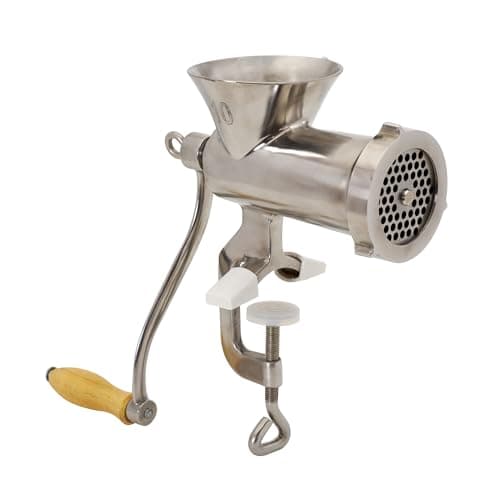
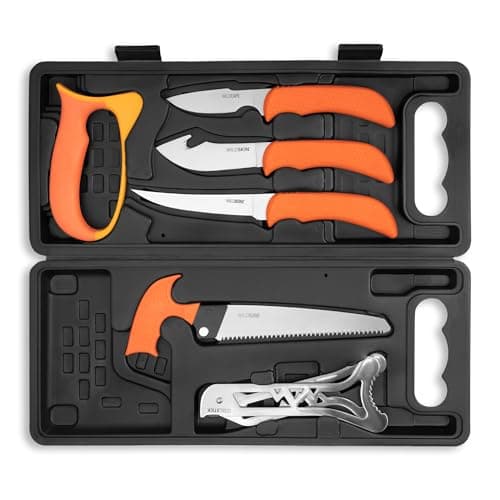
The four kits: the hand-crank minimum is the Outdoor Edge WildPak, LEM's stainless #10 hand grinder and a Weston 15-inch x 150-foot freezer paper roll. The other three are the processing gear from our 1-2 deer, 3-5 deer and 6+ deer setups with the freezer, stuffer, mixer and dehydrator taken out. If a row says hidden, that's deliberate: when any item in a kit has no fresh live price, we withhold the total rather than show a stale or guessed number. Prices refresh daily.
Read the result per season, not per lifetime. A kit that breaks even at 2.5 deer pays for itself in the first season for a three-deer hunter and in the third season for a one-deer hunter, and the gear doesn't wear out after that.
Where DIY pulls ahead: sausage, sticks and jerky
Base fees buy steaks, roasts and burger. Anything stuffed, smoked or dried is extra, usually by the pound, and these are the charges a stuffer, a mixer and a dehydrator compete with:
Duma: summer sausage $3.00/lb, snack sticks $5.00/lb, restructured jerky $7.00/lb, priced by raw weight in 5 lb increments. Duma's own list notes 25-30% cooking loss on snack sticks and 50-65% on restructured jerky.
Smith Bros.: summer sausage (30% pork) $3.79/lb and jerky $3.79/lb, with vacuum packing included.
Eddie's: smoked link sausage (50/50 deer and pork) from $4.99/lb and sliced jerky $8.69/lb, on raw, pre-smoked weight.
Pacileo's: sausage $4.00/lb bulk or $5.00/lb cased.
Worked example: 20 lb of snack sticks, the batch one Hi Mountain snack stick kit makes, is $100 in Duma's per-pound charges before the base fee, and it recurs every batch. DIY isn't free here either. Seasoning and cure kits, casings and bags are per-batch costs; our bag cost per season does that math for sealer bags. But if sausage and sticks are the point of your season, this is where home processing gains the most. Start with how to make venison sausage.
What the division leaves out
Your time. We couldn't find a published, measured figure for home processing hours per deer, so we won't invent one. Budget a full day for your first deer and decide for yourself what that day is worth.
Consumables. Bags or paper, casings, seasoning and cure all recur every season.
Yield. Ohio DNR says yield depends on "how much effort is put into butchering as well as skill and experience." Your first deer may come out lighter than a pro shop's.
Cold space. A processor has a cooler. You need a way to keep the carcass and the meat cold until it's cut and packaged, which in a warm early season can decide the question on its own.
Carcass rules. Transport, CWD testing and disposal rules vary by state; check your state wildlife agency before you haul a deer home. A processor handles disposal for you.
The starter gear, side by side
These four are the pieces the first two kits share or swap. Each value is from the maker-supplied Amazon listing cited on its card below.
+Stainless: no tinning to wear through, and it cleans without the rust worry of cast iron
+Two plates for a coarse-then-fine grind, plus stuffing tubes
+Works without power: a cabin, a camp or a power outage
What it doesn't
−LEM says standard LEM grinder knives and plates will not fit it; buy parts made for this model
−Clamps only to surfaces up to 1-1/2 in. thick
−At 2-4 lb a minute, one deer is 13-26 minutes of cranking per pass
Skip this if…
…you process two or more deer. At 2-4 lb a minute a 2-deer season (about 104 lb) is 26-52 minutes of cranking per pass; LEM rates its BigBite #8 at 7 lb a minute, about 15.
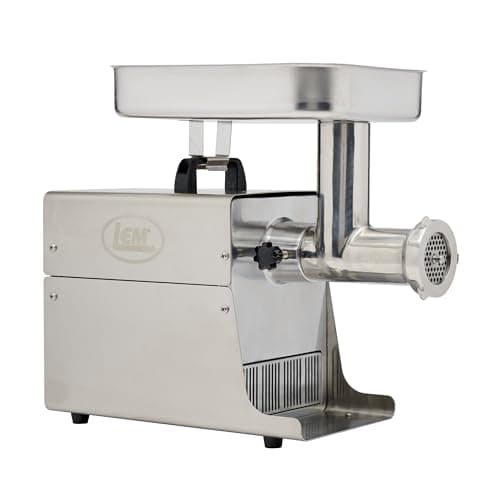
+7 lb a minute on LEM's figure: a 2-deer season (about 104 lb) is roughly 15 minutes of feeding per pass
+Stainless motor housing, knife and plates; stuffing tubes and stomper included
+5-year warranty, and LEM says it carries replacement parts for past and present models
What it doesn't
−No reverse function is listed on LEM's spec page, so a knife wrapped in silver skin means stopping and opening the head
−LEM's listing says it is not for bones
−At 3-5 deer you feed about 60% longer than on LEM's own #12 (7 vs 11 lb a minute)
Skip this if…
…you regularly process three or more deer or split beef with family. LEM rates its own #12 at about 11 lb a minute and its #22 at 13, against this one's 7.
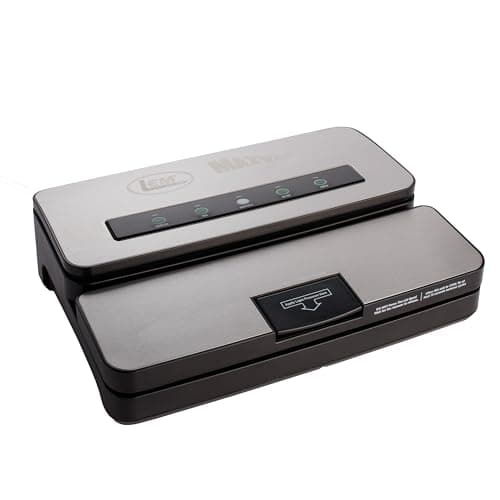
#ad · Price as of Sep 19, 2026 · Affiliate disclosure for the link to LEM MaxVac 250 Vacuum Sealer
How we picked
Units we claim to have bench-tested: none
Plenty of sites say they ground two hundred pounds through every grinder. We didn't, and we say so. What we do instead: read the maker's spec sheet, manual and warranty terms, record the figures that decide whether a machine keeps up with your season (size number, motor rating, rated pounds per minute, capacity, duty cycle, gearing), check parts availability, and score each pick on a published rubric. Then we show the season math — pounds per deer from the Ohio Division of Wildlife's yield study — so you can redo it with your own numbers.
At the six processors we checked, a standard whole-deer job is $115 to $180 on their published lists (September 2026), before extras like caping or specialty products. Fees vary by region and shop, so treat those as examples, not an average.
Is it cheaper to process your own deer?+
After the gear pays for itself, yes. Divide the gear cost by your processor's per-deer fee to get the break-even deer count; the live table on this page does it for four kits. If you make sausage, sticks or jerky, the savings come faster, because processors charge those by the pound.
What does deer processing cost per pound?+
On a flat fee it depends on your deer. Dividing the five flat fees we found by Ohio's average yield of 52.19 lb gives $2.20 to $3.45 per pound of venison; on an average antlerless deer it's $2.55 to $4.00.
Do deer processors charge by the deer or by the pound?+
Both exist. Five of the six lists we read charge a flat fee for a whole deer; Eddie's in San Antonio prices by carcass-weight bracket; and boned-out meat is often charged by the pound (Quality Deer Processing lists $3.49/lb with a $180 minimum). Specialty products are usually per pound, though some shops price smoked items per batch; Pacileo's, for one, lists its smokies and bologna that way.
Is it worth buying processing gear for one deer a year?+
On cost alone, only the cheapest kit pays back quickly at one deer a year. The better reasons at that volume are control over your cuts and trim, and making your own jerky or sausage. The 1-2 deer setup is sized for exactly that season.
We haven't bench-tested this gear and we don't pretend to. Specs come from the maker's own pages, manuals and maker-supplied listing copy (labeled as such); food-safety figures from USDA and university extension publications; yield from the Ohio Division of Wildlife; prices live from Amazon. Where a figure isn't published, we say so. Read the full method.