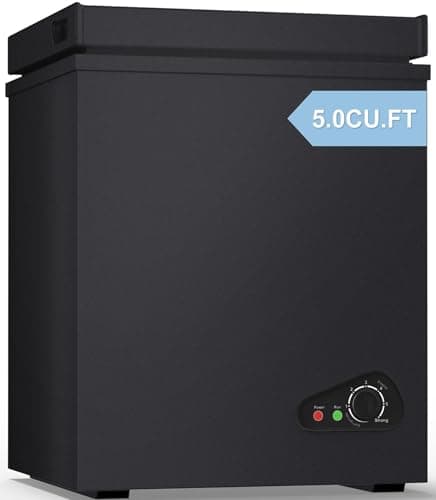
Chest Freezers Under $300, Ranked by What You Actually Get
Under $300 buys 3.5 to 5 cubic feet: one deer comfortably, two if the freezer holds nothing else. Here is what separates the four that are worth it, and which specs every one of them leaves out.
The only sub-$300 cabinet here with a defrost drain, front rollers and a stay-open hinge, at the full 5 cu ft. The layout is what you are paying the extra for.
#ad · Prices come live from Amazon, last checked Sep 24, 2026; where we have no verified live price we show none. Scores are ours, compiled from published specs, manuals and warranty terms, not bench tests. Tap a row for the full write-up.
Under $300, the best chest freezer for meat is the Igloo 5.0 cu ft: it is the only cabinet in this band that has a defrost drain, front rollers and a hinge that holds the lid open, at the full five cubic feet. If price is the whole point, the TABU 5.0 gives you the same capacity for less and asks you to defrost it with a towel. If your freezer is going somewhere that gets cold, the Midea 3.5 is the only unit here whose maker publishes an ambient range.
How the $300 line works
This matters more in this category than most. One freezer that would have led this page a week ago is not on it, for exactly that reason; see the one that crossed the line below.
What $300 actually buys
Three and a half to five cubic feet. That is the whole band. At the Good Meat Project's realistic packing density of 20-25 lb per cubic foot, five cubic feet holds roughly 100-125 lb and 3.5 holds roughly 70-88 lb. At the Ohio DNR average of 52.19 lb of venison per deer, that is:
Cabinet
Realistic capacity
Deer it holds
Room for anything else?
3.5 cu ft
About 70-88 lb
One (52.19 lb)
Very little
5.0 cu ft
About 100-125 lb
Two (104 lb)
Only if you take one deer
So the honest framing of this budget: under $300 is a one-deer freezer, or a two-deer freezer that holds nothing but deer. If you take three or more, no amount of shopping inside this band fixes it, and our chest freezers for meat roundup is the page you want.
The four, spec by spec
Spec
Igloo 5.0
TABU 5.0
Midea 3.5
Igloo 3.5
Capacity
5.0 cu ft
5.0 cu ft
3.5 cu ft
3.5 cu ft
Coldest setting
-10°F
-7.6°F
Not published
-10°F
Defrost drain
Yes, drain plug
Not mentioned
Not mentioned
Yes, drain plug
Stay-open lid
Yes, 45-90°
Yes, 45-90°
Not mentioned
Yes, 45-90°
Rollers
Yes, front
No
Adjustable legs
Yes, front
Published ambient range
None
None
0°F to 110°F
None
Converts to a fridge
No
No
Yes
No
Footprint (w x d x h, in)
21.25 x 25 x 33.13
21.06 x 20.27 x 29.13
21.5 x 17.6 x 33.5
18.88 x 21.88 x 32.5
Two rows decide most buys. The defrost drain row is the one people underrate: a chest freezer holding venison needs defrosting once a year, and a drain plug turns that from a two-towel job into a pan job. The coldest setting row is the one that matters for long storage, because USDA's 0°F storage target is a ceiling, not a goal, and margin below it is what protects quality over a full season.
What every one of them leaves out
Not one of these four publishes an EnergyGuide kWh figure, and not one publishes a warranty length. That is the real cost of shopping under $300, and it is worth saying plainly rather than scoring around it:
No yearly energy figure. The Frigidaire 5.0 has an EnergyGuide label at 216 kWh a year. None of these do, so you cannot compare running costs before you buy.
No warranty length published. Step up to the Kenmore 5.1 and you get two years in writing. Under $300, you are buying on price and specs alone.
Midea publishes no cabinet temperature range, which is odd given it is the only one that publishes an ambient range. You get one number or the other, not both.
We score the energy metric neutral (5) wherever a maker publishes nothing, rather than guessing. That is why none of these four score well on energy: not because they are inefficient, but because nobody will say.
The one that crossed the line
The Frigidaire EFRF5003 is the freezer we would normally put at the top of a sub-$300 list: same 5 cu ft, a published EnergyGuide figure of 216 kWh a year, an exterior defrost drain and a -11.2°F coldest setting. At our check for this page it was over $300, so it is not on it.
We are telling you that rather than quietly leaving it out, because the gap is small and prices move. If the Frigidaire is back under $300 when you look, buy it over the Igloo: the EnergyGuide number and the extra degree of cabinet margin are worth more than rollers. Check the live price on its button in our small chest freezers roundup.
When it is worth stretching past $300
Every year you take more than two deer, this budget costs you money rather than saving it, because the alternative to freezer space is a processor bill. Our DIY versus processor cost page does that break-even. Concretely:
One more option worth naming: two cheap freezers instead of one bigger one. Two 5 cu ft cabinets cost about what one 10 cu ft does, they can be sited in different rooms, and one of them can be switched off out of season. The cost is two compressors to fail instead of one.
In detail
The picks, in full
1
IglooNo image
Best under $300
Igloo 5.0 Cu. Ft. Chest Freezer
6.0 /10
The only sub-$300 cabinet here with a defrost drain, front rollers and a stay-open hinge, at the full 5 cu ft. The layout is what you are paying the extra for.
#ad · Price as of Sep 24, 2026 · Affiliate disclosure for the link to Igloo 3.5 Cu. Ft. Chest Freezer
How we ranked these four
Same rubric as every freezer on this site: capacity against season tier (30), temperature range and garage rating (20), published energy use (20), layout — baskets and drain (15), and value at the live price (15). Under $300 the energy column is dead weight, because none of the four publish a figure, so in practice the ranking is decided by capacity, drain and cabinet margin.
We have not bench-tested any of these freezers. Every number above is the maker's own published figure, and where a maker published nothing we have said so instead of estimating. Capacity-to-poundage uses the Good Meat Project's 20-25 lb per cubic foot range and the Ohio DNR's 52.19 lb average deer.
How we picked
Units we claim to have bench-tested: none
Plenty of sites say they ground two hundred pounds through every grinder. We didn't, and we say so. What we do instead: read the maker's spec sheet, manual and warranty terms, record the figures that decide whether a machine keeps up with your season (size number, motor rating, rated pounds per minute, capacity, duty cycle, gearing), check parts availability, and score each pick on a published rubric. Then we show the season math — pounds per deer from the Ohio Division of Wildlife's yield study — so you can redo it with your own numbers.
The Igloo 5.0 cu ft, on the strength of being the only cabinet in the band with a defrost drain, front rollers and a stay-open hinge at the full five cubic feet. The TABU 5.0 is the pick if you want the same capacity for less and will defrost it by hand.
How many deer fit in a 5 cu ft chest freezer?+
Two, at the Ohio DNR average of 52.19 lb of venison per deer and realistic packing of 20-25 lb per cubic foot — and only if the freezer holds nothing else. Our freezer space for a deer page has the full table.
Do cheap chest freezers get cold enough for long-term meat storage?+
The ones here do on paper: both Igloos reach -10°F and the TABU reaches -7.6°F, against the USDA's 0°F storage target. What you do not get under $300 is a published yearly energy figure or a stated warranty length. Put a thermometer in the cabinet rather than trusting the dial.
Is a chest freezer under $300 worth it, or should I save up?+
Worth it at one or two deer a season. At three or more, the freezer stops being the constraint and the processor bill becomes one — see our DIY versus processor break-even. Buying two cheap 5 cu ft cabinets instead of one 10 cu ft is a legitimate third option.
Can a sub-$300 chest freezer go in a garage?+
Only the Midea 3.5 publishes an ambient range (0°F to 110°F in freezer mode). The other three say nothing, so the claim cannot be checked. Our garage chest freezer page covers what goes wrong and why.
We haven't bench-tested this gear and we don't pretend to. Specs come from the maker's own pages, manuals and maker-supplied listing copy (labeled as such); food-safety figures from USDA and university extension publications; yield from the Ohio Division of Wildlife; prices live from Amazon. Where a figure isn't published, we say so. Read the full method.