The Best Chest Freezers for a Garage, and the Spec Almost Nobody Publishes
"Garage ready" is a phrase, not a specification, unless the maker states the ambient temperature range behind it. We went looking for that number on every chest freezer we list. One had it.
Midea states it in writing: 0°F to 110°F in freezer mode, designed and tested for non-climate-controlled spaces. Small, but it is the only unit here that answers the question.
Rollers, a drain plug and a stay-open hinge, and the bullets call it a garage freezer. The cabinet stops at -10°F, which is less margin than you want in a hot garage.
#ad · Prices come live from Amazon, last checked Sep 24, 2026; where we have no verified live price we show none. Scores are ours, compiled from published specs, manuals and warranty terms, not bench tests. Tap a row for the full write-up.
If a chest freezer is going in your garage, the spec that decides it is the ambient temperature range the maker will stand behind: how cold and how hot the air around the freezer is allowed to get. Of the chest freezers we list, exactly one publishes that range. The Midea 3.5 cu ft convertible states 0°F to 110°F in freezer mode, and says it was designed and tested to run in non-climate-controlled spaces. Every other unit on this page says “garage ready” somewhere in its title or bullets and then declines to say what that means.
That is the honest state of this category, and it is why this page is ordered the way it is. We have not put a freezer in a garage and measured it. What we can do is tell you which makers committed to a number and which ones did not.
What “garage ready” is supposed to mean
A freezer's thermostat reads the air. Whirlpool, explaining its own garage-ready range, puts the design difference plainly: garage-ready units have controls calibrated for a wider ambient temperature range than typical indoor appliances, so they hold safe internal temperatures through ambient swings. Its own control chart puts the normal recommended band at an ambient of 55°F to 110°F, with a separate garage mode for ambients consistently between 38°F and 55°F.
So the phrase has a real engineering meaning. The problem is that no standard forces a maker to publish the range, and most of the chest freezers sold for garages do not. A title that says “Garage-Ready” with no number behind it is a marketing claim you cannot check.
Who actually publishes the number
Freezer
Where the garage claim appears
Published ambient range
Coldest cabinet setting
Midea 3.5 cu ft convertible
Listing bullet
0°F to 110°F (freezer mode); 38°F to 110°F (fridge mode)
Not published
Kenmore 5.1 cu ft convertible
Listing bullet (“premium insulation and sealing”)
None
-11°F
Frigidaire EFRF5003 5.0 cu ft
Listing title only
None
-11.2°F
Igloo 5.0 cu ft
Listing bullet (“garage ready freezer”)
None
-10°F
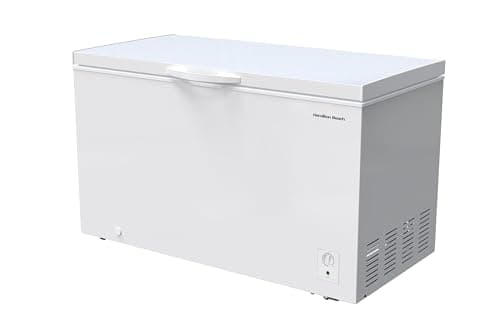
Hamilton Beach 14 cu ft
Listing title
None
Not published as a range
Hamilton Beach 17 cu ft
Listing bullet (“GARAGE READY chest freezer”)
None
Not published as a range
One row has a number in the third column. That is the whole finding, and it is why a 3.5 cu ft freezer — which holds barely one average deer — leads a page about garages. If your garage genuinely swings, the freezer that told you its limits is the one you can plan around.
Read that again if you keep a season of venison in a garage freezer. The thermostat is satisfied by cold air it can feel, the compressor stops, and the cabinet drifts up. Nothing sounds wrong. Nothing is running. USDA's guidance is that frozen food should be held at 0°F or below, and a cabinet that has quietly drifted to 20°F is still frozen solid to the touch while it loses quality by the week.
An attached garage in August is the other end of the same spec. Whirlpool's description of a standard unit in heat is that it “may run excessively, increasing energy consumption, stressing components, or failing to maintain safe food temperatures.” That is where the coldest-setting column in the table above starts to matter: a cabinet that only reaches -10°F has 10 degrees of margin below the USDA's 0°F line, and a hot garage spends that margin for you.
It is also where a published energy figure earns its keep, because a freezer running more hours costs more to run. Only two units here have an EnergyGuide number at all — the Frigidaire 5.0 at 216 kWh a year and the Hamilton Beach 14 — and neither of those publishes an ambient range. You are choosing which piece of information you would rather have.
How to choose, by what your garage does
Your garage
What to buy
Why
Attached, insulated, never below 40°F
Any chest here, sized to your season
You are inside every published ambient range, including the standard 55-110°F band
Attached, uninsulated, 0-100°F swing
Midea 3.5, or a bigger chest with the warranty to cover it (Kenmore)
The Midea's stated range covers the swing; the Kenmore covers you for two years instead
Detached or unheated, below 0°F in winter
Put the freezer in a basement or utility room instead
Below 0°F ambient, no unit here has a published range that covers you, and ENERGY STAR says keep it indoors
Hot climate, 100°F+ garage, no winter issue
A chest with the coldest published cabinet setting you can get
Margin below 0°F is what a hot garage eats; -11.2°F beats -10°F
Sizing is a separate question from siting, and the garage rating does not change it. At the Ohio DNR average of 52.19 lb of venison per deer, three deer is 157 lb, which needs roughly 6.3-7.9 cu ft at realistic packing. Our freezer space per deer page does that arithmetic deer by deer, and best chest freezers for meat ranks the whole range on capacity rather than on siting.
If your freezer is not garage rated
Most people reading this already own a chest freezer and want to know whether it can go in the garage. The published specs cannot answer that for a unit whose maker published nothing, so treat it as a monitoring problem rather than a spec problem:
Put a thermometer in the cabinet, not on the dial. The dial is a setting; the thermometer is the temperature. USDA's 0°F target is a cabinet reading.
Check it in the coldest week and the hottest week. Those are the two conditions the ambient range exists to describe, and they are the two you can actually observe.
Keep it full. A packed chest holds temperature far longer through a compressor that is not cycling, which is the exact failure Whirlpool describes.
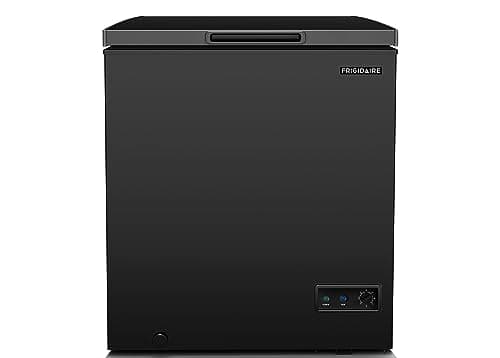
Do not rely on a title. “Garage-Ready” on the Frigidaire 5.0 appears only in the listing title; Frigidaire's own manual gives no ambient range at all.
If the cabinet will not hold 0°F where you have put it, the fix is the room, not the thermostat. Our chest vs upright comparison covers which cabinet holds temperature longer when the compressor is off, and chest freezer organization covers packing it so it stays cold.
In detail
The picks, in full
1
MideaNo image
Only published ambient range
Midea 3.5 Cu. Ft. Convertible Chest Freezer
6.1 /10
Midea states it in writing: 0°F to 110°F in freezer mode, designed and tested for non-climate-controlled spaces. Small, but it is the only unit here that answers the question.
+Energy use is on paper: 216 kWh a year on the EnergyGuide label
+Exterior defrost drain, so defrosting is a pan job rather than a towel job
+Small enough for a utility room or apartment corner
What it doesn't
−At a realistic 20-25 lb per cubic foot it holds about 100-125 lb, so two average Ohio deer (104 lb) fill it
−216 kWh sits near the top of the 137-221 kWh range the label gives for similar models
−The garage-ready claim is in the listing title only; Frigidaire's manual gives no ambient range
Skip this if…
…you take two deer a season and also want room for groceries. At realistic packing it tops out around 125 lb, and two average deer are 104 lb on their own. The 7 cu ft model is the better buy.
#ad · Price as of Sep 24, 2026 · Affiliate disclosure for the link to Frigidaire EFRF5003 5.0 Cu. Ft. Chest Freezer
4
IglooNo image
Best layout
Igloo 5.0 Cu. Ft. Chest Freezer
6.0 /10
Rollers, a drain plug and a stay-open hinge, and the bullets call it a garage freezer. The cabinet stops at -10°F, which is less margin than you want in a hot garage.
+A written garage rating: stable temperature in 0°F to 110°F surroundings
+282 kWh a year, at the low end of the 268-297 kWh range the label gives for similar models
+About 280-350 lb at realistic packing, or 5.4-6.7 average Ohio deer
What it doesn't
−One basket for 14 cu ft, so plan on bins
−One-year warranty, shorter than BLACK+DECKER's compressor coverage
−A half beef needs 11.2-14 cu ft at realistic packing, which fills it
Skip this if…
…you need a half beef and a season of venison in the same box. A half beef alone needs 11.2-14 cu ft at realistic packing. Step up to the 16.2 cu ft BLACK+DECKER and keep it indoors.
#ad · Price as of Sep 24, 2026 · Affiliate disclosure for the link to Hamilton Beach 17 Cu. Ft. Chest Freezer (HZ9471)
What we would actually buy
For a garage that stays above freezing, buy on capacity and ignore the garage badge entirely: the Hamilton Beach 14 for three to five deer, the Frigidaire 5.0 for one. For a garage that genuinely swings from near-zero to summer heat, the Midea 3.5 is the only unit here whose maker told you it belongs there, and the honest trade is that you are buying a one-deer freezer to get that certainty. For a garage below 0°F in winter, buy nothing on this page and use a basement.
We would rather see this category standardise on a published ambient range than on a badge. Until it does, the third column of our table is the only column that means anything.
One thing to notice in the scores: the Hamilton Beach 14 outscores our top pick, because the rubric rewards its capacity and its EnergyGuide figure, while this page is ordered by who will tell you their ambient range. That is deliberate and it is how every ranked page on this site works — the order answers the question in the title, and the score is the rubric's separate view of the product as a whole. Both are on the page so you can disagree with us.
How we picked
Units we claim to have bench-tested: none
Plenty of sites say they ground two hundred pounds through every grinder. We didn't, and we say so. What we do instead: read the maker's spec sheet, manual and warranty terms, record the figures that decide whether a machine keeps up with your season (size number, motor rating, rated pounds per minute, capacity, duty cycle, gearing), check parts availability, and score each pick on a published rubric. Then we show the season math — pounds per deer from the Ohio Division of Wildlife's yield study — so you can redo it with your own numbers.
Can you put a regular chest freezer in an unheated garage?+
Sometimes, but the makers will not promise it. Whirlpool says a unit that is not garage ready “may cycle less or not at all” in cold weather because the cold ambient air masks the need for cooling, which lets the cabinet warm up. ENERGY STAR's advice is to keep a freezer indoors unless your climate is mild. If you do it anyway, put a thermometer inside and check it in the coldest week of the year.
What does "garage ready" actually mean on a freezer?+
That the controls are calibrated for a wider ambient temperature range than a normal indoor appliance. The useful version of the claim comes with numbers: Midea publishes 0°F to 110°F ambient in freezer mode. Most chest freezers sold as garage ready publish no range at all, and that claim is unverifiable.
Will a freezer in a cold garage thaw my venison?+
It can, and not for the reason most people expect. The risk is not the compressor overworking, it is the compressor not running: the thermostat reads cold garage air, decides no cooling is needed, and the cabinet drifts up. Meat that is still hard to the touch can be sitting well above the USDA's 0°F storage target.
Is a chest or an upright better for a garage?+
A chest, mostly because cold air stays in it when the lid is shut and when the compressor is not running, which is the failure mode a garage creates. Our chest vs upright comparison works through the rest of the trade-offs.
Does a garage freezer cost more to run?+
In a hot garage, yes: Whirlpool notes that a unit in excessive heat runs more, which increases energy use. We cannot put a figure on it for these models, because only the Frigidaire 5.0 (216 kWh a year) and the Hamilton Beach 14 publish an EnergyGuide number at all, and neither publishes an ambient range to pair it with.
What size freezer do I need if it is going in the garage?+
The same size you would need anywhere: siting does not change capacity. At the Ohio DNR average of 52.19 lb per deer, budget roughly 20-25 lb per cubic foot of real packing. Our freezer space for a deer page has the table.
We haven't bench-tested this gear and we don't pretend to. Specs come from the maker's own pages, manuals and maker-supplied listing copy (labeled as such); food-safety figures from USDA and university extension publications; yield from the Ohio Division of Wildlife; prices live from Amazon. Where a figure isn't published, we say so. Read the full method.