Vacuum Sealer vs Ziploc Bags: What a Season Really Costs Either Way
A zipper bag is not an air barrier, and air is what causes freezer burn. But the cost comparison does not run the way most people assume, and a chamber pouch can undercut a Ziploc per package.
The bag everything else gets measured against. It costs a fraction of a vacuum pouch per package and it will not hold a seal against a year in a chest freezer.
#ad · Price as of Sep 24, 2026 · Affiliate disclosure for the link to Ziploc Quart Freezer Bags, Stay Open Design (120 Count)
Short answer: Ziploc freezer bags are fine for meat you will eat within a few months and wrong for a season's venison, because a zipper closes a bag without removing the air inside it, and that air is what causes freezer burn. The cost comparison is more interesting than the durability one, though — and it does not favour Ziploc as clearly as people expect.
The real cost per package
Every figure in this table is computed from the current listing price divided by the bags in the pack. We do not type prices into prose, because they move; a dash means we have no verified price inside our 48-hour freshness window. The per-deer column uses the Ohio DNR average of 52.19 lb of venison per deer in one-pound packages, which is about 52 packages.
Bag
Bags per pack
How we got that
Cost per package
One deer (52 packages)
Machine needed
Ziploc quart freezer bags
120
4 boxes of 30
—
—
Nothing
LEM MaxVac quart vacuum bags
100
100 pre-cut bags
—
—
Any external sealer
Avid Armor chamber pouches
300
100 each of three sizes
—
—
A chamber sealer
Every cost cell is a dash right now, because we have no verified price inside our 48-hour freshness window. We would rather show nothing than a stale figure. The arithmetic is pack price ÷ bags per pack, and the buy buttons on this page carry the live prices.
The structural reason the comparison is close: Ziploc freezer bags are sold 120 to a pack, pre-cut vacuum bags 100 to a box, and chamber pouches 300 at a time. Buying in threes beats buying convenience. Our bag cost per season page runs the same arithmetic across rolls as well, where cutting your own bag length changes the number again.
The machine is the real cost, and it is one-off
A vacuum sealer is a fixed cost paid once; bags are a cost paid every season. So the question is not “which bag is cheaper” but “how many seasons until the machine stops mattering.” Work it out like this:
Take the sealer's price from its buy button above.
Take the per-package gap between your bag options from the table.
Multiply the gap by your packages per season (52 per deer at one pound).
Divide the machine price by that annual gap.
On most combinations, that arithmetic does not pay the machine back on bag cost alone. It is important to say so: you do not buy a vacuum sealer to save money on bags. You buy it because of what happens to the meat, which is the next section. The bag-cost argument only turns positive at genuine volume with chamber pouches — see sealers for heavy use.
What the air in a Ziploc actually does
Freezer burn is not a safety problem — USDA is clear that frozen food stays safe indefinitely at 0°F, and that freezer burn is a quality issue rather than a spoilage one (FSIS, Freezing and Food Safety). It is a moisture problem: water sublimates out of the surface of the meat into the air space in the bag, leaving dry, grey, leathery patches. Venison is extremely lean, so it has little fat to buffer that, and it shows the damage sooner than beef does.
A zipper bag leaves air in by design. Ziploc publishes no film thickness in mil for these bags, which is the other half of the problem: you cannot compare a Ziploc to a 3-mil vacuum bag on paper, because one of the two numbers does not exist. A vacuum bag removes most of the air and is a thicker film. Those are the two mechanisms, and neither is marketing.
How long each one actually holds
We keep the storage-duration detail on one page rather than repeating it, because the numbers come from the same USDA and FoodSafety.gov sources and we would rather they could not drift apart: how long vacuum-sealed meat lasts has the timelines with the citations. The summary that matters here is directional and well supported: the less air sitting against the meat and the thicker the film, the longer the quality holds at the same temperature.
Temperature does at least as much work as packaging. Both bags fail fast in a freezer that is not actually at 0°F — which is worth checking if yours lives in a garage, for reasons our garage freezer page gets into.
Where Ziploc genuinely wins
Four cases, and they are real ones:
Short-term storage. Anything you will cook within a couple of months. The air has not had time to do much.
Marinating. A zipper you can reopen is the point.
Awkward shapes and wet mixes. A zipper bag does not care about liquid; an external vacuum sealer very much does. Our wet meat guide covers the workarounds.
Stand-up filling. Ziploc's stand-up bottom means you can fill one single-handed, which matters when your other hand is covered in trim.
A lot of well-run kitchens use both: vacuum bags for the season's storage, zipper bags for the week's cooking. That is not a compromise, it is just using each for what it does.
The third option most people forget
Freezer paper. It costs less per package than either bag here, it handles awkward shapes, and it is what butchers used before vacuum sealers existed. It is also more work per package and gives you no window to see what is inside. We compare it properly in freezer paper vs vacuum sealing, and how to package deer meat covers the double-wrap method that makes paper work.
The verdict
What you are doing
Use
Why
Storing a season of venison
Vacuum sealer
Less air against the meat and a thicker film; quality holds longer at the same temperature
Meat you will eat within a couple of months
Ziploc freezer bags
The air has not had time to matter, and there is no machine to buy
Marinating, brining, portioning for the week
Ziploc
Reopenable, and liquid is not a problem
Wet cuts, in volume
Chamber sealer
Liquid is not pulled toward the seal, and pouches are the cheapest bag per package
Cheapest possible per package, work not a problem
Freezer paper
Lowest cost per package of any option we price
And the honest caveat on the money question: buy a sealer for what it does to the meat after eight months in a chest freezer, not to save on bags. If saving on bags is the goal, the answer is freezer paper or chamber pouches bought 300 at a time, not a zipper bag.
In detail
The contenders, in full
Best for 3-5 deer
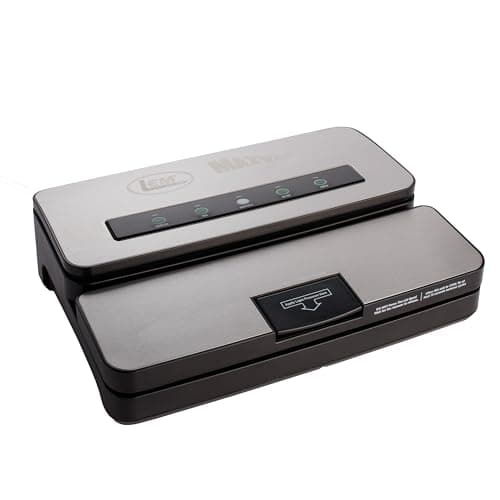
LEM MaxVac 250 Vacuum Sealer
7.1 /10
Half the 500's rated run (250 consecutive seals) in a smaller box, which still works out to almost five deer of one-pound packages in one go.
#ad · Price as of Sep 24, 2026 · Affiliate disclosure for the link to LEM MaxVac 250 Vacuum Sealer
ZiplocNo image
The cheapest wrap that works short-term
Ziploc Quart Freezer Bags, Stay Open Design (120 Count)
4.7 /10
The bag everything else gets measured against. It costs a fraction of a vacuum pouch per package and it will not hold a seal against a year in a chest freezer.
+Cheapest cost per package of anything on this site, by a wide margin
+No machine, no power and no learning curve
+The stand-up bottom means you can fill one single-handed, which matters with wet hands
What it doesn't
−A zipper is not an air barrier: air stays in the bag and that air is what causes freezer burn
−Ziploc publishes no film thickness in mil, so it cannot be compared with a 3-mil vacuum bag on paper
−Quart only in this pack, which is short for a backstrap or a roast
Skip this if…
…the meat is going to sit past a few months. For a season's venison the air left in a zipper bag is the whole problem; see our vacuum-sealer-versus-Ziploc comparison for the cost and the timeline side by side.
#ad · Price as of Sep 24, 2026 · Affiliate disclosure for the link to Ziploc Quart Freezer Bags, Stay Open Design (120 Count)
How we picked
Units we claim to have bench-tested: none
Plenty of sites say they ground two hundred pounds through every grinder. We didn't, and we say so. What we do instead: read the maker's spec sheet, manual and warranty terms, record the figures that decide whether a machine keeps up with your season (size number, motor rating, rated pounds per minute, capacity, duty cycle, gearing), check parts availability, and score each pick on a published rubric. Then we show the season math — pounds per deer from the Ohio Division of Wildlife's yield study — so you can redo it with your own numbers.
Are Ziploc bags as good as vacuum sealing for freezing meat?+
No, for long storage. A zipper closes the bag but leaves the air inside, and that air is what dries the surface of the meat into freezer burn. For meat you will cook within a couple of months the difference is small; for a season of venison it is not.
Is vacuum sealing cheaper than Ziploc bags?+
Per package it can be, which surprises people — chamber pouches are sold 300 at a time against Ziploc's 120, so the per-bag cost can come out lower. But you also have to buy the machine, and on most combinations the bag saving alone does not pay it back. Buy a sealer for meat quality, not bag economics.
How long does meat last in a Ziploc bag in the freezer?+
It stays safe indefinitely at 0°F — USDA is explicit that freezing keeps food safe indefinitely and that freezer burn is a quality problem, not a spoilage one. Quality is the limit, and it is shorter than a vacuum bag at the same temperature. Our storage timeline page has the figures with citations.
Can you get the air out of a Ziploc bag without a sealer?+
Mostly, yes: lower the bag into water so the pressure pushes the air out, then seal the last corner above the waterline. It is free and it genuinely helps. What it cannot do is give you a thicker film, or scale to the 52 or so packages one average deer produces.
What is the cheapest way to package venison for the freezer?+
Freezer paper, properly double-wrapped — cheaper per package than any bag we price. It is more work and you cannot see inside. See freezer paper vs vacuum sealing.
Do vacuum sealer bags work in a Ziploc-style zipper?+
No — they are different products. Vacuum bags are a thicker, channelled or textured film designed to be welded shut by a heat bar. A zipper is a mechanical closure with no air removal. Our vacuum bag roundup covers what fits which machine.
We haven't bench-tested this gear and we don't pretend to. Specs come from the maker's own pages, manuals and maker-supplied listing copy (labeled as such); food-safety figures from USDA and university extension publications; yield from the Ohio Division of Wildlife; prices live from Amazon. Where a figure isn't published, we say so. Read the full method.