Vacuum Sealers ◆ Guide
Weston Pro-2300 Review: You Are Buying the 15-Inch Bar
The widest seal bar on any external sealer we cover, a double-piston pump rated to 28 in. Hg and a fan-cooled 1,020-watt motor sold for repetitive use. The catch is in the manual: Weston still asks for 20 seconds between cycles, and the bar you are paying for is one most hunters never fill.
We earn a commission if you buy through our links, at no extra cost to you. It never decides the ranking — the method is published · Affiliate disclosure
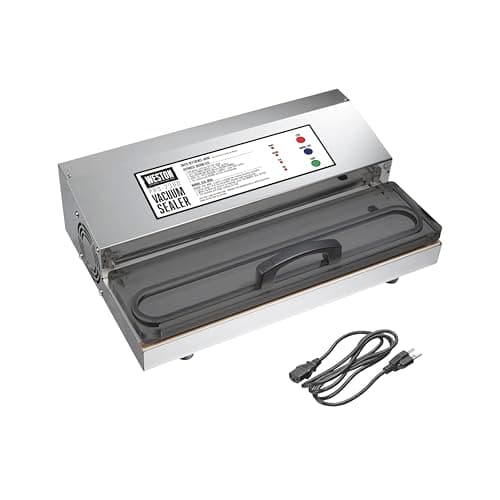
The Weston Pro-2300 is the sealer we point at exactly one buyer: the person sealing things that are too wide for everything else. Its seal bar takes bags up to 15 inches across, which is wider than any other external machine on this site, and wider than the inside of any home chamber sealer we rank. If you are sealing whole backstraps, a dry-aging bag over a strip loin, or a salmon fillet laid out flat, that single number is the whole purchase.
If you are not, you are about to pay a premium for a bar you will never fill. That is the honest shape of this review, and the rest of the page is the detail behind it.
What the Pro-2300 is
It is a stainless external (suction) sealer built around a double-piston pump rated up to 28 in. Hg, with a 1,020-watt, fan-cooled motor Weston sells for continuous repetitive use and a 5 mm seal bar that accepts bags up to 15 inches wide. The lid is clear so you can line a bag up before you commit, and there are two modes: automatic vacuum-then-seal, and a manual seal you trigger yourself.
“External” is the important word. The bag mouth sits in a port and the machine sucks air out through it, which is a different mechanism from a chamber sealer, where the bag sits inside a box and the whole box is evacuated. That difference decides how each one behaves with wet meat, and it is its own page: chamber vs external vacuum sealer. This review assumes you have decided you want an external machine, or that you need a bag wider than any chamber will take.
One thing it is not: a roll-storage machine. Weston does not list a built-in roll compartment or cutter on this model, so you cut bags off a separate roll on the bench. Several cheaper sealers — the LEM MaxVac 250 among them — do have that, and on a long session it is a genuine convenience the Pro-2300 gives up.
The specs, and where they come from
We split this table deliberately. The left column is what Weston publishes; the right is what it means on a processing bench. Nothing here is a measurement we took.
| Spec | Weston's figure | What it means for you |
|---|---|---|
| Maximum bag width | 15 in. | The reason to buy this machine. Nothing else external we rank goes past 14 in. |
| Seal bar | 5 mm wide | A broad weld, which matters most on thick film and on bags you will freeze for a year |
| Pump | Double-piston, up to 28 in. Hg | The hardest pull we can document on an external sealer; LEM publishes 21 in. Hg |
| Motor | 1,020 W, fan-cooled, sold for continuous repetitive use | The fan is why it survives a long session at all |
| Rest between cycles | At least 20 seconds, lid open | The figure that sets your real throughput. Worked through below |
| Overheat behavior | Thermal protector cuts it off; resume after about 20 minutes | Push past the rest rule and the machine stops you, mid-deer |
| Modes | Automatic vacuum-and-seal; Manual Seal | Manual seal is how you handle anything juicy — see below |
| Published continuous rating | None | Weston gives a rest interval, not a seal count. The MaxVac 500 gives both |
| Roll storage and cutter | Not listed | You cut bags off a separate roll |
Sources, in order of how much we trust them for this model: the maker-supplied Amazon listing copy for the current 65-0220-W for width, pump, wattage and modes, and the Pro-2100 / Pro-2300 owner's manual (65-0101 / 65-0201) for the rest interval and the thermal protector. That manual is for an earlier revision; see the documentation problem for why we are telling you that rather than hiding it.
The 15-inch bar: who actually needs it
Bar width is the only spec on this machine that nothing else can substitute for. A harder pump is a nice-to-have; a wider bag is either possible or it is not. So the first question is honest and short: what is the widest thing you will seal?
| What you are sealing | Width you need | Does the Pro-2300 earn its keep? |
|---|---|---|
| One-pound bricks of ground venison | 8 in. is plenty | No. You are buying 7 unused inches |
| Steaks, chops, roasts, two-pound packages | 11 in. covers it | No — most sealers we rank take an 11 in. bag |
| A whole venison backstrap, laid flat | 11-14 in. depending on how you fold it | Helpful, not essential |
| Whole salmon or large fish fillets | Often past 11 in. | Yes — see our fish sealer roundup |
| A dry-aging bag over a whole strip loin | 15 in. | Yes, and nothing else we rank will do it |
That last row is why the Pro-2300 is the #1 pick on our best vacuum sealers for dry aging page. Dry-aging bags are sold to fit whole subprimals, and the usual thing that kills a home attempt is a seal bar too narrow for the bag the reader already bought. Fifteen inches solves a problem no amount of extra vacuum pressure solves.
The 20-second rest rule, and what a deer actually takes
Here is the part no retailer page leads with. The Pro-2300 manual asks for at least 20 seconds with the lid open between cycles, and the machine enforces it the hard way if you do not comply: a thermal protector shuts the unit off, and you wait about 20 minutes before it will run again.
Put a number on that. The Ohio DNR weighed 115 field-dressed whitetails from the 2017 gun season and reported an average of 52.19 lb of meat per deer. In one-pound packages — our stated assumption everywhere on this site — that is about 52 bags, which means 51 rest intervals, which means about 17 minutes of standing still per deer. Over a 3-5 deer season at the top of the tier, that is roughly 85 minutes of mandated idle time spread across your sealing sessions.
The comparison that matters here is the LEM MaxVac 500, whose maker publishes an actual continuous rating: 500 consecutive seals, up to five hours. That is nearly ten deer in one unbroken run. Weston publishes no equivalent figure for the Pro-2300 — only the rest interval — so on paper the MaxVac 500 is the machine for marathon sessions and the Pro-2300 is the machine for wide ones. Our heavy-use roundup ranks the whole field on exactly that axis.
Wet meat and manual seal mode
Every external sealer has the same weakness with fresh game: it pulls air out through the bag mouth, so it also pulls blood and juice toward the seal, and film with liquid on it does not weld reliably. The Pro-2300's answer is Manual Seal mode — you run the vacuum as far as you want, then trigger the seal yourself before the liquid arrives. Weston's manual points to manual seal for liquids directly.
It works, and it is a real skill rather than a feature that does it for you. Our how to vacuum seal wet meat page covers the technique — the pre-freeze, the paper-towel cuff, the fold-back — and all of it applies here. What the Pro-2300 does not have is a liquid-detecting moist preset of the kind NESCO builds into the VS-22LB.
If sealing bloody trim is the main thing you do, the honest answer is a chamber machine, where there is no bag-mouth port to pull liquid toward in the first place. That is the whole argument on our chamber sealer roundup, and it is the one case where we would tell a Pro-2300 shopper to buy something else and accept the 11-inch pouch ceiling.
What it costs to feed
An external sealer needs embossed or channeled film — smooth bags have no air path for the pump to draw through — and that film costs more per bag than the smooth pouches a chamber machine uses. Because the Pro-2300 has no roll holder or cutter, you will be working from a roll on the bench and cutting to length, which is actually the cheaper way to do it: you stop wasting 11 inches of bag on a pound of burger.
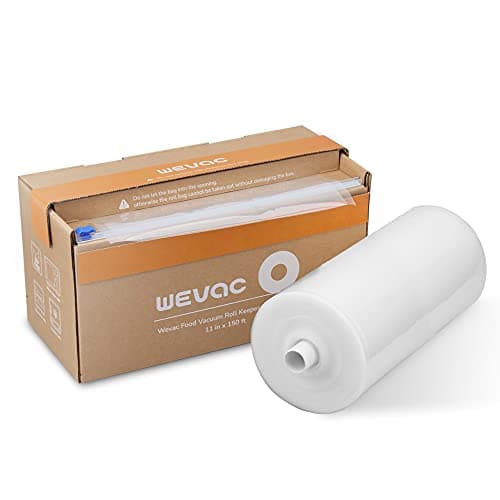
At the Wevac roll's live price (as of November 4, 2026), bagging one deer on the Pro-2300 comes to about $11.09 of film — roughly $0.21 a package. The arithmetic: roll price ÷ 150 bags × 52 packages, where 150 is a 150-foot roll cut into 12-inch lengths and 52 is the Ohio DNR average deer in one-pound packages. Embossed film is the price of admission on any external sealer; a chamber machine runs smooth pouches instead, which is most of why our bag cost per season page exists.
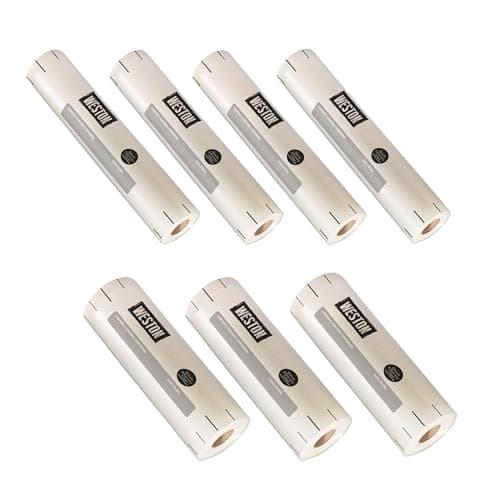
Two practical notes on bags for this machine specifically. First, buy at least one roll in a wide width if the 15-inch bar is why you bought it — an 8-inch roll in a 15-inch machine is a joke at your own expense. Second, the Weston 3 mil roll pack below gives you two widths in one box, which is a sensible way to find out what you actually reach for before you commit to a 150-foot roll.
Picks for this job
The Pro-2300 and the film to run through it
One machine and two ways to buy bags for it: a two-width starter pack, and the long roll that drops your cost per package once you know which width you use.
Best for wide cuts
Weston Pro-2300 Vacuum Sealer
The machine this page is about. Buy it for the 15-inch bar; plan around the 20-second rest rule.
$474.45Amazon#ad · Price as of November 4, 2026 · Affiliate disclosure for the link to Weston Pro-2300 Vacuum Sealer
Best two-width roll pack
Weston 3 mil Vacuum Sealer Rolls, 7-Pack
Seven rolls in 8 in. and 11 in. widths, 3 mil 2-ply. The sensible way to learn which width your season actually needs.
Check price · Amazon#ad · Price as of November 4, 2026 · Affiliate disclosure for the link to Weston 3 mil Vacuum Sealer Rolls, 7-Pack
Best roll for external sealers
Wevac Vacuum Sealer Roll, 11 in. x 150 ft
150 feet of 11-inch embossed film in a cutter box. Cheapest per package once you are cutting every bag to the cut.
$31.99Amazon#ad · Price as of November 4, 2026 · Affiliate disclosure for the link to Wevac Vacuum Sealer Roll, 11 in. x 150 ft
Against the alternatives
| If this is your situation | The machine we would buy |
|---|---|
| Dry-aging whole subprimals, or sealing long fillets flat | Weston Pro-2300 — the 15-inch bar has no substitute |
| Six-plus deer, hours of back-to-back one-pound packages | LEM MaxVac 500 — 500 consecutive seals published, 14-inch bags |
| Mostly bloody trim and juicy cuts, packages under 11 in. | A chamber machine — the Avid Armor USV20 |
| One or two deer a year, cost is the constraint | Something far cheaper — see our wild-game roundup |
| You want roll storage and a cutter built in | LEM MaxVac 250 — smaller, narrower, far more convenient |
The documentation problem
Who should buy it
Buy the Pro-2300 if the widest thing you seal is genuinely wide. Dry-aging a strip loin, sealing whole salmon flat, bagging a backstrap without cutting it in half — those are jobs where this machine is the answer and the rest of the field simply cannot do it. The 28 in. Hg pump and the 5 mm weld are good reasons to want it on top of that; they are not, on their own, reasons to buy it.
Skip it if your season is a long stack of one-pound packages. The 15-inch bar does nothing for you, Weston publishes no continuous rating, and the MaxVac 500 is the better machine for that work at less money. Skip it too if wet trim is your main problem: a chamber sealer handles that at the cost of bag width, and we would rather you cut a loin in half than fight an external sealer all afternoon.
Whichever you buy, a sealer is the middle of a chain, not the end of it. The grinder decides how fast the meat arrives — the LEM BigBite #12 is our pick for a 3-5 deer season — and the freezer decides how long the work lasts. University of Maine Cooperative Extension is clear that vacuum packaging slows spoilage but does not replace refrigeration or freezing, and FoodSafety.gov's cold storage chart is the reference for how long sealed meat actually keeps. Our how long vacuum-sealed meat lasts page has those tables in full.
Questions
Frequently asked
Is the Weston Pro-2300 worth the money?
How wide a bag does the Weston Pro-2300 take?
Does the Weston Pro-2300 need a rest between seals?
Weston Pro-2300 or LEM MaxVac 500?
Can the Weston Pro-2300 seal wet meat?
What bags does the Weston Pro-2300 use?
What is the warranty on the Weston Pro-2300?
Keep going down the chain
Related
- Best vacuum sealers for dry agingThe job the 15-inch bar exists for.
- Best vacuum sealers for heavy useWhere duty cycle, not width, decides it.
- Avid Armor USV20 reviewThe chamber alternative, if wet trim is your problem.
- LEM MaxVac 500 reviewThe external rival that publishes a 500-seal duty cycle.
- Vacuum sealer bag cost per seasonWhat embossed film really costs across a season.
- How to vacuum seal wet meatThe technique Manual Seal mode is for.
Receipts
Sources
- Amazon listing, manufacturer-supplied copy — Weston Pro-2300 (65-0220-W)
- Weston Pro-2100 / Pro-2300 owner's manual (models 65-0101 / 65-0201), PDF hosted on Amazon — the most recent Pro-2300 manual we could fetch
- LEM Products — MaxVac 500 Vacuum Sealer product page
- LEM Products — MaxVac 250 Vacuum Sealer product page
- Amazon listing, manufacturer-supplied copy — Wevac 11 in. x 150 ft roll (1122019)
- Amazon listing, manufacturer-supplied copy — Weston vacuum sealer roll 7-pack (30-2001-W)
- Ohio Department of Natural Resources, Division of Wildlife — Venison Meat Yield (115 deer, 2017 gun season) [PDF]
- University of Maine Cooperative Extension — Vacuum Sealing Safely at Home (September 2024)
- FoodSafety.gov (U.S. Department of Health & Human Services) — Cold Food Storage Chart
Specs come from the maker's own pages, manuals and maker-supplied listing copy (labeled as such); food-safety figures from USDA and university extension publications; yield from the Ohio Division of Wildlife; prices live from Amazon. Where a figure isn't published, we say so. Read the full method.