The Best Dehydrators for Jerky, Ranked on the 160°F Rule
We scored every unit first on its maker's published maximum temperature, then on tray area. Two popular models top out below 160°F, and one has no temperature dial at all.
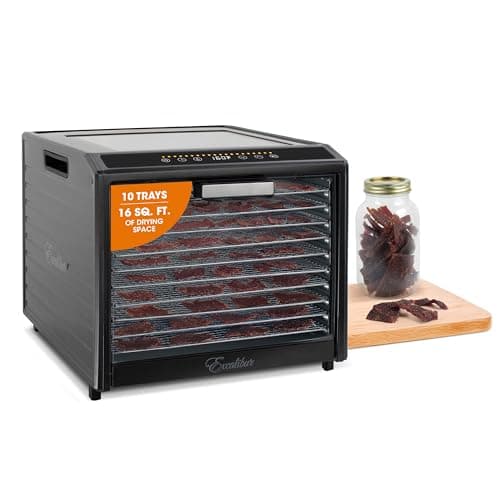
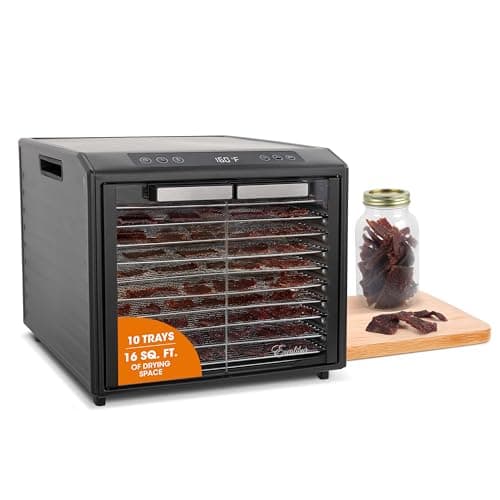
Sixteen square feet of tray, a dial that runs to 165°F and horizontal airflow: the most jerky per load among the units that clear every temperature bar.
#ad · Prices come live from Amazon, last checked Sep 19, 2026; where we have no verified live price we show none. Scores are ours, compiled from published specs, manuals and warranty terms, not bench tests. Tap a row for the full write-up.
If you jerk venison in real quantity, buy the Excalibur Select 10. It has 16 sq ft of tray and an adjustable thermostat that runs to 165°F. On a tight budget, the Nesco FD-75A still reaches 160°F on an adjustable dial and stacks to 12 trays when your batches grow. Skip any unit with a fixed temperature, and treat a maximum below 160°F as a warning sign. Those units only work if the 160°F heating step happens in your oven every single time.
We haven't bench-tested these dehydrators. Each score comes from the maker's spec sheet, product page or manual, checked against what USDA and the extension services say jerky needs. The spec that decides the ranking is how hot the dial goes.
What USDA actually asks of a dehydrator
The USDA Meat and Poultry Hotline's current advice is to heat meat to 160°F and poultry to 165°F before the dehydrating process, then hold a constant 130°F to 140°F while it dries. USDA is blunt about why: most dehydrator instructions skip that heating step, and "a dehydrator may not reach temperatures high enough to heat meat to 160°F." It also asks for a dehydrator "that has an adjustable temperature dial" and will hold at least 130°F to 140°F for the whole run.
The Pacific Northwest Extension bulletin PNW 632 sets the bar a little higher. It says a dryer must be able to hold 145°F to 155°F for safe jerky. It also explains why a spec sheet number isn't the whole story. In the research it summarizes, home dehydrators took anywhere from 30 minutes to 4 hours to come up to temperature when loaded with meat. Some swung 30°F to 40°F during drying, and the air inside could differ from the dial setting by as much as 40°F.
That's why we score the maximum setting. A dial that stops at 155°F has no room left if the unit runs cool. A dial that goes to 160°F or 165°F lets you nudge it up until a thermometer confirms the air is where it should be.
Max temperature and tray area, unit by unit
These are the makers' published figures. Tray area is what the unit ships with. Where Nesco publishes a per-tray area, we multiplied it by the tray count.
Model
Max setting
Control
Tray area as shipped
Expands to
Excalibur Select 10
165°F
Adjustable, 85-165°F
16 sq ft
Fixed at 10 trays
Excalibur Performance 10
165°F
Adjustable, two-phase
16 sq ft
Fixed at 10 trays
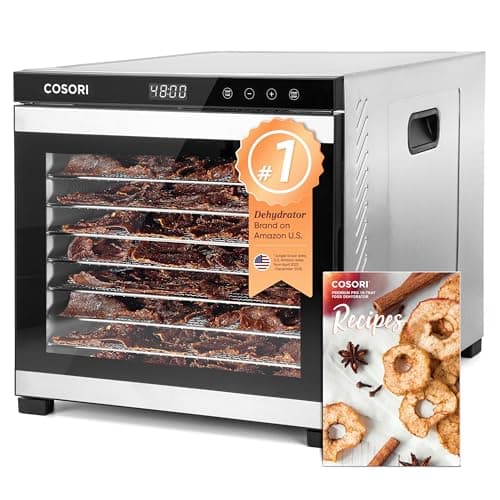
Cosori 10-tray
165°F
Adjustable in 1°F steps
16.2 sq ft
Fixed at 10 trays
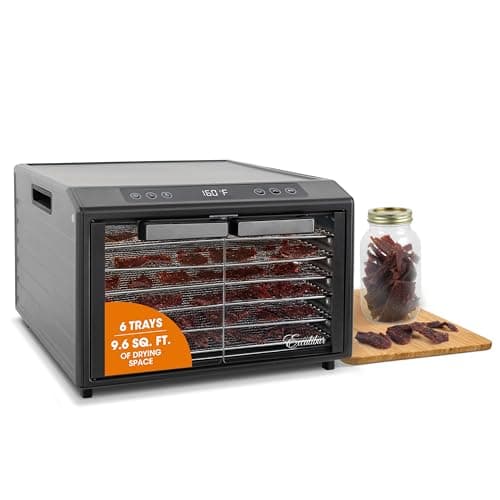
Excalibur Select 6
165°F
Adjustable, 85-165°F
9.6 sq ft
Fixed at 6 trays
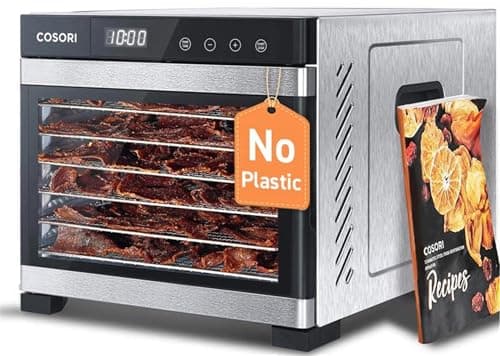
Cosori 6-tray
165°F
Adjustable in 1°F steps
6.5 sq ft
Fixed at 6 trays
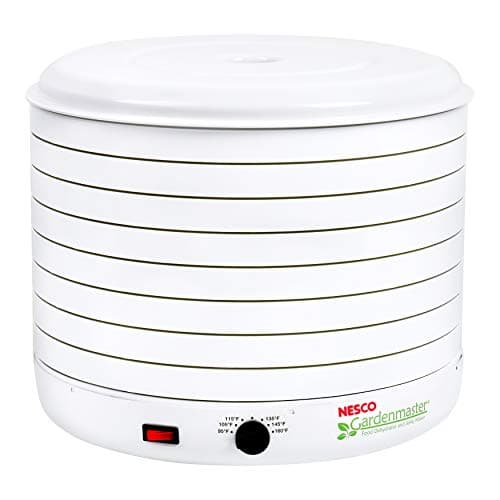
Nesco FD-1018A
160°F
Adjustable, 95-160°F
About 8 sq ft (8 × 1 sq ft)
30 trays
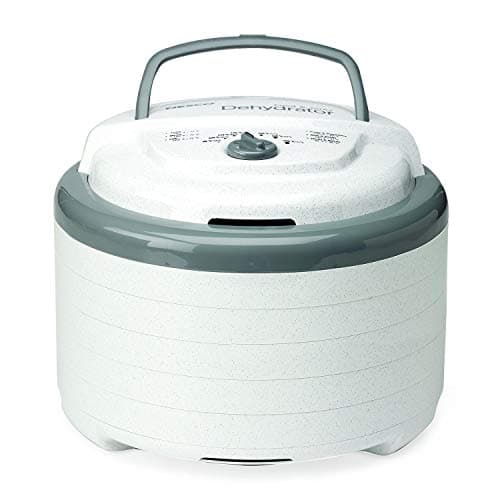
Nesco FD-75A
160°F
Adjustable, 95-160°F
About 4 sq ft (5 × 0.8 sq ft)
12 trays
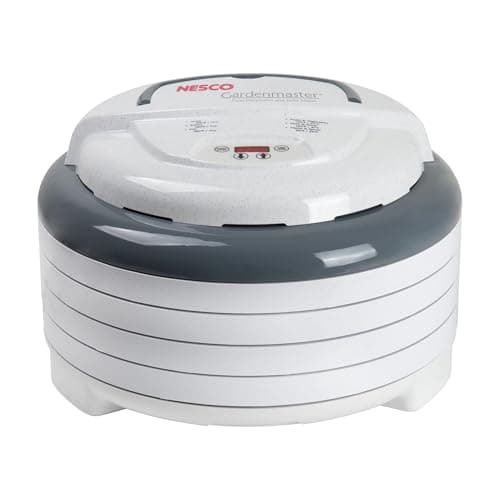
Nesco FD-1040
160°F
Digital, 90-160°F
About 4 sq ft (4 × 1 sq ft)
20 trays
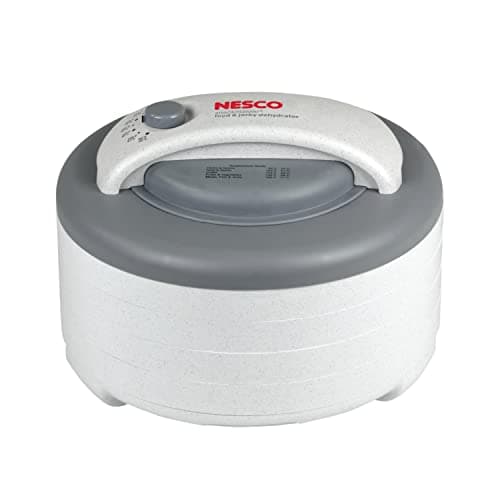
Nesco FD-60
155°F
Adjustable, 95-155°F
Not published
12 trays
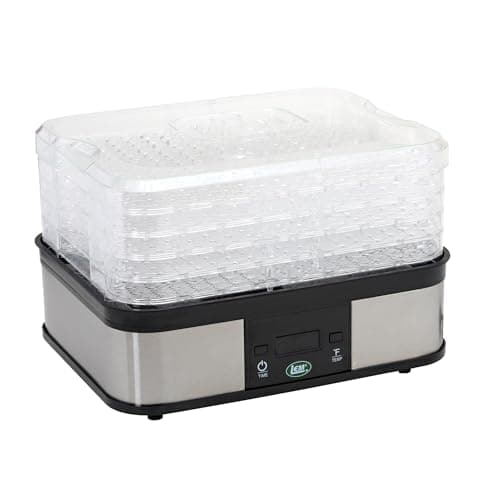
LEM 5-Tray
158°F
Seven fixed presets
3.5 sq ft
Fixed at 5 trays
Presto 06300 (not ranked)
About 165°F
None: preset
Not published
8 trays
Two units in the Nesco and LEM lines stop short of 160°F. The Nesco FD-60 tops out at 155°F, which is the very top of PNW's holding band with nothing to spare. The LEM 5-Tray's highest preset is 158°F. Both can still be set inside the 140-155°F drying range. They rank last because they have no headroom if the air runs cooler than the setting. With either one, the 160°F step has to happen in the oven.
Why the Presto 06300 isn't ranked
At our last price check, the Presto Dehydro 06300 was the least expensive dehydrator we looked at. Its manual says it "operates at a preset temperature of approximately 165°F," and there is no way to change that. USDA asks for a dehydrator with an adjustable dial. PNW 632 goes further: "Do not use dehydrators with factory preset temperatures that cannot be controlled." To Presto's credit, its manual includes USDA's pre-cook and post-bake jerky steps. But a fixed-temperature unit can't be corrected if it runs hot or cold, so we left it off the list.
Tray area is your batch size
USDA says a pound of meat weighs about four ounces once it's jerky. So a 10 lb session of trimmed venison ends up as roughly 2½ lb of finished jerky. A Hi Mountain cure kit seasons up to 15 lb of whole-muscle meat, which works out to about 3¾ lb of jerky. How many loads that takes depends on square feet of tray, and the gap between units is large. The Excalibur Select 10 (16 sq ft) holds four times the tray area of a stock Nesco FD-75A (about 4 sq ft). One Select 10 load equals four FD-75A loads, and NCHFP puts a load at 10 to 24 hours for strips not heated in marinade.
None of these makers publishes a pounds-of-raw-meat-per-tray figure, and we won't invent one. The number depends on your strip width and how tight you lay them. You can measure your own. NCHFP says to lay strips close together but not touching or overlapping. Ohio State Extension suggests leaving about 25 percent open space on each tray. Load one tray that way with weighed strips and multiply by your tray count.
The Nesco models change the math because you can add trays. Twelve 0.8 sq ft Snackmaster trays on an FD-75A come to 9.6 sq ft, the same as an Excalibur Select 6. Thirty Gardenmaster trays on an FD-1018A would be 30 sq ft. Extra trays are a separate purchase, and the Nesco pages we checked don't say how drying time changes at full height, so treat the maximum as a ceiling rather than a promise.
Round stack or square box: airflow
Nesco's Converga-Flow design mounts the fan on top. According to Nesco, it forces heated air down an outer chamber and then horizontally across each tray, and the air converges in the center. The top-mounted fan also keeps marinade drips out of the heater. The Excaliburs use what Excalibur calls horizontal Parallex airflow, meant to dry evenly without rotating trays. Cosori uses a rear-mounted fan and says the 6-tray needs no rotation. Its 10-tray page is more cautious and says rotating trays occasionally may help. The LEM 5-Tray moves air up a central chimney. Ohio State Extension advises rotating trays at least every 2 hours in vertical-airflow units like that one.
Once your dehydrator is sorted, the rest of the chain matters too. Even strips come from a meat slicer set for jerky or a board. Ground jerky needs one of the jerky guns we rank. NCHFP lists vacuum packaging as a good option for finished jerky, so our sealers for wild game are the next stage. The time and temperature guide covers what to set once the unit is on your counter.
In detail
The picks, in full
1
Best overall: 16 sq ft, 165°F
Excalibur Select Series 10-Tray Food Dehydrator
8.9 /10
Sixteen square feet of tray, a dial that runs to 165°F and horizontal airflow: the most jerky per load among the units that clear every temperature bar.
#ad · Price as of Sep 19, 2026 · Affiliate disclosure for the link to LEM 5-Tray Digital Food Dehydrator
Check a dehydrator before you trust it with meat
Because dials can drift, PNW 632 says to confirm with a thermometer that the empty, running dryer delivers at least 145°F. Ohio State Extension recommends the same empty-unit check with a bi-metallic stemmed thermometer. Run it for a while, read the air temperature between trays, and adjust the dial until you hit your target. This is where a 165°F ceiling earns its keep: if your 160°F setting reads 145°F, you still have room to turn it up. If a unit can't hold 145°F empty, PNW says not to use it for meat.
Which size for your season
Jerky is usually a slice of the season, not all of it. Ohio DNR puts the average venison yield at 52.19 lb per deer, so three deer is about 157 lb of meat, and most of that will be ground or cut into steaks. Size the dehydrator to the jerky share, not the whole deer.
A kit or two a year (up to about 15 lb raw per session): the Nesco FD-75A or Cosori 6. Less tray area means more loads per kit, so weigh one loaded tray to learn your number.
Jerky from every deer, 3-5 a season: the Excalibur Select 6 (9.6 sq ft) or a Nesco FD-1018A (about 8 sq ft, expandable).
Big batches, 6+ deer or a family share: the 16 sq ft Excalibur Select 10 or Performance 10, or the 16.2 sq ft Cosori 10. One load does what takes four on a stock FD-75A.
Wattage. None of these makers ties watts to a come-up time or to how well the unit holds temperature, so we don't score it. The empty-unit thermometer check tells you more. Timers. Timers with auto shut-off are useful for overnight runs, but they don't change safety. Glass doors and clear trays let you check progress without opening the unit. 1°F steps on the Cosori units make it easy to stay inside a narrow band. After you've checked the unit with a thermometer, that precision is a genuine help.
How we scored
Every dehydrator gets five scores from 0 to 10, weighted per our published rubric. The weights are: reaches and holds a temperature that fits USDA jerky guidance (30), tray area and batch size (25), airflow design (15), cleanup (10), and value at the live price (20). Where a maker doesn't publish a figure, such as tray area on the Nesco FD-60, we score it neutral and say so. The full method is on how we pick.
How we picked
Units we claim to have bench-tested: none
Plenty of sites say they ground two hundred pounds through every grinder. We didn't, and we say so. What we do instead: read the maker's spec sheet, manual and warranty terms, record the figures that decide whether a machine keeps up with your season (size number, motor rating, rated pounds per minute, capacity, duty cycle, gearing), check parts availability, and score each pick on a published rubric. Then we show the season math — pounds per deer from the Ohio Division of Wildlife's yield study — so you can redo it with your own numbers.
What temperature should a dehydrator be for jerky?+
USDA says to hold a constant 130°F to 140°F while drying, after the meat has been heated to 160°F. NCHFP dries at 140°F. PNW Extension says the dryer should hold 145°F to 155°F. Buy a unit whose dial reaches at least 160°F so you have headroom to correct a dryer that runs cool.
Does a dehydrator need to reach 160°F for jerky?+
The 160°F figure is a meat temperature, and USDA says a dehydrator may not get meat there on its own. Pre-cook the strips or post-bake them at 275°F for 10 minutes. A dial that reaches 160°F to 165°F still matters because dials can read up to 40°F off, per PNW 632, and headroom lets you correct for that.
What's the best budget dehydrator for jerky?+
The Nesco FD-75A. At our last price check it was the least expensive unit here with an adjustable thermostat that reaches 160°F. It ships with five trays and expands to 12. Check the live price in the table above.
Is Nesco or Excalibur better for jerky?+
Excalibur's Select units reach 165°F and have more tray area in the box. Nesco reaches 160°F, costs less and lets you add trays. The full breakdown is in our Nesco vs Excalibur comparison.
Can I use a dehydrator with a fixed temperature for jerky?+
PNW 632 says not to: "Do not use dehydrators with factory preset temperatures that cannot be controlled." USDA also asks for an adjustable dial. That's why the preset Presto 06300 isn't ranked here.
We haven't bench-tested this gear and we don't pretend to. Specs come from the maker's own pages, manuals and maker-supplied listing copy (labeled as such); food-safety figures from USDA and university extension publications; yield from the Ohio Division of Wildlife; prices live from Amazon. Where a figure isn't published, we say so. Read the full method.