Food Dehydrators Under $100 for Jerky: Only One Passes the 160°F Test
Under a hundred dollars the deciding spec is not tray area or timers. It is whether the machine can reach the temperature USDA's jerky guidance is built around, and whether you can choose it.
95-160°F adjustable, 600W and five trays expandable to twelve. It reaches the temperature and lets you choose it, which nothing else under $100 here does.
The same Converga-Flow airflow as the FD-75A with a 500W element that tops out at 155°F, five degrees short of the USDA step. Fine with the oven finish.
#ad · Prices come live from Amazon, last checked Sep 24, 2026; where we have no verified live price we show none. Scores are ours, compiled from published specs, manuals and warranty terms, not bench tests. Tap a row for the full write-up.
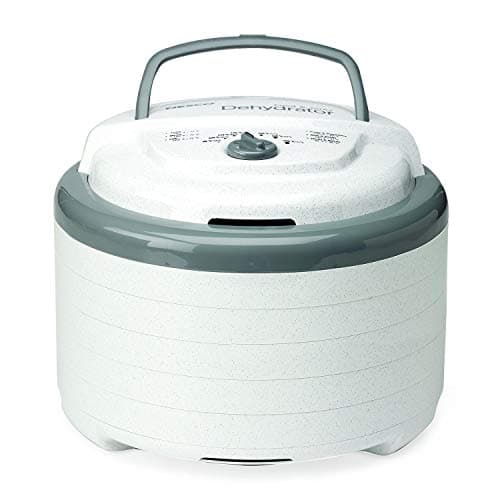
Under $100, buy the NESCO FD-75A Snackmaster Pro. It is the only dehydrator in this price band that both reaches 160°F and lets you set the temperature, which are two different requirements and the reason the other three sit below it. Six hundred watts, five trays expandable to twelve, and a 95-160°F adjustable dial.
That is a narrower recommendation than most sub-$100 roundups give, and the narrowness is the point: three of the four machines here fail the same test in three different ways.
The 160°F test, and why it decides this page
USDA's jerky guidance is built around getting the meat itself to 160°F (165°F for poultry) to kill pathogens, rather than trusting drying alone to do it (FSIS, Jerky and Food Safety). There are two accepted routes, and both are in the extension literature our how to make deer jerky page works through:
Heat the meat to 160°F first, by steaming or roasting, then dry it at a lower temperature.
Dry first, then finish in the oven — 10 minutes at 275°F for strips cut ¼ inch or thinner, per NCHFP, PNW and K-State.
A dehydrator that reaches 160°F can do the whole job in one box. One that stops short is not unsafe, but it requires the oven step, every batch, forever. That is a real ownership difference and it is worth knowing before you buy rather than discovering in the manual.
Who passes, and how the others fail
Dehydrator
Published temperature
Reaches 160°F?
Adjustable?
NESCO FD-75A
95-160°F, adjustable
Yes
Yes
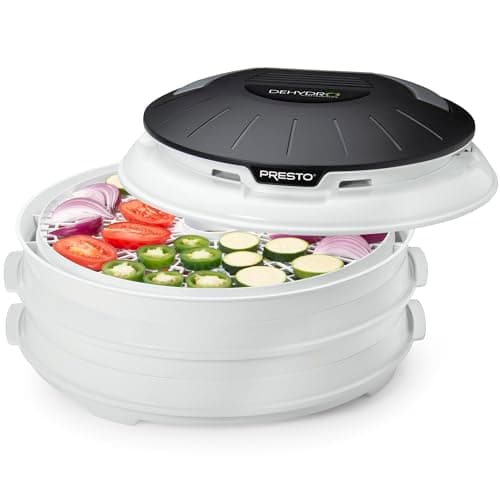
Presto 06300
Preset at about 165°F, not adjustable
Yes (and past it)
No
Nesco FD-60
95-155°F, adjustable
No — 5°F short
Yes
LEM 5-tray digital
Presets to 158°F
No — 2°F short
Yes, by preset
Three distinct failure modes, and it is worth being fair about each:
The Presto passes on temperature and fails on control. A fixed 165°F preset is hot enough for jerky and too hot for fruit, herbs or anything delicate. If jerky is genuinely all you will dry, this is not much of a flaw — and it is the cheapest machine here.
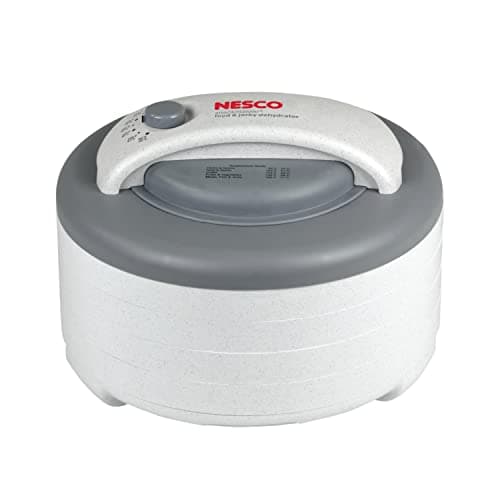
The Nesco FD-60 misses by five degrees. It has the same Converga-Flow airflow design as the winner with a smaller 500W element. Perfectly good jerky machine; it just commits you to the oven finish.
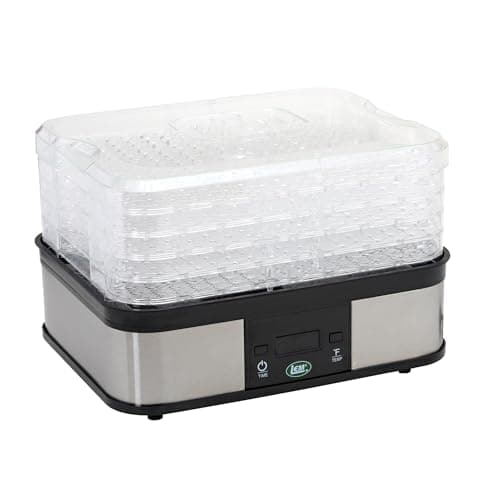
The LEM misses by two. Frustrating, because it otherwise has the best feature set on the page: a 48-hour timer with auto shut-off, digital presets, and a published one-year warranty. Two degrees.
The four, side by side
Spec
NESCO FD-75A
Presto 06300
Nesco FD-60
LEM 5-tray digital
Temperature
95-160°F
~165°F fixed
95-155°F
Presets to 158°F
Power
600W
600W
500W
250W
Trays included
5
4
4
5
Expandable to
12
8
12
Not stated
Airflow
Top fan, Converga-Flow, no rotation needed
Top fan and element
Top fan, Converga-Flow
Per LEM's spec
Timer
No
No
No
48-hour, auto shut-off
Warranty
Per Nesco
One year limited
Per Nesco
One year
Cleaning
Per Nesco
Trays and base immersible; not dishwasher safe
Per Nesco
Per LEM
Note the 250W element on the LEM against 600W on the two winners. Wattage on a dehydrator is roughly how fast it can put heat back into a full stack after you open the lid, so it matters most on a big batch — which is the other reason the FD-75A leads.
If your dehydrator cannot reach 160°F
Two of the four here cannot, and so can plenty of machines people already own. That is fine, and the fix is documented rather than improvised:
Finish in the oven. Ten minutes at 275°F after drying, for strips cut ¼ inch or thinner — the alternative NCHFP, PNW and K-State all publish.
Or precook before drying. Steam or roast the strips to 160°F first, then dry at whatever temperature your machine gives you.
Either way, check with a thermometer. The dial is a setting, not a measurement.
The practical cost is a hot oven at the start or end of every batch. Over years of jerky that is the argument for spending a little more once — and it is why we would take the FD-75A over the better-specified LEM for two degrees.
What you give up under $100
Being honest about the ceiling matters more than stretching the picks. Compared with the machines on our main dehydrator roundup, under $100 you are giving up:
Horizontal airflow. Every machine here is a round stack with a top-mounted fan. Square-box dehydrators with a rear fan dry more evenly across a full load — see Nesco vs Excalibur.
Tray area. The biggest machines are several times the drying area of a five-tray stack.
Timers, mostly. Only the LEM has one, and it is the machine that cannot hit 160°F.
Stainless trays. These are plastic-tray machines at this price.
What you do not give up is safe jerky. All four can produce it; two of them need the oven step to do it.
Tray area: the spec to check second
Once a machine clears the temperature test, batch size is what decides whether you enjoy owning it. Jerky loses a lot of weight in drying, so a deer produces far more trays of jerky than people expect: at the Ohio DNR average of 52.19 lb of venison per deer, even dedicating a few pounds to jerky is several full loads on a five-tray stack.
Both Nescos expand to twelve trays, which is the quiet advantage of the round-stack design and the reason we would pick one of them over the Presto's eight if you expect to make jerky more than occasionally. Our slicing guide covers getting uniform strips so a full stack finishes at the same time.
In detail
The picks, in full
1
The only one that passes
NESCO FD-75A Snackmaster Pro Food Dehydrator
7.4 /10
95-160°F adjustable, 600W and five trays expandable to twelve. It reaches the temperature and lets you choose it, which nothing else under $100 here does.
#ad · Price as of Sep 24, 2026 · Affiliate disclosure for the link to Presto 06300 Dehydro Electric Food Dehydrator
3
Stops at 155°F
Nesco FD-60 Snackmaster Express Food Dehydrator
5.8 /10
The same Converga-Flow airflow as the FD-75A with a 500W element that tops out at 155°F, five degrees short of the USDA step. Fine with the oven finish.
#ad · Price as of Sep 24, 2026 · Affiliate disclosure for the link to LEM 5-Tray Digital Food Dehydrator
How we ranked these
On the dehydrator rubric this site uses everywhere: reaching and holding a USDA-fit temperature (the heaviest weight), tray area and batch size, airflow design, cleanup and value. Under $100 the first metric is decisive, because it is the one that changes your routine for the life of the machine.
Every temperature figure comes from the maker's own manual or spec page, cited on each product card. We have not bench-tested any of these machines and we have not verified that a dial reading 160°F produces 160°F air — which is exactly why the safety step is measured at the meat, with a thermometer, rather than read off the front panel.
What we would buy
NESCO FD-75A, for almost everybody: it passes the temperature test, it is adjustable, and it expands to twelve trays. Presto 06300 if you want the cheapest machine and will only ever dry jerky. We would take either Nesco over the LEM despite the LEM's better feature set, purely on the 158°F ceiling — and if you want a timer badly enough to accept the oven finish, the LEM is a reasonable choice made with your eyes open.
How we picked
Units we claim to have bench-tested: none
Plenty of sites say they ground two hundred pounds through every grinder. We didn't, and we say so. What we do instead: read the maker's spec sheet, manual and warranty terms, record the figures that decide whether a machine keeps up with your season (size number, motor rating, rated pounds per minute, capacity, duty cycle, gearing), check parts availability, and score each pick on a published rubric. Then we show the season math — pounds per deer from the Ohio Division of Wildlife's yield study — so you can redo it with your own numbers.
What is the best food dehydrator under $100 for jerky?+
The NESCO FD-75A Snackmaster Pro. It is the only machine in this price band that both reaches 160°F and lets you set the temperature, on a 600W element with five trays expandable to twelve.
Do you need a dehydrator that reaches 160°F?+
Not strictly, but if yours does not you must use the oven every batch — either heating the meat to 160°F before drying, or 10 minutes at 275°F afterwards for strips ¼ inch or thinner. USDA's guidance is about the meat reaching 160°F, not the air.
Is a cheap dehydrator good enough for venison jerky?+
Yes, with one caveat: check the top temperature before you buy. All four machines here make safe jerky, but two of them (the Nesco FD-60 at 155°F and the LEM at 158°F) commit you to an oven step every time.
Why does a fixed-temperature dehydrator matter?+
The Presto 06300 runs at about 165°F with no adjustment. That is hot enough for jerky and too hot for fruit, herbs or anything delicate, so it is a jerky-only machine. If that is all you want, it is the cheapest way in.
How many trays do you need for a deer's worth of jerky?+
More than the four or five that come in the box. Jerky loses a lot of weight in drying, so even a few pounds of venison is several loads on a five-tray stack. Both Nescos expand to twelve trays, which is the round-stack design's real advantage.
Dehydrator or oven, if the budget is under $100?+
Try the oven first to find out whether you like making jerky — PNW frames oven drying exactly that way. Then buy a dehydrator, because PNW also puts oven drying at two to three times the drying time and generally lower quality. See our dehydrator vs smoker vs oven comparison.
We haven't bench-tested this gear and we don't pretend to. Specs come from the maker's own pages, manuals and maker-supplied listing copy (labeled as such); food-safety figures from USDA and university extension publications; yield from the Ohio Division of Wildlife; prices live from Amazon. Where a figure isn't published, we say so. Read the full method.