Nesco vs Excalibur for Jerky: Round Stack or Square Box
The Nesco FD-75A and the Excalibur Select 6 both clear the 160°F bar on paper. The difference is 5°F of headroom, how the trays grow, and cleanup. Cosori's 6-tray gets a look too.
#ad · Price as of Sep 19, 2026 · Affiliate disclosure for the link to Cosori 6-Tray Stainless Steel Food Dehydrator
Buy the Excalibur Select 6 if you want a 165°F ceiling, 9.6 sq ft of tray in the box and a three-year warranty. Buy the Nesco FD-75A if budget comes first and you like the option to stack up to 12 trays later. For jerky specifically, the tiebreaker is the Excalibur's 5°F of headroom above 160°F. PNW Extension found dehydrator dials can read as much as 40°F away from the actual air temperature, and headroom is how you correct for that.
That's a comparison on paper. We haven't run the units side by side, so every figure below comes from Nesco's and Excalibur's own pages and listing copy.
Side by side
Spec
Nesco FD-75A
Excalibur Select 6
Cosori 6-tray
Temperature range
95-160°F
85-165°F
95-165°F, 1°F steps
Tray area as shipped
About 4 sq ft (5 × 0.8 sq ft)
9.6 sq ft
6.5 sq ft
Maximum tray area
About 9.6 sq ft at 12 trays
9.6 sq ft (6 trays)
6.5 sq ft (6 trays)
Airflow
Top-mounted fan, Converga-Flow
Horizontal Parallex airflow
Rear-mounted fan
Tray rotation
Not needed, per Nesco
Not needed, per Excalibur
Not needed, per Cosori
Trays
Round, 13½ in (Nesco Snackmaster figure)
Chrome, dishwasher-safe
Stainless, dishwasher-safe
Timer
None listed
Up to 60 hours
Up to 48 hours
Warranty
Not stated on the pages we checked
3-year limited
2-year limited
Temperature: 160°F vs 165°F
Both clear the bar. USDA wants the drying run held at 130°F to 140°F after the meat has been heated to 160°F, and PNW 632 wants a dryer that can hold 145°F to 155°F. Both dials cover that band, and USDA wants it held "throughout the drying process," not just reached once. The difference shows up when the dial is wrong. PNW's summary of university research found air temperatures up to 40°F away from the dial setting and swings of 30°F to 40°F during drying. If your empty Nesco reads 145°F on a thermometer at its 160°F maximum, you're at the floor with nowhere to go. An Excalibur reading the same at 160°F still has 5°F of dial left. Neither dial replaces the 160°F step for the meat itself. Do that in the oven, as USDA's jerky guidance lays out.
Tray area and growing into it
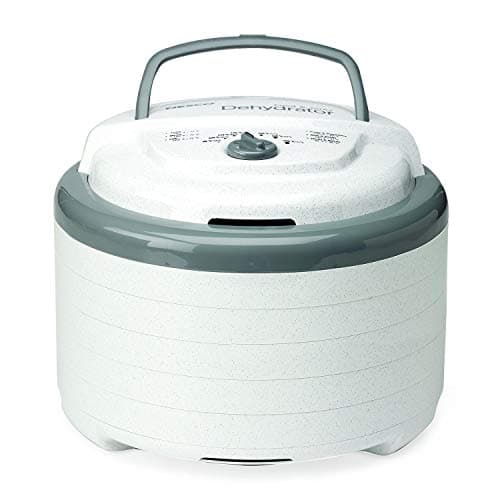
Out of the box, the Excalibur has more than twice the tray area: 9.6 sq ft against about 4 sq ft. Nesco publishes 0.8 sq ft of drying area per 13½-inch Snackmaster tray, and the FD-75A ships with five. Its advantage is expansion. At its 12-tray maximum it reaches about 9.6 sq ft, the same as the Excalibur. You buy the extra trays separately. The Excalibur's tray count is fixed; neither its page nor the listing mentions add-on trays.
In practice the Nesco suits someone who isn't sure how much jerky they'll make. It starts small and grows with the hobby. The Excalibur suits someone who already knows, and would rather load one box than stack a tall column.
Airflow: top-down vs side-to-side
Nesco's fan sits on top. Nesco says Converga-Flow forces heated air down an outer chamber, then horizontally across each tray, where it converges in the center. Nesco's FD-75A listing says the top-mounted fan "prevents liquids from dripping into the heating element and eliminates hot spots," which is useful with wet, marinated strips. Excalibur's Select line uses what it calls Hyperwave technology with horizontal Parallex airflow for even drying without rotating trays. Both makers claim no rotation is needed, so on paper it's a draw. The real difference is the shape of the trays: round and stacked on the Nesco, square shelves in a box on the Excalibur.
Cleanup and warranty
Excalibur's page lists the Select 6's chrome trays as dishwasher-safe and covers the unit with a three-year limited warranty. Nesco's FD-75A listing and the Snackmaster Pro page we checked don't state either. That doesn't mean there's no warranty, only that we couldn't confirm one, so we scored it neutral. If cleanup ranks high for you, the Cosori below is the one with stainless, dishwasher-safe trays.
Timers and overnight runs
NCHFP puts drying at 10 to 24 hours for strips not heated in marinade, so a lot of jerky dries overnight. The Excalibur Select 6 has a timer of up to 60 hours, and Excalibur says it shuts itself off when the countdown ends. The Cosori 6 has a 48-hour timer. The FD-75A listing shows no timer at all, which means you're the timer. That's fine if you're checking strips from the 3-hour mark, as NCHFP suggests. It's a real difference if you like to load the trays at night.
Before the first batch, whichever you buy
PNW 632 says to run the empty dryer and confirm with a thermometer that it delivers at least 145°F (PNW 632). Do that with either unit on day one. If the Nesco reads low at its maximum, you've learned its limit before any meat is at stake. If the Excalibur reads low at 160°F, turn it toward 165°F and check again. It's the cheapest safety test in jerky, and it's the practical reason the 5°F of extra dial matters.
Excalibur vs Cosori: the third box
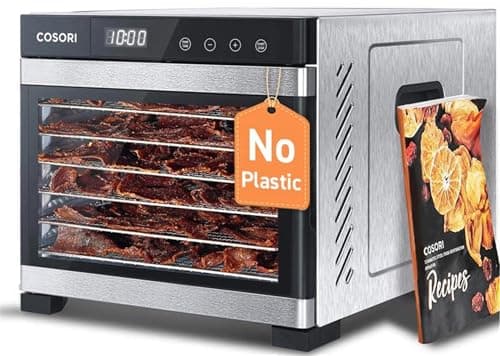
The Cosori 6-tray is the third box worth a look. Its range matches the Excalibur's 165°F ceiling, and it sets temperature in 1°F steps, which makes a narrow holding band easy to hit once you've checked the unit with a thermometer. Its six stainless trays are dishwasher-safe, Cosori rates it under 48 dB, and the warranty is two years. The trade-off is area. The Excalibur has about half again as much tray per load (9.6 against 6.5 sq ft), and its warranty runs a year longer. The Cosori is the pick if cleanup and precision matter more than batch size.
Which one for your season
If you make jerky from one deer and grind the rest, the FD-75A's roughly 4 sq ft means more loads per kit than the Excalibur, and that's fine for a once-a-year batch. If jerky comes out of every deer in a three- to five-deer season, fewer loads saves a lot of time, and the Excalibur's 9.6 sq ft earns its price. If you might jerk three deer one year and none the next, the Nesco's add-a-tray approach matches that pattern better than a fixed box. Whichever you choose, the settings and timing are the same, covered in our jerky time and temperature guide. The whole process, sliced or ground, is in how to make deer jerky.
In detail
The contenders, in full
Best mid-size pick
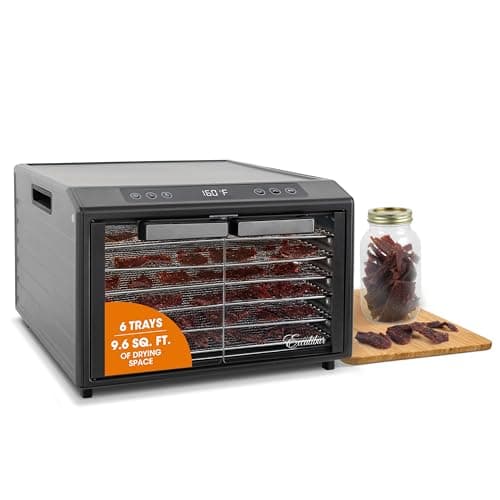
Excalibur Select Series 6-Tray Food Dehydrator
8.3 /10
9.6 sq ft, 85-165°F and horizontal airflow in a mid-size box: the sensible Excalibur for a hunter jerking part of one or two deer.
#ad · Price as of Sep 19, 2026 · Affiliate disclosure for the link to Cosori 6-Tray Stainless Steel Food Dehydrator
How we picked
Units we claim to have bench-tested: none
Plenty of sites say they ground two hundred pounds through every grinder. We didn't, and we say so. What we do instead: read the maker's spec sheet, manual and warranty terms, record the figures that decide whether a machine keeps up with your season (size number, motor rating, rated pounds per minute, capacity, duty cycle, gearing), check parts availability, and score each pick on a published rubric. Then we show the season math — pounds per deer from the Ohio Division of Wildlife's yield study — so you can redo it with your own numbers.
On paper, the Excalibur Select 6. It reaches 165°F instead of 160°F, has more than twice the tray area as shipped and carries a three-year warranty. The Nesco FD-75A costs less and expands to 12 trays.
Does the Nesco FD-75A get hot enough for jerky?+
Its dial runs to 160°F, which covers USDA's 130-140°F drying range and PNW's 145-155°F band. Check the empty unit with a thermometer, and do the 160°F meat step separately.
Excalibur vs Cosori: which is better for jerky?+
Both reach 165°F. The Excalibur Select 6 has more tray area (9.6 vs 6.5 sq ft) and a longer warranty. The Cosori 6 has 1°F control and stainless dishwasher-safe trays.
Can you add trays to an Excalibur Select 6?+
Neither Excalibur's product page nor the listing mentions add-on trays; it ships with six. Nesco's FD-75A is the expandable one, up to 12 trays.
We haven't bench-tested this gear and we don't pretend to. Specs come from the maker's own pages, manuals and maker-supplied listing copy (labeled as such); food-safety figures from USDA and university extension publications; yield from the Ohio Division of Wildlife; prices live from Amazon. Where a figure isn't published, we say so. Read the full method.