Skip to content
GRIND & CURE

Home Processing Our picks

Boning Knives for Deer: Semi-Stiff, Flexible or Both

Most of a deer comes off the bone with one knife. Here's which blade shape and flex does that job best, and when a second knife earns its place.

By Mike M.Updated How we pick
#ad

We earn a commission if you buy through our links, at no extra cost to you. It never decides the ranking — the method is published · Affiliate disclosure

The short answer

Quick picks

#ProductBest forScorePrice
1
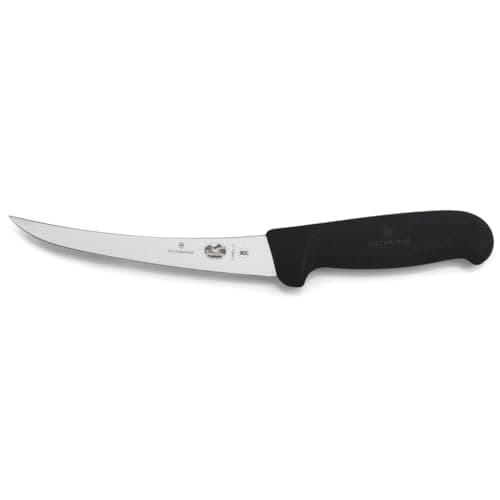
Victorinox Victorinox Fibrox Pro 6 in Curved Boning Knife, Semi-Stiff
Victorinox Fibrox Pro 6 in Curved Boning Knife, Semi-Stiff

The first knife to buy for deer: a 6 in curved blade with enough spine to lever around joints and enough give to follow the seams.

Best boning knife for deer7.6 /10$25.50Amazon
2
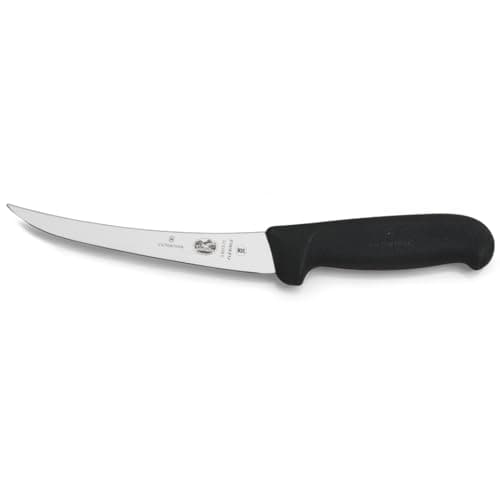
Victorinox Victorinox Fibrox 6 in Curved Boning Knife, Flexible
Victorinox Fibrox 6 in Curved Boning Knife, Flexible

The trimming partner to the semi-stiff: same curved 6 in pattern, with the flex to follow fat, sinew and silver skin.

Best for trimming and silver skin7.2 /10$31.17Amazon
3
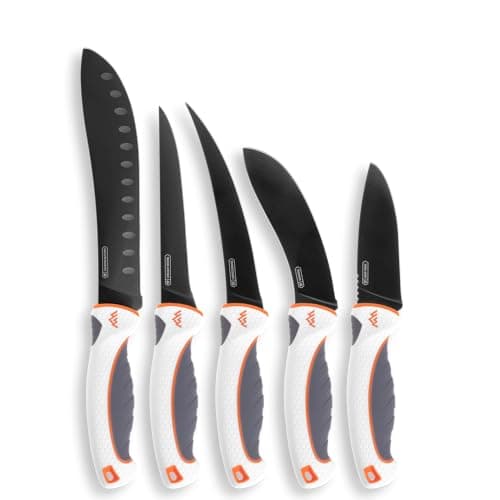
Outdoor Edge Outdoor Edge ErgoMax 6-Piece Processing Knife Set
Outdoor Edge ErgoMax 6-Piece Processing Knife Set

Five knives chosen for the cutting table, including a semi-stiff and a mid-flex boning blade. No saw or field tools, and the maker says keep it out of the dishwasher.

Best boning pair in one set7.2 /10$109.99Amazon
4
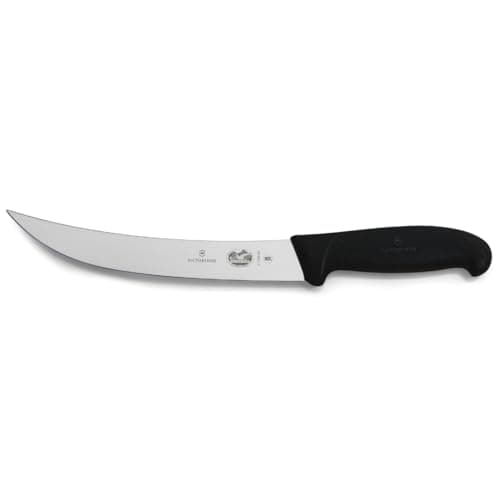
Victorinox Victorinox Fibrox 8 in Curved Breaking Knife
Victorinox Fibrox 8 in Curved Breaking Knife

Not a boning knife. It's the knife that portions what the boning knife takes off the bone.

The partner knife7.5 /10$36.79Amazon
5
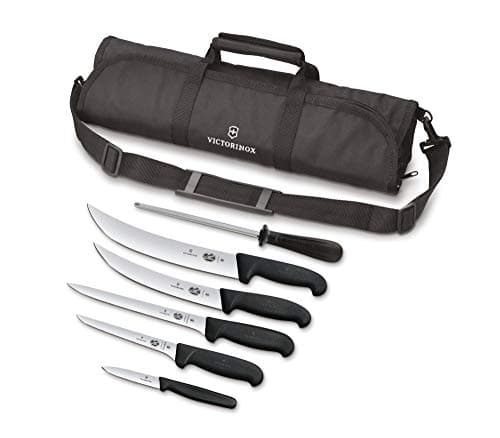
Victorinox Victorinox Fibrox Field Dressing Kit, 7-Piece
Victorinox Fibrox Field Dressing Kit, 7-Piece

Five commercial Fibrox butcher patterns plus a 10 in steel in a knife roll: the set a meat cutter would assemble, minus the field tools.

Straight flexible boner, in a full set7.7 /10$199.51Amazon

#ad · Prices come live from Amazon, last checked Sep 19, 2026; where we have no verified live price we show none. Scores are ours, compiled from published specs, manuals and warranty terms, not bench tests. Tap a row for the full write-up.

For deer, buy a 6 in curved semi-stiff boning knife first, and the Victorinox Fibrox Pro is the one we'd pick. Victorinox's own copy makes the case: thick meats call for a less flexible knife, but this blade's slight bend still allows a delicate touch, and the curve gives a better working angle close to and around the bone. Add the flexible version of the same knife when trimming becomes the bottleneck.

We haven't bench-tested these. Blade lengths, flex, weights and care rules below come from Victorinox and Outdoor Edge product pages or their listing copy, and every card links its sources.

Stiff, semi-stiff and flexible, in the makers' own words

Flex is the choice that matters most, and Victorinox lays out the logic better than most reviews do. Its listing for the semi-stiff curved boner says thick meats like beef or pork require a less flexible knife, and that this blade's slight bend allows a delicate touch. The flexible version, per its listing, is for “thinner or more delicate cuts of meat such as chicken or fish,” and Victorinox's product page adds “trimming fat and sinew.” The straight boner in its Field Dressing Kit is described as extra narrow and flexible, for delicate trimming and deboning.

Deer sit between those poles. Venison muscles come apart along natural seams, which a flexible blade follows well, but getting a hindquarter off at the hip or working around the shoulder blade takes a blade that won't bow when you lean on it. Semi-stiff handles both. A fully stiff boning knife suits heavy beef and pork work, by the same reasoning Victorinox gives for the semi-stiff blade; on a deer, the semi-stiff covers that role, which is why none of our picks is a stiff blade.

The boning blades compared

KnifeBladeFlexWeightDishwasher
Victorinox Fibrox Pro, curved (5.6603.15)5.9 in curvedSemi-stiff3.4 ozYes
Victorinox Fibrox, curved (5.6613.15)5.9 in curvedFlexible3.2 ozYes
Victorinox Fibrox, straight (5.6413.15, in the Field Dressing Kit)5.9 in straight, extra narrowFlexible3 ozYes
Outdoor Edge ErgoMax straight boner6.0 in straightSemi-stiffNot publishedNo (hand-wash)
Outdoor Edge ErgoMax curved boner6.0 in curvedMid-flexNot publishedNo (hand-wash)

Victorinox sells its 6 in boning knives with a 5.9 in blade on its spec pages, so the “6 in” and “5.9 in” you'll see are the same knife. The curved semi-stiff pattern is also sold under two listings (5.6603.15 and 5.6603.15BK). Buy whichever is cheaper the day you shop.

Curved or straight

Victorinox says the curved edge allows smooth, clean cuts close to and around the bone, and that is the case for curved as your only boning knife. A straight blade is easier to steer on a flat board and handier for trimming, which is how Outdoor Edge splits its ErgoMax pair: straight and semi-stiff, curved and mid-flex. If you buy one knife, make it curved. If you buy two, the second can be either shape as long as it's the other flex.

Why 6 inches

Every dedicated boning knife on this page runs 5.9 to 6.0 in. The boning/fillet blades in hunting kits run shorter: 5.0 in on the WildPak and WildLite, 5.5 in on the Game-Pro, 5.9 in on the PR-1, per Outdoor Edge. A shorter blade takes more strokes on the big hindquarter muscles. A longer one, like an 8 in fillet knife, is harder to keep on line in a deep seam. Six inches is where both makers on this page land for their dedicated boning knives.

Where the boning knife does its work on a deer

Once the deer is skinned and cold, the boning knife does most of what follows. It takes the front shoulders off along the seam against the ribs, frees the backstraps along both sides of the spine, lifts out the tenderloins, and separates each hindquarter into its big muscle groups by following the seams between them. The neck, shanks and rib meat come off it too, usually bound for the grinder. Our home processing guide walks through the order.

Two habits make the knife more effective. Penn State Extension advises cleaning your knife frequently between cuts so you don't drag bacteria into the meat, and removing all visible dirt, hair and bloodshot areas as you go. Sorting as you cut (steaks and roasts in one lug, jerky pieces in another, trim for the grinder in a third) saves a second handling. Our best cuts for jerky and how to grind deer meat guides pick up from there.

Semi-stiff or flexible, job by job

If you're deciding whether a second knife is worth it, it helps to see which blade suits which job. This is our reading of the makers' flex descriptions applied to a deer, not a measured result.

JobBetter bladeWhy
Freeing a shoulder along the ribsSemi-stiffLong seam with some resistance; you lean on the blade
Separating a hindquarter at the hipSemi-stiffYou work the tip around a joint and lever against bone
Lifting backstraps off the spineSemi-stiffThe blade rides along bone the whole length
Seam-boning hindquarter musclesEitherMembrane seams part easily; flex follows curves, stiffness keeps the line
Peeling silver skinFlexibleThe blade needs to lie flat and follow the surface
Trimming fat and sinew for the grinderFlexibleVictorinox pitches its flexible boner for exactly this

Count the rows. The semi-stiff blade owns the jobs that happen once per quarter and need leverage; the flexible blade owns the jobs that repeat on every single piece of meat. That's why one semi-stiff knife gets a first deer done, and why trimming is where a season with several deer starts to drag without the second knife.

The knife that goes with it

A boning knife takes meat off bone. It's not the best tool for cutting a boned-out top round into even steaks; that's a longer, heavier curved blade like the Victorinox 8 in breaking knife, which Victorinox says keeps slices uniform and stops meat from tearing. It's ranked fourth here as the partner, not as a boning knife. Our butcher knife set roundup covers the full table lineup.

In detail

The picks, in full

1
Victorinox Victorinox Fibrox Pro 6 in Curved Boning Knife, Semi-Stiff

Best boning knife for deer

Victorinox Fibrox Pro 6 in Curved Boning Knife, Semi-Stiff

7.6 /10

The first knife to buy for deer: a 6 in curved blade with enough spine to lever around joints and enough give to follow the seams.

Steel & edge retention (per maker)
6.5
Completeness vs a real breakdown
6
Handle & safety
9
Sheath / cleaning
8.5
Value at live price
9

What it gets right

  • Victorinox itself pitches the semi-stiff blade for thicker meats that need a less flexible knife
  • Curved edge gives a better working angle close to and around bone, per the maker
  • NSF-listed handle stays grippy when wet

What it doesn't

  • Stiffer than you want for peeling silver skin off a backstrap
  • Hardness not published

Skip this if…

your main job is trimming membrane off already-boned cuts for jerky or roasts. The flexible version of this knife follows a flat surface better.

$25.50$40.0036%View on Amazon

#ad · Price as of Sep 19, 2026 · Affiliate disclosure for the link to Victorinox Fibrox Pro 6 in Curved Boning Knife, Semi-Stiff

2
Victorinox Victorinox Fibrox 6 in Curved Boning Knife, Flexible

Best for trimming and silver skin

Victorinox Fibrox 6 in Curved Boning Knife, Flexible

7.2 /10

The trimming partner to the semi-stiff: same curved 6 in pattern, with the flex to follow fat, sinew and silver skin.

Steel & edge retention (per maker)
6.5
Completeness vs a real breakdown
5
Handle & safety
9
Sheath / cleaning
8.5
Value at live price
8.5

What it gets right

  • Victorinox pitches it for trimming fat and sinew, the most repeated job on a deer
  • Dishwasher safe with a lifetime warranty, per Victorinox
  • Same handle and length as the semi-stiff, so the pair feels identical in hand

What it doesn't

  • The listing copy pitches the flex for tender, delicate cuts like chicken or fish, so it's the wrong blade for levering around a hip joint
  • Hardness not published

Skip this if…

it would be your only knife. Buy the semi-stiff first; add this when trimming becomes the bottleneck.

$31.17$40.0022%View on Amazon

#ad · Price as of Sep 19, 2026 · Affiliate disclosure for the link to Victorinox Fibrox 6 in Curved Boning Knife, Flexible

3
Outdoor Edge Outdoor Edge ErgoMax 6-Piece Processing Knife Set

Best boning pair in one set

Outdoor Edge ErgoMax 6-Piece Processing Knife Set

7.2 /10

Five knives chosen for the cutting table, including a semi-stiff and a mid-flex boning blade. No saw or field tools, and the maker says keep it out of the dishwasher.

Steel & edge retention (per maker)
6.5
Completeness vs a real breakdown
7
Handle & safety
8.5
Sheath / cleaning
7
Value at live price
7

What it gets right

  • Two 6 in boning knives with different flex, the pair most deer breakdowns actually use
  • 8 in Granton butcher knife for portioning steaks and roasts
  • The maker publishes care instructions and a sharpening angle, which most kits don't

What it doesn't

  • No saw, spreader, shears or gloves; it is a butcher set, not a field kit
  • Hand-wash only, per Outdoor Edge
  • No hardness figure published for the 5Cr15Mov blades

Skip this if…

you want one case that also handles field dressing and bone. Nothing here cuts bone, so you'd be buying a saw and a gut-hook separately.

$109.99View on Amazon

#ad · Price as of Sep 19, 2026 · Affiliate disclosure for the link to Outdoor Edge ErgoMax 6-Piece Processing Knife Set

4
Victorinox Victorinox Fibrox 8 in Curved Breaking Knife

The partner knife

Victorinox Fibrox 8 in Curved Breaking Knife

7.5 /10

Not a boning knife. It's the knife that portions what the boning knife takes off the bone.

Steel & edge retention (per maker)
7
Completeness vs a real breakdown
5.5
Handle & safety
9
Sheath / cleaning
8.5
Value at live price
8.5

What it gets right

  • Wider, heavier blade keeps slices uniform and stops meat tearing, per Victorinox
  • 8 in length suits deer-sized muscles without being unwieldy
  • Shares its base item number (5.7203.20) with the slaughter knife in Victorinox's Field Dressing Kit

What it doesn't

  • Not a boning knife; too long and wide to work around joints
  • Hardness not published

Skip this if…

you only grind. If every scrap goes through the grinder, a boning knife alone does the job.

$36.79View on Amazon

#ad · Price as of Sep 19, 2026 · Affiliate disclosure for the link to Victorinox Fibrox 8 in Curved Breaking Knife

5
Victorinox Victorinox Fibrox Field Dressing Kit, 7-Piece

Straight flexible boner, in a full set

Victorinox Fibrox Field Dressing Kit, 7-Piece

7.7 /10

Five commercial Fibrox butcher patterns plus a 10 in steel in a knife roll: the set a meat cutter would assemble, minus the field tools.

Steel & edge retention (per maker)
7
Completeness vs a real breakdown
8
Handle & safety
8.5
Sheath / cleaning
8
Value at live price
7

What it gets right

  • Four dedicated meat-cutting patterns, including the 9.8 in cimeter Victorinox describes for portioning large cuts
  • Includes a honing steel, the tool that keeps an edge working through a long session
  • Item numbers match Victorinox's standalone knives, so a lost or worn blade is easy to replace singly

What it doesn't

  • No saw, gut-hook or rib spreader; you still need field tools
  • A roll protects less than a hard case in a truck
  • Victorinox publishes no hardness figure

Skip this if…

you want one box for the field and the table. This is table-only; the Outdoor Edge PR-1 carries the saw and field pieces.

$199.51View on Amazon

#ad · Price as of Sep 19, 2026 · Affiliate disclosure for the link to Victorinox Fibrox Field Dressing Kit, 7-Piece

Buying a boning knife: what matters

Flex first

Semi-stiff for your first or only knife. Flexible as the second, for trimming fat, sinew and silver skin. The makers describe both; a listing that doesn't say which flex you're getting is a listing to skip.

A handle that holds when it's wet

Victorinox describes its Fibrox Pro handle as non-slip even when wet and says the knife meets NSF standards. Outdoor Edge's ErgoMax uses a triple-shot TPR handle designed to reduce hand fatigue. Both matter more on the third hour than the first.

Care you'll actually follow

Victorinox lists its Fibrox boning knives as dishwasher safe. Outdoor Edge says to hand-wash the ErgoMax and keep it out of the dishwasher. If cleanup is a family job, the dishwasher-safe knife is the one that won't get ruined by a well-meaning helper.

An edge you can maintain

All of these have plain edges, which you can hone on a steel or touch up on a pull-through sharpener. The ErgoMax set includes a two-stage carbide and ceramic sharpener that its listing says finishes at 22 degrees. The standalone Victorinox knives come without one.

Warranty

Victorinox offers a lifetime guarantee against defects in material and workmanship on these knives. Outdoor Edge's Service for Life covers defects but, per its pages, not normal wear, misuse or sharpening.

When the kit blade is enough

If you already own a processing kit, you may already own a boning knife. The PR-1's 5.9 in boning/fillet blade is the right length; what you don't know is its flex, because Outdoor Edge doesn't publish it. The 5.0 in blades in the WildPak and WildLite are short for a big hindquarter. Our advice: use the kit blade for your first deer, notice where it bows or where it runs out of reach, and buy the Victorinox that fixes that specific problem. A blade that bows at the joints means you need the semi-stiff; a blade that won't lie flat on silver skin means you need the flexible.

One knife or two for your season

At one or two deer, about 52-104 lb of meat at the Ohio DNR average of 52.19 lb per deer, one semi-stiff boning knife and a way to keep it sharp is enough. At three to five deer, 157-261 lb, the flexible knife pays off: trimming is the most repeated job at the table, and a second blade means you can hone one while using the other. Our 1-2 deer setup and 3-5 deer setup show the knives next to the rest of the gear. And if you're tempted by the fillet knife in your tackle box, read our boning knife vs fillet knife comparison first.
How we picked

Units we claim to have bench-tested: none

Plenty of sites say they ground two hundred pounds through every grinder. We didn't, and we say so. What we do instead: read the maker's spec sheet, manual and warranty terms, record the figures that decide whether a machine keeps up with your season (size number, motor rating, rated pounds per minute, capacity, duty cycle, gearing), check parts availability, and score each pick on a published rubric. Then we show the season math — pounds per deer from the Ohio Division of Wildlife's yield study — so you can redo it with your own numbers.

Scores are editorial judgments from that documented research, not lab results. Nobody pays for placement. The rubric and weights are on the How We Pick page.

Questions

Frequently asked

What is the best boning knife for deer?
A 6 in curved semi-stiff boning knife. Our pick is the Victorinox Fibrox Pro (5.6603.15), which Victorinox pitches for thicker meats that need a less flexible blade while keeping enough bend for close work around bone.
Should a boning knife for venison be stiff or flexible?
Semi-stiff for your main knife: it has the spine to work around joints and enough give to follow seams. Flexible is the better second knife, for trimming fat, sinew and silver skin. Fully stiff blades are built for heavier beef and pork work.
What size boning knife do I need for deer?
About 6 in. Victorinox's 6 in boning knives measure 5.9 in on its spec pages, and Outdoor Edge's ErgoMax boners are 6.0 in. Kit boning blades of 5.0-5.5 in work but take more strokes on large muscles.
Can I use a fillet knife to debone a deer?
You can, but it's the wrong tool for joints. An 8 in fillet blade is long and flexible, built for fish, and bows when you need leverage. See our boning vs fillet comparison.
Curved or straight boning knife for deer?
Curved, if you're buying one. Victorinox says the curve gives smooth, clean cuts close to and around the bone. A straight blade makes a good second knife for trimming on a board.

Keep going down the chain

Receipts

Sources

We haven't bench-tested this gear and we don't pretend to. Specs come from the maker's own pages, manuals and maker-supplied listing copy (labeled as such); food-safety figures from USDA and university extension publications; yield from the Ohio Division of Wildlife; prices live from Amazon. Where a figure isn't published, we say so. Read the full method.