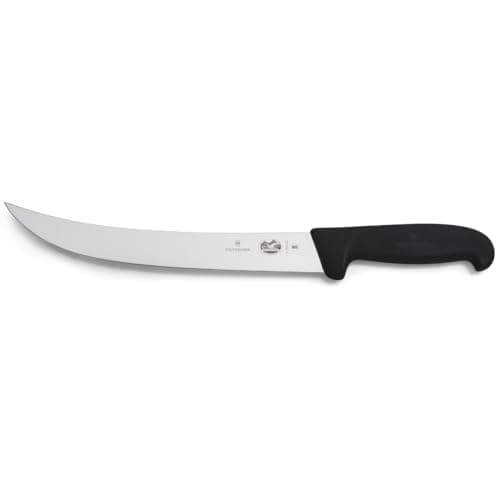
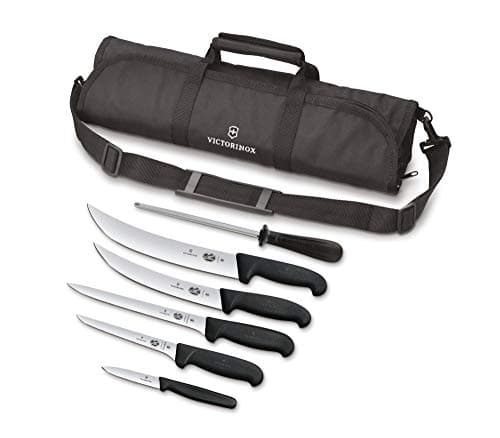
The butcher knife set we'd buy for game is the Victorinox Fibrox Field Dressing Kit. The name undersells it. Per the maker-supplied listing, it holds a 3-1/4 in paring knife, a boning knife, a filleting knife, a slaughter knife, a cimeter and a 10 in sharpening steel in a knife roll. Four of those are dedicated meat-cutting patterns from Victorinox's Fibrox line, and the knives carry item numbers Victorinox also sells singly, so a lost or worn blade is a single replacement, not a new set.
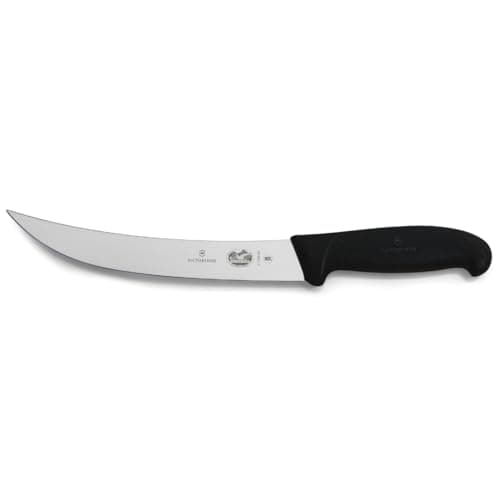
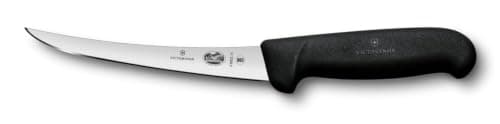
If you'd rather spend less, two Victorinox knives cover most of a deer: an 8 in curved breaking knife and a 6 in curved semi-stiff boning knife. That pair sits at third and fourth below as a build-your-own set.
We left out generic, unbranded “20-piece” butcher sets whose sellers don't publish the steel, blade lengths or warranty. If a maker won't say what the knife is, we can't score it. Everything below comes from Victorinox and Outdoor Edge product pages or their listing copy; we haven't bench-tested any of it.
A processing kit and a butcher set are different purchases
A processing kit mixes field tools with a few table knives: a gut-hook skinner, a ribcage spreader, a short saw, gloves. A butcher set is table knives only, chosen for taking meat off the bone and cutting it into portions. If you've been getting by with the boning/fillet blade from a hunting kit, this is the upgrade. If you have nothing yet, our deer processing kit roundup may be the better first buy, with a breaking knife from this page added later.
What each knife in a butcher set does
The Victorinox kit is a useful map of the jobs, because each knife has a published item number and its own product page. Here is what each one is for, in Victorinox's words where it gives them.
| Knife in the Victorinox kit | Blade (per Victorinox) | Job on a deer |
|---|
| Boning knife, 5.6413.15 | 5.9 in straight, extra narrow and flexible | Trimming and deboning; Victorinox calls it perfect for “delicate trimming and deboning tasks” |
| Slaughter knife, 5.7203.20 | 7.9 in curved (same base item as the 8 in breaking knife) | Breaking boned-out muscles into roasts and steaks |
| Cimeter, 5.7303.25 | 9.8 in curved | Portioning large cuts “with a single, fluid motion” |
| Filleting knife, 5.3763.20 | 7.9 in, long and flexible | Fish; long, flat trimming strokes on venison |
| Paring knife | 3-1/4 in | Small detail work |
| Sharpening steel | 10 in | Honing the edge between sharpenings |
Two jobs carry most of a deer: taking muscle off bone (the boning knife) and cutting that muscle into portions (the breaking knife or cimeter). The rest of the set is support. That's why the two-knife route below works.
Why the Victorinox set ranks first
Victorinox describes the blades as high carbon stainless steel with a special tempering process, and the Fibrox handles as thermoplastic elastomer. The listing calls the set dishwasher safe, which is the opposite of the ErgoMax guidance and matters on a long processing day. It's also the only set here with a honing steel instead of a carbide sharpener.
The trade-offs: it comes in a roll rather than a hard case, there's no saw or field gear, and Victorinox publishes no hardness figure. Its boning knife is the straight, flexible pattern, which suits trimming but has less spine for levering around a hip joint. We'd add the curved semi-stiff boning knife from our boning knife list, and it's the fourth pick here for that reason.
The ErgoMax: a game-specific set for the table
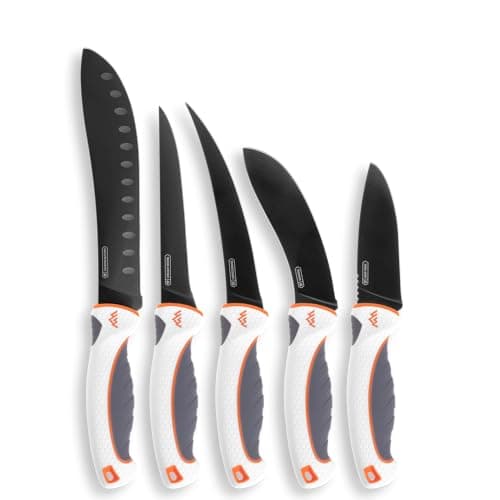
Outdoor Edge's ErgoMax takes a different route to the same table. Its five knives are an 8.0 in Granton butcher, a 6.0 in semi-stiff straight boner, a 6.0 in mid-flex curved boner, a 5.0 in deep-bellied skinner and a 4.0 in drop point, in black titanium coated 5Cr15Mov with triple-shot TPR handles. It has something the Victorinox kit lacks, two boning knives of different flex, and drops the cimeter, fillet knife and steel for a two-stage carbide and ceramic sharpener.
Choose it over the Victorinox if you skin your own deer and want the skinner in the same case, or if you value a hard case with a clear lid. Choose the Victorinox if you want dishwasher-safe knives and a proper cimeter for portioning.
The two-knife set
A curved 8 in breaking knife and a 6 in curved semi-stiff boning knife cover the two big jobs on a deer. Victorinox says the breaking knife's wider, heavier blade makes uniform slicing easier and keeps meat from tearing, and that the semi-stiff boner's curve gives a better working angle close to and around the bone. Both carry Victorinox's lifetime warranty against defects.
What the pair doesn't include is a way to keep the edge. The Victorinox kit comes with a 10 in steel and the ErgoMax with a two-stage sharpener; with the two-knife route you'll need your own. If most of your deer goes through the grinder, the boning knife alone does nearly all of the work. Our boning vs fillet knife comparison covers why the fillet knife isn't the one to add second.
For elk, big-bodied bucks or a beef primal, the 10 in breaking knife (ranked sixth) is the long-reach version. It is also the knife where Victorinox says the most about the steel: high carbon stainless, conical ground and ice tempered.
When a set with a saw makes sense
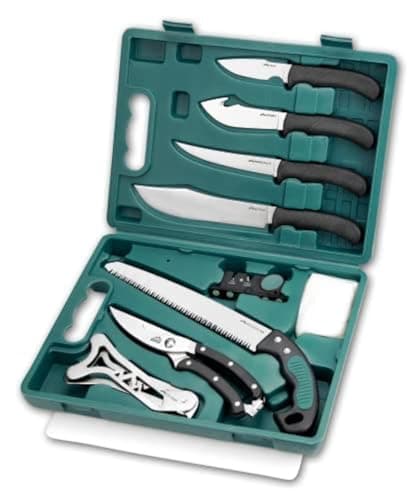
The Game-Pro ranks fifth because it isn't really a butcher set; it's a full processing kit. But if you're starting from nothing and want four knives plus a 10.0 in bone saw, shears and a spreader in one hard case, it gets you to the table faster than any set above. You'll still want a longer saw for bone-in cuts; see our meat saw picks.
What to check before you buy a knife set
Blade steel, as the maker names it
Victorinox says “high carbon, stainless steel.” Outdoor Edge says 420J2 stainless for its hunting kits and 5Cr15Mov for the ErgoMax. None of them publishes a hardness figure, so none of these sets can claim better edge retention on paper. We score steel close to neutral across the board and let the tiebreakers decide: how you keep the edge (steel or sharpener), whether single knives can be replaced, and the warranty.
Blade shapes that match the jobs
You want at least one boning knife around 6 in and one curved knife of 8 in or more. Curved blades follow bone and roll through long slices; straight blades are easier to steer on a board. A set with only straight knives, or with nothing longer than 6 in, will slow you down at the portioning stage.
Handles you can hold when they're wet
Victorinox's listing copy describes the Fibrox handle as non-slip even when wet, and its individual boning and breaking knives meet NSF standards. Outdoor Edge uses rubberized TPR. Either is a step up from polished wood or plastic when your hands are cold and greasy. Penn State Extension recommends cleaning your knife frequently between cuts, so handles that tolerate constant wiping matter.
Cleaning rules
Victorinox lists its Fibrox knives as dishwasher safe. Outdoor Edge says the ErgoMax should be hand-washed and dried immediately. Neither choice is wrong, but know which one you're buying before the first cleanup.
Storage
A roll protects edges from each other and packs flat. A hard case protects them from everything else. If your knives ride in a truck to a camp or a shared processing shed, the case earns its bulk.
Replacement and warranty
A set is only as good as its weakest knife, and knives get lost in hide piles and bent on bone. Victorinox sells the knives in its Field Dressing Kit individually under the same base item numbers, so one lost blade is one replacement. It covers these knives with a lifetime warranty against defects in material and workmanship. Outdoor Edge's Service for Life terms cover defects in its sets too, but its pages say they don't cover normal wear, misuse or sharpening.
Who should skip a set entirely
If you grind nearly everything, a set is more knife than you need. One semi-stiff boning knife and a sharpener handle a grind-only deer from start to finish, and the money is better spent on a grinder sized to your season. Our grinder sizes explainer covers that side.
How many knives does a season need?
No maker publishes edge life in pounds of meat, so we won't pretend to. The volume math is still useful: at the Ohio DNR average of 52.19 lb of venison per deer, one or two deer is roughly 52-104 lb to cut, and three to five deer is 157-261 lb. At the lower end, one boning knife and one breaking knife are plenty. At the higher end, especially with two people at the table, a second boning knife means nobody waits while an edge gets honed.
Our 3-5 deer setup and 6+ deer setup put these knives in context with the grinder, sealer and freezer they feed.