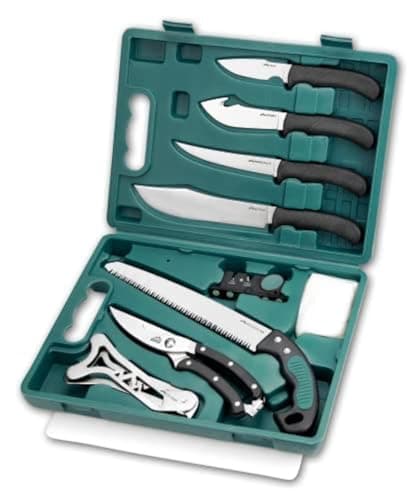
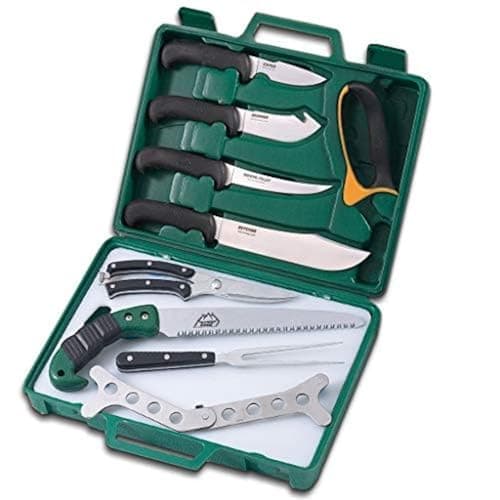
If you want one case that takes a deer from field dressing to portioned roasts, buy the Outdoor Edge Game Processor PR-1. Per Outdoor Edge's own spec page, it carries four knives (4.3 in caping, 4.5 in skinning, 5.9 in boning/fillet and an 8.3 in butcher blade), a 10.2 in wood-and-bone saw, game shears, a ribcage spreader, a carving fork, a cutting board and a carbide sharpener. No other kit here covers as many stages of the job.
If you already own a saw and want better knives for the cutting table, the ErgoMax is the stronger set: five knives, including two 6 in boning blades with different flex. The WildLite is the honest budget pick, as long as you buy it for what it is. It's a field kit, and it stops at the tailgate.
We haven't bench-tested these kits. Every blade length, steel name and piece count below comes from Outdoor Edge's product pages or the maker-supplied Amazon listing copy, and each product card links its sources.
What a kit has to cover
Kit listings sell the piece count. A 12-piece kit sounds twice as capable as a 6-piece one, but gloves, a sharpener and the case all count as pieces. The better test is to walk through the stages of a home breakdown and ask which tool does each job. Our stage-by-stage guide to processing a deer at home covers the work itself. Here is what each kit brings to it, straight from the maker's contents lists.
| Tool | PR-1 | Game-Pro | ErgoMax | WildPak | WildLite |
|---|
| Skinning knife | 4.5 in | 4.4 in | 5.0 in deep-bellied | 4.0 in gut-hook | 3.75 in gut-hook |
| Caping / detail knife | 4.3 in caping | 2.6 in caping | 4.0 in drop point | 2.5 in caping | 2.5 in caping |
| Boning knife | 5.9 in boning/fillet | 5.5 in | 6.0 in semi-stiff + 6.0 in mid-flex | 5.0 in boning/fillet | 5.0 in boning/fillet |
| Butcher knife | 8.3 in | 7.5 in | 8.0 in Granton | None | None |
| Saw | 10.2 in | 10.0 in | None | 6.0 in | None |
| Spreader, shears, gloves | All three | All three | None | Spreader, gloves | Gloves |
| Sharpener | Carbide V | Two-stage | Carbide + ceramic | Carbide | Two-stage |
Read the table by row, not by column. Only the PR-1 and the Game-Pro have something in every row that matters for a home breakdown: a knife to skin, a knife to bone, a long knife to portion and a saw for bone. The ErgoMax covers the cutting table and nothing else. The WildPak and WildLite cover the field and the first half of the boning.
Why the PR-1 ranks first
It has the longest butcher knife (8.3 in) and the longest saw (10.2 in) of the five, and its boning/fillet blade is the longest of the kits that pair boning with field tools, at 5.9 in. Add the shears, spreader, fork and board and it is the one case on this list you could buy on Monday and process a deer with on Saturday without a second order. Outdoor Edge lists the blades as full-tang 420J2 stainless with non-slip TPR handles, and the hard-side case gives each tool its own slot.
Its limits are worth knowing before you buy. The boning blade is a boning/fillet hybrid, and Outdoor Edge doesn't say how flexible it is. The 10.2 in saw is sized for the field. It will open and quarter a deer, but if you plan to cut bone-in chops or split a carcass, a 20-22 in butcher saw does that with far fewer strokes. We cover those in our meat saw roundup.
ErgoMax: the best knives here, missing the field tools
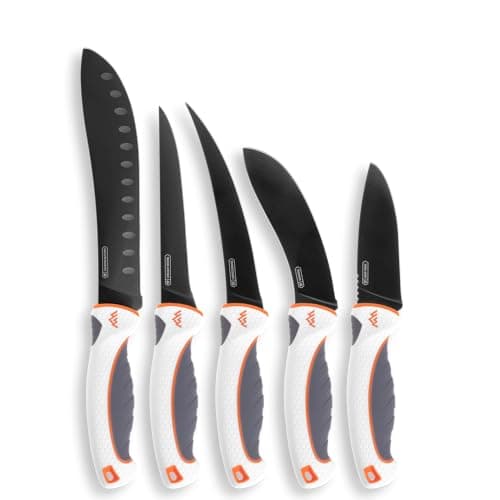
The ErgoMax is built for the table. Its five knives are an 8.0 in Granton butcher, a 6.0 in semi-stiff straight boning knife, a 6.0 in mid-flex curved boning knife, a 5.0 in deep-bellied skinner and a 4.0 in drop point. That pair of boning knives is the reason it ranks second. One has the spine to work around joints; the other has the give to follow a seam or peel membrane. Our boning knife guide explains why deer work splits between those two.
Outdoor Edge names the blade steel as black titanium coated 5Cr15Mov and is the only maker on this page that publishes care instructions: hand-wash, dry immediately and keep it out of the dishwasher. The listing puts the sharpener's finish angle at 22 degrees. What you give up is everything for the field and for bone. There is no saw, spreader, shears or gloves, so budget for a separate saw if you cut anything bone-in.
Game-Pro vs PR-1: nearly the same case
On paper the Game-Pro is the PR-1 with shorter blades and a different sharpener. Its knives run 2.6 in caping, 4.4 in skinning, 5.5 in boning and 7.5 in butcher against the PR-1's 4.3, 4.5, 5.9 and 8.3 in. The saws are close (10.0 in vs 10.2 in, both chrome-coated 65Mn steel). The Game-Pro swaps the PR-1's single carbide V-notch for a two-stage sharpener and its board for a cutting mat, and drops the carving fork.
Amazon calls it an 11-piece set; Outdoor Edge's own page lists ten tools and the hard-sided case. Whichever count you prefer, the choice comes down to price on the day. If the two are close, the PR-1's longer boning and butcher blades are the better deal for home processing.
WildPak and WildLite: field kits first
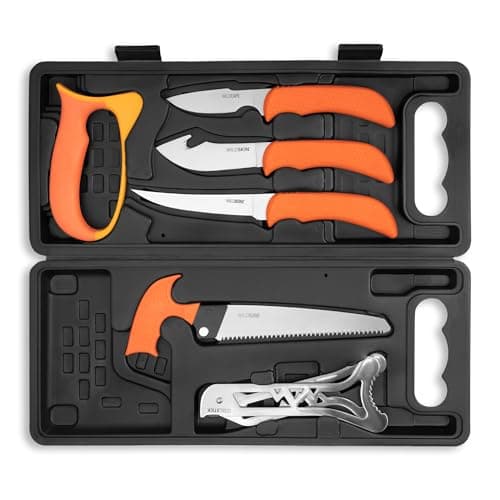
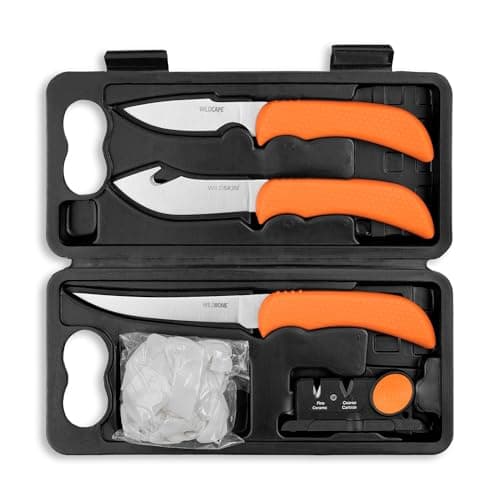
Both carry the same three-knife core: a 2.5 in caping knife, a gut-hook skinner (4.0 in on the WildPak, 3.75 in on the WildLite) and a 5.0 in boning/fillet blade, all in 420J2 stainless with blaze-orange TPR handles. The WildPak adds a 6.0 in wood/bone saw and a ribcage spreader. The WildLite keeps it light at 1.2 lb, per Outdoor Edge.
Neither has a knife longer than 5 in, so neither is a home-processing kit on its own. They make sense as the kit that lives in your pack, paired with proper table knives at home. Our butcher knife set picks cover that second half.
What the spec sheets leave out
None of these kits comes with a published blade hardness (HRC). Outdoor Edge names the steel, 420J2 stainless for four kits and 5Cr15Mov for the ErgoMax, and says the WildPak and WildLite blades are heat treated and hand finished. Without a hardness figure we can't rank edge retention between them, so that metric sits close to neutral for every kit, and the tiebreakers become what is published: blade lengths, the sharpener in the case, and the warranty.
On warranty, Outdoor Edge's Service for Life terms cover defects in materials or workmanship; its pages say they don't cover normal wear, misuse or sharpening. On edges, the practical answer is the sharpener you'll actually use, which is why a sharpener that lives in the same case as the knives counts for something in our scoring. One more habit matters more than the steel: Penn State Extension advises cleaning your knife frequently between cuts so you don't drag bacteria into the meat.
How to choose a processing kit
Start from where you'll cut
If you field dress, hang the deer and then break it down on a table at home, you need a kit with both field tools (gut-hook, spreader, gloves) and table tools (a 6 in-class boning knife and a butcher knife of 7.5 in or more). That is the PR-1 or Game-Pro. If a processor or a friend does the table work and you only need to get the deer out, the WildLite is enough. If you already have a field knife you trust, skip the kits and buy table knives.
Compare blade lengths, not piece counts
A 12-piece kit and an 8-piece kit can carry the same three knives. Count the knives, then look at the longest one. A deer hindquarter is easier to portion with an 8 in blade than a 5 in one, and a 5 in boning blade takes more strokes on the big muscles than a 6 in blade does.
Decide whether you need the saw
The saws in these kits run 6.0 to 10.2 in, which is field length. If you bone out every deer, you may never need a bigger saw. If you like bone-in chops, shanks or rib sections, plan on a 20-22 in butcher saw regardless of the kit. Penn State Extension lists the spinal cord and backbone among the high-risk parts for chronic wasting disease, so if you hunt in a CWD area, check your state's guidance before sawing through the spine.
Read the care rules before the first wash
Only the ErgoMax page publishes care instructions, and they say avoid the dishwasher. The other Outdoor Edge pages we checked don't address it, so hand-washing and drying is the cautious default. If dishwasher-safe matters to you, Victorinox says its Fibrox knives are dishwasher safe.
Kit or separate knives?
A kit is the fastest way to have every tool on hand. Separate knives let you pick the exact blade for each job. If you're building from zero, the kit wins on convenience. If you already own a field knife, two Victorinox knives (a 6 in curved boning knife and an 8 in breaking knife) will outperform the table half of any kit here on blade choice. Skip the fillet knife as a second purchase for deer; a flexible boning knife does that job better.
How a kit fits your season
Knives don't scale with volume the way a grinder does. A sharp PR-1 handles one deer or six. What changes is hours at the table. At the Ohio DNR average of 52.19 lb of venison per deer, a three- to five-deer season means roughly 157-261 lb of meat to take off the bone and trim by hand. At that volume, a second boning knife, enough lugs to keep the meat cold and a real table start to matter more than the kit itself.
Our 1-2 deer setup and 3-5 deer setup show where the kit sits in the full chain, next to the grinder, sealer and freezer. And if you're still deciding whether to do the work at all, start with our DIY vs processor cost breakdown.