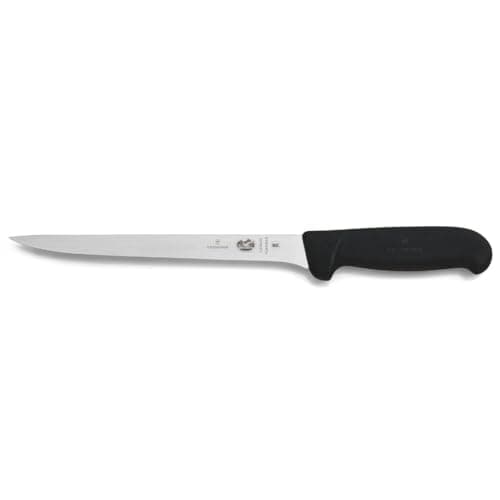
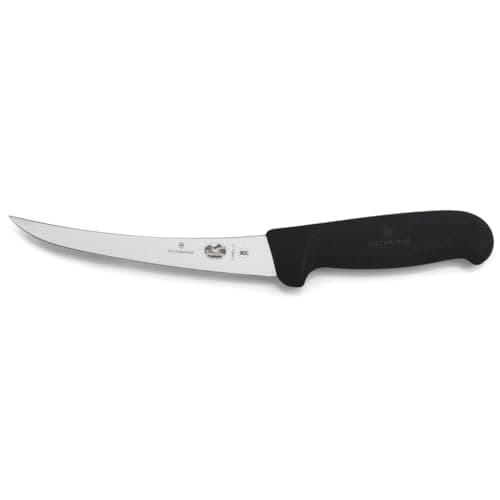
A boning knife has a shorter, stiffer blade, usually curved, for working meat off bone and around joints. A fillet knife has a longer, thinner, more flexible blade for sliding along a fish's frame. For deer, buy the boning knife. In Victorinox's Fibrox line, that's a 5.9 in curved semi-stiff blade against a 7.9 in flexible fillet blade, and the difference shows up the first time you reach a hip joint.
Boning knife vs fillet knife: the specs
| Spec | Boning knife (Victorinox Fibrox Pro, curved, semi-stiff) | Fillet knife (Victorinox Fibrox 8 in, flexible) |
|---|
| Blade length | Sold as 6 in; 5.9 in on Victorinox's spec page | Sold as 8 in; 7.9 in on Victorinox's spec page |
| Flex | Semi-stiff | Flexible |
| Blade shape | Curved | Long and narrow, straight edge |
| Weight | 3.4 oz | 3 oz |
| Maker's intended job | Deboning; “ideal for meat and poultry prep” | “Clean, efficient filleting” |
| Handle | Fibrox Pro, non-slip even when wet | Thermoplastic elastomer, non-slip when wet |
| Dishwasher safe | Yes | Yes |
| Warranty | Lifetime, defects in material and workmanship | Lifetime |
Every value above comes from Victorinox's product pages or its maker-supplied listing copy; the product cards below link each one. We haven't bench-tested either knife.
Choose the boning knife if, choose the fillet knife if
Choose the boning knife if you're processing deer, elk, hogs or any four-legged game; you need to work around joints and along bone; you want one knife that does most of the breakdown; or you're buying your first processing knife.
Choose the fillet knife if fish make up a real share of your freezer; you want a long, flexible blade for long, flat trimming strokes on already-boned venison; or you already own a semi-stiff boning knife and want the opposite blade for a second.
If you're buying one knife for a deer, it's the boning knife. That isn't a close call.
Where each one works on a deer
Most of a deer breakdown is boning: the shoulders come off along the seam against the ribs, the backstraps along the spine, the hindquarters at the hip, and then each quarter is taken apart muscle by muscle along its seams. Every one of those jobs has a moment where you need to lever the blade against bone or turn it in a tight space. That's where a semi-stiff blade pays off. Victorinox says the curved, semi-stiff shape gives a better working angle close to and around the bone, and that its slight bend still leaves room for a delicate touch.
A fillet knife is built for the opposite. Victorinox describes it as a long, flexible blade for smooth filleting. On a fish, that flex lets the blade ride over the rib bones. On a deer, the same flex bows away when you push against a joint, and nearly 8 in of thin blade is a lot to keep on line in a deep seam. The result is slower, fussier work around every joint.
The fillet knife does have one job on a deer where it's at home: long, flat strokes on a boned-out muscle, such as running under the membrane on a backstrap or cleaning up a slab before it's cut for jerky. Our guide to slicing meat for jerky picks up from there.
The third option: a flexible boning knife
If what you actually want is flex for trimming, there's a better second knife for a deer than a fillet knife: the flexible version of the same Victorinox boning knife (5.6613.15). It has the same 5.9 in curved blade and handle as the semi-stiff, with the flex Victorinox pitches for “trimming fat and sinew or deboning poultry and meat.” You get the fillet knife's give in the boning knife's length, which is easier to control at the table.
Our rule of thumb: deer-only households pair the semi-stiff boning knife with the flexible boning knife. Households that fish as much as they hunt pair the semi-stiff boning knife with the fillet knife. Our boning knife roundup ranks all of them.
What the kits and sets give you
Many hunting kits split the difference with a “boning/fillet” blade. Outdoor Edge's PR-1 has a 5.9 in boning/fillet knife, and its WildPak and WildLite have 5.0 in versions; the maker doesn't publish how flexible any of them are. They work, but you're guessing at the flex. Victorinox's Field Dressing Kit takes the other approach and includes both: a straight, extra narrow, flexible boning knife (5.6413.15) and the same 8 in filleting knife compared here (base item 5.3763.20). See our processing kit picks and butcher knife sets for the full contents.
Does the size of your season change the answer?
Not the choice, but the number of knives. At the Ohio DNR average of 52.19 lb of venison per deer, a three- to five-deer season is about 157-261 lb of meat, and nearly all of it passes under a boning knife before it goes anywhere else. At that volume, a second knife with the other flex is worth having so you can trim with one while the other waits for the steel. At one or two deer, one semi-stiff boning knife is enough.
| Your freezer | First knife | Second knife |
|---|
| 1-2 deer, no fish | Semi-stiff curved boning knife | None needed yet |
| 3+ deer, no fish | Semi-stiff curved boning knife | Flexible curved boning knife, for trimming |
| Deer and fish | Semi-stiff curved boning knife | 8 in flexible fillet knife |
Notice the first column never changes. Whatever else you process, the semi-stiff boning knife is the one that does the deer, and the second knife is chosen by what else ends up on the table.
Three mix-ups worth avoiding
“A fillet knife is just a flexible boning knife.” Not quite. Victorinox makes both a flexible 6 in boning knife and an 8 in fillet knife, and the difference is about 2 in of blade. That extra length suits long strokes along a fish, and it's the same length that makes it harder to steer inside a hindquarter.
“Venison is lean, so flexible is always better.” Lean meat doesn't change the bones. The joints on a deer still need a blade you can lean on, which is the case Victorinox makes for its semi-stiff blade. Flex helps with trimming; it doesn't help at the hip.
“A longer blade is faster.” On a long, open cut, sometimes. In a seam, control matters more than reach, and every dedicated boning knife we list sits at 5.9-6.0 in for that reason. Length pays off at the portioning stage, which is the job for an 8 in breaking knife, not a fillet knife.
Care: the same rules for both
Victorinox lists both knives as dishwasher safe, and both carry its lifetime warranty. During processing, Penn State Extension recommends cleaning your knife frequently between cuts, using clean water, pre-moistened wipes or alcohol swabs, so you don't drag bacteria into the meat. Plain edges on both mean a honing steel keeps them working through a long session.