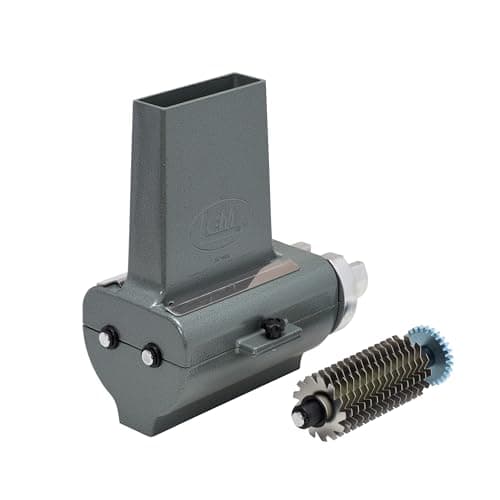
Meat Tenderizer Machines for Venison: What a Cuber Actually Fixes
A cuber is the answer to the two cuts nobody enjoys eating: the round and the shoulder. One spec decides which machine to buy, and most sellers in this category will not publish it.
The only manual machine that publishes both chute dimensions -- 4.5 in wide by 0.75 in thick -- which is the size a venison round steak actually arrives in. C-clamps included.
#ad · Prices come live from Amazon, last checked Sep 24, 2026; where we have no verified live price we show none. Scores are ours, compiled from published specs, manuals and warranty terms, not bench tests. Tap a row for the full write-up.
For a normal deer season, buy the Weston Meat Tenderizer and Cuber. It is hand-cranked, it costs about a quarter of what the electrics cost, and it is the only manual machine here that publishes both dimensions of its chute — 4.5 in wide by 0.75 in thick — which is the only way to know a venison round steak will fit before you buy it. If you process beef as well as deer, or several deer a season, the VEVOR 750W takes a 6.61 in cut under power and is built entirely in 304 stainless.
What a cuber actually fixes
A deer gives you two problem areas. The backstraps and tenderloins need nothing done to them. The round (the hind leg muscles) and the shoulder are lean, heavily grained and full of connective tissue, and they are the reason so much venison ends up as burger by default. At the Ohio DNR average of 52.19 lb of venison per deer, those tough cuts are a large share of the animal, and grinding all of them is a decision rather than a necessity.
A cuber is a mechanical answer: a comb of blades cuts across the muscle fibre and the connective tissue in one pass, the same operation that turns beef round into cube steak. You get a steak that fries in minutes from meat that would otherwise need three hours in a braise. That is the whole pitch, and it is a real one.
What it does not do is rescue badly handled meat. If the problem is that the deer was not cooled fast enough or the silverskin was left on, a cuber will not fix it — see how to process a deer at home for the steps upstream of this one.
The one spec that decides it
How big a piece of meat the chute swallows. Everything else — blade count, motor wattage, stainless grade — is secondary, because a machine your steaks do not fit into is a machine you will stop using by the second deer.
A venison round steak cut across the grain from a whole hind leg muscle runs roughly 3 to 5 inches across. A shoulder cut is smaller but often thicker. So the numbers to look for are a chute at least 4 in wide and at least 0.75 in of thickness clearance. Here is who publishes what:
Machine
Published width
Published thickness limit
Takes a venison round steak?
Weston manual cuber
4.5 in
0.75 in
Yes, and it is the only one that says so in both dimensions
VEVOR manual, 5.8 in port
5.8 in
Not published
On width, yes. Thickness is a gamble
VEVOR 750W electric
6.61 in (working length)
0.87 in (22 mm)
Yes, with the most room of anything here
VEVOR 450W electric
5.12 in (130 mm)
0.87 in (22 mm)
Yes
LEM BigBite 2-in-1 attachment
Not published as a chute width
Not published
Unknown — it is an attachment, sized by the grinder head
COFUN manual
Not published
Not published
Unknown. COFUN publishes spacings only
Two of six publish both numbers. That is the state of this category, and it is why a $100 hand crank leads a page that includes a $350 stainless machine: Weston told us what fits.
The six, side by side
Spec
Weston
VEVOR manual
VEVOR 750W
VEVOR 450W
COFUN
Drive
Hand crank
Hand crank
750W electric
450W electric
Hand crank
Blades
31
31
67 (304 stainless)
54
Not published
Body
Cast aluminum, coated
Die-cast aluminum
All 304 stainless
Stainless exterior
Not specified
Throughput published
No
No
No
120 kg/h (~265 lb/h)
No
Reverse
n/a (manual)
n/a (manual)
Not listed
Yes
n/a (manual)
Adjustable spacing
No
No (0.26 in fixed)
No
No
Yes, 10 / 12.5 / 15 mm
Clamps to bench
Yes, C-clamps included
Yes, clamp plus clip
Freestanding
Freestanding
Not specified
Strips down for washing
Hand wash only
Yes, four parts
Not specified
Not specified
Yes, fully
Warranty published
No
No
No
No
No
Look at the last row. Not one machine in this category publishes a warranty length, which is unusual even by the standards of the gear on this site. Factor it in: you are buying a mechanical device with no stated support term.
The USDA rule a cuber puts you under
This is the part most tenderizer listings do not mention, and it changes how you cook the result. Mechanical tenderizing moves bacteria from the outside of the meat to the inside. USDA's Food Safety and Inspection Service is explicit about it, and explicitly includes doing it at home:
In practice: 145°F internal with a 3-minute rest, measured with a thermometer. That rules out serving cubed venison rare, which is exactly how a lot of people like to eat venison steak. It is not a reason to skip a cuber — it is a reason to know what you are signing up for before you run a backstrap through one out of curiosity. The round and shoulder cuts a cuber is for get cooked through anyway.
The rule is serious enough that FSIS made retail labelling of mechanically tenderized beef mandatory, with validated cooking instructions on the pack (FSIS final rule announcement). At home, you are the one doing the tenderizing, so you are the label. A fast instant-read thermometer is the tool that closes this out; ours are ranked in thermometers for jerky and sausage.
Manual or electric, by the pound
The honest dividing line is how much tough meat you put through in a session, not how many deer you shoot. Only the round and the shoulder go through a cuber; the backstraps, tenderloins and trim do not.
Tough-cut volume per session
Buy
Why
Under about 25 lb (one deer's round and shoulder)
Weston manual cuber
A crank is fine for an hour, and the chute size is published
25-50 lb (two deer, or one plus beef)
Weston, or VEVOR manual for the wider port
Still a manual job; the wider port saves trimming to fit
50-100 lb
VEVOR 450W
The reverse button and 265 lb/h rating start to matter
100 lb+, or a half beef
VEVOR 750W
6.61 in working length and an all-stainless body
Match this against our season setups if you are buying a whole kit rather than one machine: 1-2 deer, 3-5 deer and 6+ deer.
A cuber is not a grinder, and not a jerky slicer
Three machines get confused with each other because they all have blades and all deal with tough venison:
The overlap case on this page is the LEM BigBite 2-in-1 slicer and tenderizer, which does two of the three by running off a LEM BigBite grinder's drive. It is genuinely convenient if you already own that grinder and a poor value if you do not, which is why it sits fifth here rather than higher.
Cleaning is the real ownership cost
A blade comb is the hardest thing in a processing kitchen to clean. Thirty-one to sixty-seven thin blades with narrow gaps, all of which have just had raw meat pushed through them. Two things to weigh before you buy:
Does it come apart? The VEVOR manual removes its handle, comb, top cover and blade assembly. COFUN says it is fully detachable. The Weston is hand wash only and does not advertise stripping down, which is its main weakness against an otherwise excellent machine.
Is it dishwasher safe? None of them say yes. Assume hand washing with a brush, and assume it takes longer than the tenderizing did.
Do it immediately, before the protein dries in the gaps. University of Arkansas Extension's deer processing guidance is to sanitize at each step rather than at the end, and a cuber is a good argument for that habit: there is nowhere for residue to hide except somewhere you cannot see.
In detail
The picks, in full
1
WestonNo image
Best for most deer seasons
Weston Meat Tenderizer and Heavy Duty Cuber (07-3101-W-A)
7.4 /10
The only manual machine that publishes both chute dimensions -- 4.5 in wide by 0.75 in thick -- which is the size a venison round steak actually arrives in. C-clamps included.
+The 4.5 in chute takes a whole venison round steak without trimming it to fit
+C-clamps are in the box, so it bolts to a processing table rather than walking across it
+Weston publishes the blade count and both chute dimensions, which most sellers in this class do not
What it doesn't
−Hand wash only, and 31 blades in a comb is the worst kind of thing to hand wash
−Cast aluminum with a coating, not stainless: a chipped coating is the part that ages
−Manual, so it is one steak per crank — fine for a deer, slow for a beef
Skip this if…
…you run more than about 100 lb of round and shoulder through a season. At that point the cranking is the bottleneck and an electric tenderizer earns its bench space.
+6.61 in working length beats the Weston's 4.5 in chute, so a whole round steak goes through in one pass
+All-304 stainless body rather than coated aluminum
+Comes with the tray, so the meat has somewhere to land
What it doesn't
−Same 22 mm thickness ceiling as the 450W model, for twice the motor
−VEVOR lists no reverse function on this model, unlike the 450W
−No voltage, amp draw or certification published, and no warranty length
Skip this if…
…you are not processing beef or several deer a season. This is a commercial machine priced like one, and the manual Weston covers a normal deer season.
+Reverse function, which is the feature you want the first time a shoulder cut binds
+Publishes both the length and the thickness range it accepts, in millimetres
+265 lb an hour on VEVOR's figure is more than a whole deer's round and shoulder
What it doesn't
−22 mm (0.87 in) thickness ceiling: a thick-cut venison steak has to be trimmed down to fit
−No voltage, amp draw or safety certification on the listing
−Nothing published about whether the blade assembly is dishwasher safe
Skip this if…
…you process one or two deer. A 450W machine and its cleaning routine is a lot of bench for a couple of afternoons; the Weston manual cuber does the same job.
+Three spacings, so one machine suits thin and thick cuts
+Fully detachable for cleaning, which COFUN spells out step by step
+Cheapest way onto this page
What it doesn't
−COFUN publishes no blade count, no feed-port width and no thickness limit — the three numbers that matter most
−Spikes, not a blade comb: it perforates rather than cutting the fibre the way a bladed cuber does
−No warranty length on the listing
Skip this if…
…you are buying this to make cubed steak out of venison round. Without a published port size you cannot tell whether your steaks fit, and the Weston tells you they do.
#ad · Price as of Sep 24, 2026 · Affiliate disclosure for the link to COFUN Manual Meat Tenderizer with 3 Spacing Settings
How we ranked these
Cut size the chute swallows (30), build and drive (30), cleaning and food contact (20), value at the live price (20). We have not bench-tested any of these machines. Every figure is the maker's published spec from its own listing copy, and where a maker publishes nothing the table says so and the metric is scored down for the absence rather than estimated.
We deliberately did not score on blade count. A comb with 67 blades and a comb with 31 do different jobs at different spacings, and without a published spacing figure for most of them the count on its own tells you nothing useful.
What we would buy
One or two deer a year: Weston manual cuber, and accept the hand washing. Deer plus a half beef, or a bench you can dedicate: VEVOR 750W. Already own a LEM BigBite and also want a jerky slicer: the LEM 2-in-1 attachment. We would not buy the COFUN for venison specifically, because without a published port size you cannot confirm your steaks fit.
One thing to notice in the scores: both VEVORs outscore the Weston, mostly on cleaning and on raw cut width. The Weston leads anyway because it is the only manual machine that publishes the thickness limit as well as the width, and a chute your steaks do not fit is a machine you stop using. That is deliberate and it is how every ranked page on this site works — the order answers the question in the title, and the score is the rubric's separate view of the product as a whole. Both are on the page so you can disagree with us.
How we picked
Units we claim to have bench-tested: none
Plenty of sites say they ground two hundred pounds through every grinder. We didn't, and we say so. What we do instead: read the maker's spec sheet, manual and warranty terms, record the figures that decide whether a machine keeps up with your season (size number, motor rating, rated pounds per minute, capacity, duty cycle, gearing), check parts availability, and score each pick on a published rubric. Then we show the season math — pounds per deer from the Ohio Division of Wildlife's yield study — so you can redo it with your own numbers.
A comb of blades cuts across the muscle fibre and the connective tissue of a whole steak in one pass, which is how beef round becomes cube steak. On venison it turns the round and shoulder — the lean, heavily grained cuts most people grind by default — into steaks that fry in minutes.
Do you need to cook mechanically tenderized meat differently?+
Yes. USDA FSIS says bacteria on the outside of the meat is carried to the inside during mechanical tenderization, and that mechanically tenderized meat should be cooked to an internal temperature of 145°F with a 3-minute rest. That rules out serving it rare. Use a thermometer, not colour.
Is a manual or electric meat tenderizer better?+
Manual, for almost every deer season. Only the round and shoulder go through a cuber — roughly 25 lb from an average deer — and a hand crank handles that in about an hour. Electric earns its price past about 50 lb of tough cuts per session, or if you process beef.
What size chute do you need for venison?+
At least 4 in wide and 0.75 in of thickness clearance, because a round steak cut across the grain from a whole hind leg muscle runs roughly 3 to 5 in across. Only the Weston manual and the two VEVOR electrics publish both numbers.
Can a meat tenderizer replace a grinder?+
No, and it is not trying to. A cuber leaves you a steak; a grinder leaves you burger or sausage mix. A cuber is what lets you stop grinding the whole hind leg by default.
Are meat tenderizer machines hard to clean?+
Yes — it is the main ownership cost. None of the machines here are advertised as dishwasher safe, so plan on hand washing a comb of 31 to 67 thin blades with a brush, immediately after use. The VEVOR manual and the COFUN both strip down; the Weston is hand wash only.
We haven't bench-tested this gear and we don't pretend to. Specs come from the maker's own pages, manuals and maker-supplied listing copy (labeled as such); food-safety figures from USDA and university extension publications; yield from the Ohio Division of Wildlife; prices live from Amazon. Where a figure isn't published, we say so. Read the full method.