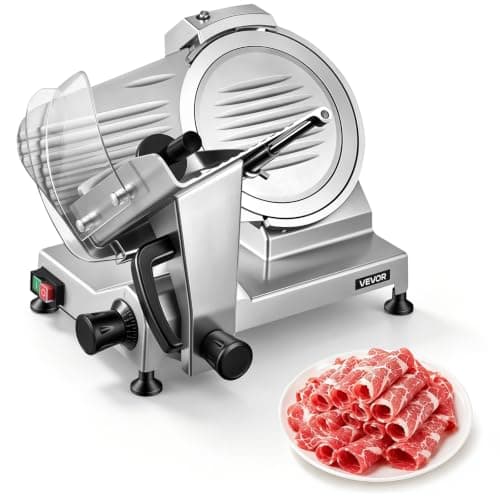
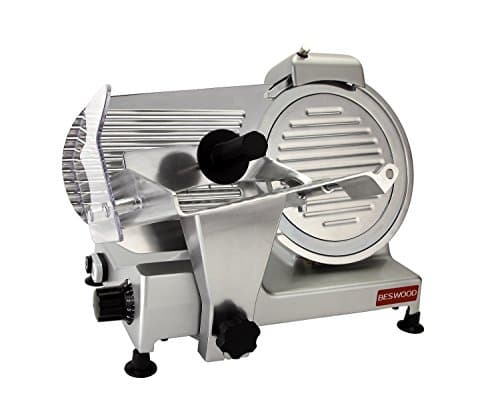
Buy the BESWOOD 250 if you want a machine you can hold to its numbers. It is the only slicer on this site whose maker publishes blade speed, maximum cut capacity and a warranty term together. Buy the VEVOR 10-inch if you want a 10-inch blade for meaningfully less money and you value that VEVOR states, in its own copy, that the machine handles frozen meat — which BESWOOD never claims.
They are closer than the price gap suggests. Both are 10 in, both are 240W, and both have a built-in sharpener. The difference is what each company is willing to put in writing.
Every published figure, side by side
| Spec | BESWOOD 250 | VEVOR 10-inch |
|---|
| Blade | 10 in high-carbon, chromium-plated | 10 in, 45# carbon steel |
| Motor | 240W (1/3 HP) | 240W load, 130W no-load |
| Blade speed | 282 rpm | 350-400 rpm |
| Thickness range | 1-12 mm (about 0-1/2 in) | 0-12 mm (0-0.47 in) |
| Maximum cut size | 210 mm (8.25 in) long x 170 mm (6.7 in) high | Not published |
| Drive | V-belt | Not published |
| Sharpener | Top-mounted two-stone | Built-in stone |
| Frozen meat claim | None — neither the page nor the listing mentions it | Yes — “frozen, raw and cooked meats” |
| Corrosion protection | Chromium plating | None stated — bare carbon steel |
| Warranty | 12 months | Not published |
| Weight | 33 lb | 34 lb |
What actually separates them
1. BESWOOD publishes the cut capacity; VEVOR does not. This is the most useful single number on a slicer spec sheet and almost nobody gives it. 8.25 in long by 6.7 in high tells you whether your roast fits before you buy. With the VEVOR you are inferring it from the blade diameter.
2. VEVOR claims frozen meat; BESWOOD stays silent. VEVOR's listing says it handles frozen, raw and cooked meats. BESWOOD — which publishes more than anyone else about everything else — never mentions frozen work. A maker who documents this thoroughly and then declines to make that one claim has probably thought about it, and we would not read the silence as an oversight.
3. The blade speeds differ, and slower is not worse. BESWOOD turns at 282 rpm against VEVOR's 350-400. A slower blade takes a bigger bite per revolution, which on firm meat is generally kinder to the motor and gives a cleaner face. A faster blade gets through volume quicker. Neither is a defect.
4. Chromium plating versus bare carbon steel. Both blades are carbon steel underneath, which is what holds a keen edge. BESWOOD plates its blade; VEVOR does not. If you will not reliably dry the blade the moment it is washed — and most home kitchens will not — the plating is worth real money over a few seasons.
5. BESWOOD has a warranty; VEVOR publishes none. Twelve months against nothing stated.
Which one for which job
| What you slice | Pick | Why |
|---|
| Deli meat, cheese, roasts | BESWOOD | Published cut capacity and a warranty; plating survives a real kitchen |
| Partially frozen venison | VEVOR | It is the one whose maker names frozen meat |
| Jerky strips | Either | Both cover 1/8 to 1/4 in comfortably; see our jerky slicer page |
| Whole cured pork belly | Neither | 10 in is too narrow — see slicers for bacon |
| Paper-thin hot pot | Neither | Both stop around 0-1 mm and neither is rated for a solid block |
| You are on a budget | Neither | See slicers under $200 |
Care, which matters more on the VEVOR
Both blades are carbon steel and both dull with use, which is why both machines have a sharpener built in — use it rather than removing the blade. The difference is corrosion: the BESWOOD's chromium plating is a barrier the VEVOR does not have, so the VEVOR must be dried immediately after every wash. Salt and moisture are what kill a bare carbon blade, and cured meat is both.
The verdict
BESWOOD 250 for most people. The published cut capacity, the V-belt drive, the chromium plating and the 12-month warranty together make it the machine you can actually evaluate before buying and hold to afterwards. That is worth the premium in a category where almost every listing is vague on purpose.
VEVOR 10-inch if the budget is real or the meat is cold. It gives you the same blade diameter and the same wattage for less, and it is the only one of the two whose maker will say the word frozen. Dry the blade every time and it will do the same work.
If neither fits, the wider field is on best meat slicers for home use.
How we picked
Units we claim to have bench-tested: none
Plenty of sites say they ground two hundred pounds through every grinder. We didn't, and we say so. What we do instead: read the maker's spec sheet, manual and warranty terms, record the figures that decide whether a machine keeps up with your season (size number, motor rating, rated pounds per minute, capacity, duty cycle, gearing), check parts availability, and score each pick on a published rubric. Then we show the season math — pounds per deer from the Ohio Division of Wildlife's yield study — so you can redo it with your own numbers.
Scores are editorial judgments from that documented research, not lab results. Nobody pays for placement. The rubric and weights are on the How We Pick page.