Home Processing ◆ Guide
BESWOOD 250 Review: The Slicer That Publishes Its Numbers
Almost no home meat slicer tells you how fast the blade turns, how tall a piece it will take or how long the warranty runs. BESWOOD publishes all three, which is most of the reason it keeps winning our slicer pages - and it still never once mentions frozen meat.
We earn a commission if you buy through our links, at no extra cost to you. It never decides the ranking — the method is published · Affiliate disclosure
Buy the BESWOOD250 if you slice regularly and want a machine whose maker will put numbers in writing. A 10-inch high-carbon, chromium-plated blade turning 282 rpm off a 240 W, 1/3 HP motor through a V-belt; a 210 mm by 170 mm cut window; a 1-12 mm thickness dial; a top-mounted two-stone sharpener; an aluminum alloy body; and a 12-month manufacturer warranty. Four of those six figures are not published by any other slicer we cover.
Skip it if the job is occasional, or if the job is frozen. It is the most expensive slicer on this site by a wide margin, and neither BESWOOD's own page nor its Amazon listing says anything at all about slicing frozen or partly frozen meat - which is exactly what jerky and shabu-shabu slicing ask for. The VEVOR 10-inch, at a substantially lower price, addresses frozen meat directly in its listing copy.
We have no test bench and we do not claim one. Every figure below is BESWOOD's published number or the maker-supplied Amazon listing copy, both cited under Sources.
What BESWOOD actually publishes
The reason this machine keeps placing first on our slicer pages is not that we like the brand. It is that the spec block on BESWOOD's own site answers questions the rest of the category leaves blank:
| Spec | BESWOOD250 (10 in.) | Published by the rest of the category? |
|---|---|---|
| Blade diameter | 10 in., high-carbon chromium-plated steel | Yes, always |
| Motor | 110-120 V, 240 W, 1/3 HP | Usually watts only |
| Blade speed | 282 revolutions per minute | Rarely - the VEVOR gives a 350-400 rpm range |
| Maximum cut length | 210 mm (8¼ in.) | No |
| Maximum cut height | 170 mm (6.7 in.) | No |
| Thickness range | 1-12 mm (about 0 to ½ in.) | Yes, usually |
| Drive | V-belt, for noise and vibration reduction | No |
| Warranty | 12 months from date of purchase | No - most slicer listings state no term at all |
A published number is not a test result, and we are careful about the difference everywhere on this site. But a maker that publishes blade speed and cut capacity is a maker that can be held to them, and that is the whole basis on which a site with no bench can rank anything. See how we pick for the rest of that argument.
One housekeeping note from the same page: BESWOOD sells a 9-inch version of this machine with a smaller cut window - 205 mm by 155 mm - at the same 240 W and 282 rpm. If you find a BESWOOD listing whose cut capacity reads 205 by 155, that is the 9-inch, not this one.
1-12 mm, in jerky terms
Thickness is the only spec on a slicer that directly touches food safety, because the USDA-aligned oven-finish route for jerky is written for strips cut a quarter inch or thinner. Millimeters are easier to buy on than fractions:
The practical consequence: this is not a slicer you buy for jerky alone. The jerky band uses a third of its dial, and a 6.4 mm setting is available on machines costing a fraction as much. What the extra range buys is everything else - sandwich meat thin enough to see through, bacon at a consistent thickness, a roast portioned evenly. Our jerky slicer roundup ranks for the narrow job, and how to slice meat for jerky covers doing it without a machine at all.
Cut capacity: the spec that decides bacon
210 mm by 170 mm - about 8¼ inches long by 6.7 inches tall - is the piece this machine will accept. Nobody else in the category publishes this figure, and it is the one that decides whether a given job is possible at all rather than merely slow.
A home-cured pork belly is commonly 10 to 14 inches on its long side, which means a belly gets cut down before it gets sliced on any 10-inch machine, this one included. A venison backstrap section, a chunk of eye of round for jerky, a shop-bought roast or a block of cheese all fit comfortably. Our bacon slicer roundup works through the belly-length problem properly, because it is the single most common disappointment in this category.
The other number worth planning for is the one on the box: the Amazon listing puts the machine at 33 lb. That is not a cupboard appliance. It wants a permanent place on a bench, which in a processing setup usually means the processing table rather than the kitchen counter.
The chromium-plated blade, and the sharpener on top
BESWOOD's claim for the blade is corrosion protection and edge life: a high-carbon steel blade with a chromium-plated coating and a high-temperature treatment, which it says stays sharp longer and does not need frequent sharpening. Plating is a real advantage on a machine that is going to meet brine, marinade and wet venison.
The sharpener is mounted on top of the aluminum alloy body and uses two stones, which is the arrangement commercial deli slicers use: you sharpen in place rather than removing the blade, so the edge gets maintained instead of neglected. BESWOOD also specifies the on/off switch runs at 24 V - a low-voltage control circuit, so the switch you touch with wet hands is not carrying line voltage.
A V-belt drive is the quietest detail on the spec sheet and the easiest to overlook. Belt drive absorbs shock and reduces vibration, and it is the component a direct-drive budget slicer saves money on. On a machine running for twenty minutes at a time, it is the difference between a kitchen you can talk in and one you cannot.
The spec it never mentions
Here is the honest gap, and it is a real one for this site's readers. Neither BESWOOD's product page nor its Amazon listing says anything about frozen or partly frozen meat. Not a recommendation, not a warning - nothing.
That matters because partly frozen is exactly how you slice for jerky and for hot pot: firm meat holds its shape against a blade, and soft meat rolls and tears. A machine that does not publish a position on frozen meat is a machine you are using off-label when you put a half-frozen eye of round through it, and a 12-month warranty is the only thing standing behind the decision.
If frozen slicing is the whole reason you are buying, start with slicers for frozen meat instead of here, and read VEVOR vs BESWOOD for the two 10-inch machines head to head.
Is it a commercial slicer?
The listing title says “for commercial and for home use.” In marketplace copy that phrase carries no certification and no duty rating, which is worth saying plainly - we make the same point about chamber sealers in commercial chamber sealers.
BESWOOD goes further than most, and not entirely consistently. Its feature bullets claim ETL certification; the spec block on the same page reads “US standard approved: ETL, NSF,” and a separate line lists ETL, GS, CE and RoHS. ETL is an electrical safety listing. NSF/ANSI 2 is the sanitation and cleanability standard that actually separates commercial food equipment from domestic, and it is the claim the two parts of the page disagree about. If an NSF listing matters for your use - a licensed kitchen, a cottage food operation - confirm it with BESWOOD in writing rather than taking the spec block's word for it.
What is not in doubt is duty: BESWOOD publishes no continuous-run rating, and neither does anything else in this price class. Nobody in this category will tell you how long you may run the machine, which is the same gap we keep hitting with external vacuum sealers.
Cleanup, and the hand-wash rule
BESWOOD's care instruction is hand wash only, and the box includes a cleaning brush and a bottle of food machine oil. That is the honest cost of a belt-driven metal machine: nothing goes in the dishwasher, and the machine expects to be oiled.
It is also where the cheaper competition has quietly moved ahead. CUSIMAX states that its blade and slide rail may go in the dishwasher and that its tray rotates out 90 degrees for access. On a tool you use weekly, a 10-minute cleanup versus a 20-minute one decides how often you reach for it - which is the same argument we make about dehydrator trays in dehydrators under $300.
Whatever you buy, a slicer is a blade exposed at waist height. Use the food pusher every time, unplug it before the blade comes off, and keep the ring guard on. The USDA's jerky guidance is about what happens after the slicing; the slicing itself is just a sharp edge turning 282 times a minute.
Where the money goes instead
This is the most expensive single tool in our home slicer rankings, and a buyer-first answer has to say what else that money buys. In a processing setup, the same spend covers a mid-size grinder, or a sealer with a published duty rating, or most of a chest freezer - all three of which do work a knife cannot do at all. A slicer, by contrast, replaces a knife you already own.
So the honest sequence is: knife and board first, then the machines that have no manual equivalent, then a slicer when slicing has become a weekly job rather than a seasonal one. That order is the backbone of our 3-5 deer setup, and the budget version is in slicers under $200.
Who should buy it
Buy the BESWOOD250 if you slice most weeks - a household that buys whole roasts and cures its own bacon, a hunter who runs jerky batches through the winter, someone feeding a sandwich habit - and you want published numbers, a plated blade, a belt drive and a warranty term behind the purchase.
Buy the VEVOR 10-inch if you want the same blade size for much less and a maker that at least addresses frozen meat. Buy the CUSIMAX 9-inch if two speeds, two blades and dishwasher-safe parts matter more than cut capacity. And buy neither if jerky twice a year is the whole use case: a jerky board and knife cuts even strips for a fraction of the money and stores in a drawer.
Picks for this job
The BESWOOD250 and the two machines it is really up against
The slicer this review covers, the 10-inch alternative that publishes a frozen-meat claim, and the adjustable 9-inch for a smaller budget.
Best-documented 10-inch
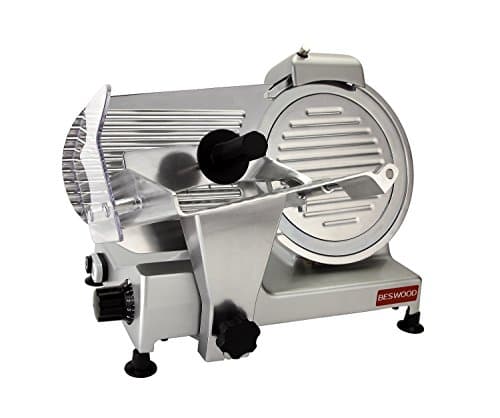
BESWOOD 10-Inch Electric Deli Meat Slicer (BESWOOD250)
The subject of this review: 10 in. chromium-plated blade at 282 rpm, 240 W / 1/3 HP, 210 x 170 mm cut window, 1-12 mm dial, V-belt drive, 12-month warranty, hand wash only.
$358.00Amazon#ad · Price as of November 4, 2026 · Affiliate disclosure for the link to BESWOOD 10-Inch Electric Deli Meat Slicer (BESWOOD250)
Best slicer for jerky
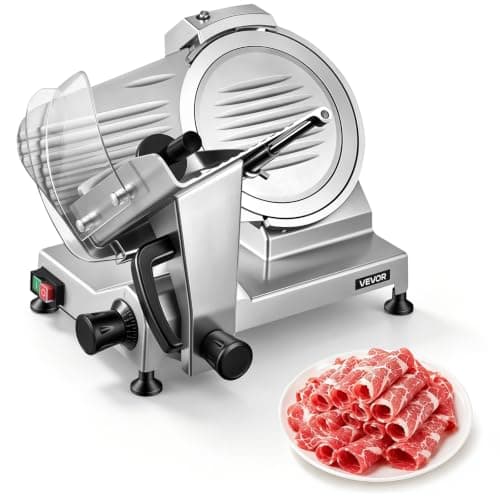
VEVOR 10-Inch Commercial Meat Slicer (240W)
Same blade size for substantially less, a 350-400 rpm blade and a listing that states frozen, raw and cooked meats. No warranty term published.
$262.90Amazon#ad · Price as of November 4, 2026 · Affiliate disclosure for the link to VEVOR 10-Inch Commercial Meat Slicer (240W)
Best under $200
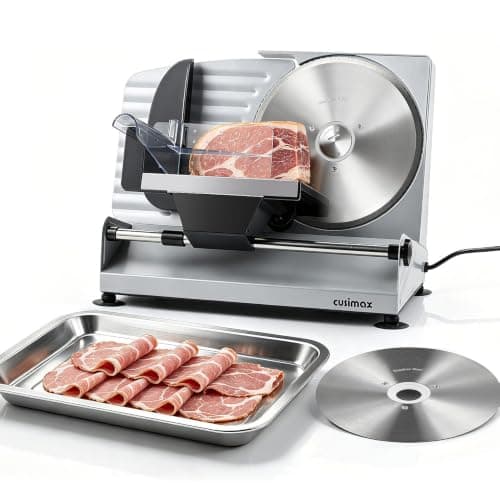
CUSIMAX 9-Inch Electric Meat Slicer (200W, 2-Speed)
Two speeds, a smooth and a serrated blade in the box, a 1-20 mm dial and stated dishwasher-safe blade and rail, with an 18-month promise.
$146.98Amazon#ad · Price as of November 4, 2026 · Affiliate disclosure for the link to CUSIMAX 9-Inch Electric Meat Slicer (200W, 2-Speed)
Questions
Frequently asked
Is the BESWOOD 250 worth the money?
Can the BESWOOD 250 slice frozen meat?
How thick can the BESWOOD 250 slice?
Will a whole pork belly fit on a BESWOOD 250?
Is the BESWOOD 250 NSF certified?
BESWOOD 250 or VEVOR 10-inch?
Keep going down the chain
Related
- VEVOR vs BESWOOD meat slicerThe two 10-inch machines, head to head.
- Best meat slicers for home useWhere the BESWOOD250 lands against the whole field.
- Best meat slicers for baconThe cut-capacity problem a pork belly creates.
- Best meat slicers for frozen meatThe machines whose makers do publish a frozen claim.
- Best meat slicers for jerkyRanked for the narrow job this one is overqualified for.
Receipts
Sources
- BESWOOD — BESWOOD-250 10 in. Electric Deli Meat Slicer product page (specs block: blade diameter, 240 W / 1/3 HP, 282 rpm, 210 mm cutting length, 170 mm height, 1-12 mm thickness, 12-month warranty; fetched 2026-10-30)
- The Restaurant Warehouse — NSF/ANSI Standard 2 guide (what a commercial food-equipment listing means)
- USDA Food Safety and Inspection Service — Jerky and Food Safety
- Amazon listing, manufacturer-supplied copy — BESWOOD 10 in. electric deli meat slicer (BESWOOD250)
- Amazon listing, manufacturer-supplied copy — VEVOR 10 in. commercial meat slicer, 240 W
- Amazon listing, manufacturer-supplied copy — CUSIMAX 9 in. electric meat slicer, 200 W, 2-speed
Specs come from the maker's own pages, manuals and maker-supplied listing copy (labeled as such); food-safety figures from USDA and university extension publications; yield from the Ohio Division of Wildlife; prices live from Amazon. Where a figure isn't published, we say so. Read the full method.