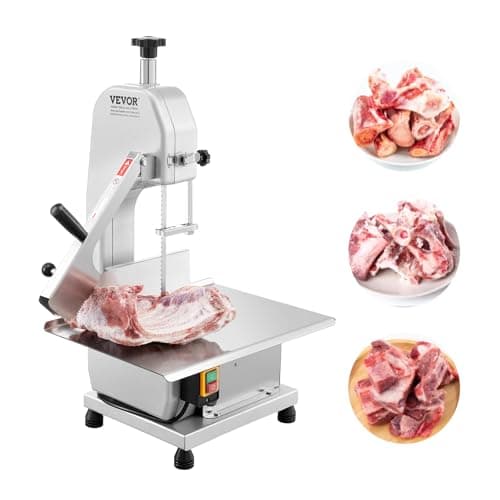
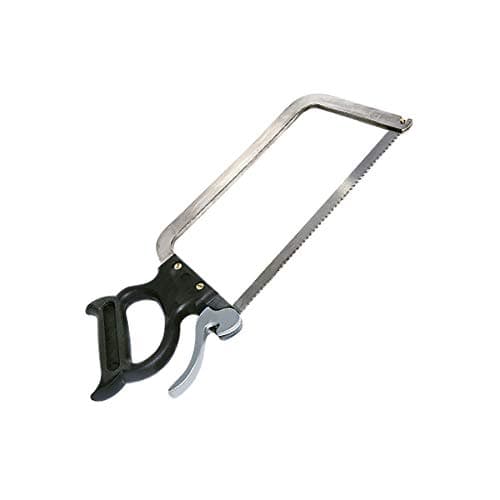
Buy the hand bone saw. If you bone out your deer — taking the muscles off the skeleton rather than cutting through it — a 22 in hand saw does the handful of cuts you actually need, costs about a tenth of a bandsaw, and cleans in a sink. A bandsaw earns its bench space in one situation: when you regularly cut through bone for bone-in chops, ribs and shanks, or cut frozen blocks. VEVOR's own copy makes that boundary unusually clear, and in a way that argues against the machine for most readers of this page.
What each one is rated for
The decisive fact is in the bandsaw listing, not the hand saw's. VEVOR says its bandsaws are for hard bones and frozen meat, and specifically not for boneless fresh meat. Read that as the maker telling you the machine's job: it is a bone-and-block saw, not a general butchery tool. A hand bone saw, by contrast, will cut bone or not cut bone entirely at your discretion.
| Spec | Weston 22 in hand bone saw | VEVOR 650W bandsaw (BS-130) |
|---|
| Maker's intended job | Butchering meat and bone by hand | Hard bones and frozen meat; not boneless fresh meat |
| Power | You | 650W |
| Weight | Hand tool | About 63 lb |
| Bench space | Hangs on a nail | 12.4 x 18.1 in worktable, permanent fixture |
| Cleaning | Blade comes out; wash in a sink | Cleaning procedure not described in the listing |
| Electrical requirements | None | Not published — no voltage or amp draw in the listing |
| Safety certification | n/a | Not published |
Two rows there should give you pause about the bandsaw regardless of which you buy: no published electrical requirement and no published safety certification, on a 650W machine with an exposed blade. Our meat saw roundup scores both classes on the same rubric and reaches the same conclusion this page does, which is why its headline is “hand saws first.”
How many bone cuts does a deer actually need?
This is the question that settles it, and the answer surprises people. If you bone out a deer the way our processing guide describes, the breakdown is almost entirely knife work: the shoulders come off along the seam against the ribs, the backstraps along the spine, the hindquarters at the hip joint, and then each quarter comes apart muscle by muscle along its seams.
The saw comes out for a short list:
- Splitting the pelvis or brisket, if you open the carcass that way
- Taking the head or lower legs off
- Cutting the ribs free as a rack, if you keep ribs
- Splitting a shank for osso buco
That is minutes of sawing per deer. A 63 lb machine that occupies a permanent 12 x 18 in of bench to save you those minutes is a hard case to make. A $50-ish hand saw that hangs on the wall is the proportionate tool.
When the bandsaw genuinely wins
There are real cases, and they are specific:
| What you cut | Which saw | Why |
|---|
| Boned-out deer, a few bone cuts | Hand saw | Minutes of work; no bench, no power, easy cleaning |
| Bone-in chops and steaks, every animal | Bandsaw | Dozens of repeatable straight cuts through bone; a hand saw wanders and tires you out |
| Pork or lamb, bone-in, whole carcass | Bandsaw | This is the volume the machine is designed for |
| Frozen blocks or frozen quarters | Bandsaw | The one cutting job VEVOR names in writing; no slicer is rated for it |
| Boneless fresh venison | Knife | VEVOR says explicitly this is not what its bandsaw is for |
Notice the last row. If you bought a bandsaw expecting it to replace a knife for portioning boneless venison, the maker has already told you it will not. That is the single most common reason a bandsaw ends up under a bench.
One reason to prefer boning out entirely
There is a non-equipment argument for the hand saw, which is that cutting through bone less often is sometimes the point. Many states restrict moving whole carcasses and spinal or skeletal material out of chronic wasting disease management areas, and boning out the animal in the field is the standard way to comply. The CWD Alliance maintains the state-by-state carcass import regulations; check yours before you plan a season around bone-in cuts.
If you are boning out anyway for that reason, the saw question mostly answers itself.
Blade and care, for whichever you buy
A bone saw blade is not a wood blade: the teeth are set for bone and they dull on it. Weston's 22 in saw takes a replaceable blade, which is the correct way to own one — sharpen nothing, swap the blade. The bandsaws come with spare blades for the same reason; the 1500W VEVOR ships with seven of them.
On hygiene, a saw is the worst tool in the kitchen for it, because bone dust and marrow get into the teeth and the frame. Penn State Extension's field-dressing guidance is to clean your tools frequently between cuts rather than at the end. That is easy with a hand saw whose blade comes out and awkward with a bandsaw whose listing does not describe a cleaning procedure at all.
The verdict
Buy the hand bone saw unless you can name the bone-in cuts you plan to make and you make them every year. The hand saw handles the four or five cuts a boned-out deer needs, costs a fraction, stores on a nail and washes in a sink. Buy the bandsaw if you cut bone-in chops and ribs as a matter of course, process pork or lamb whole, or need to cut frozen — and budget for confirming its electrical requirements with VEVOR, because the listing does not publish them.
If you want the full field of both classes ranked rather than a head-to-head, that is our best meat saws page. And if what you actually wanted was to cut frozen meat into slices rather than through it, read slicers for frozen meat first — the cheaper answer there is usually to thaw it an hour.