Home Processing ◆ Guide
How to Use a Hand Meat Saw Without Making a Mess of It
A butcher saw is the simplest tool in a processing kit and the one most often used wrong. Three things matter: tension, the direction the teeth face, and how little you let the blade wander.
We earn a commission if you buy through our links, at no extra cost to you. It never decides the ranking — the method is published · Affiliate disclosure
Tension the blade until it rings, point the teeth away from the handle so the saw cuts on the push stroke, score the meat with a knife down to the bone first, then saw with long, light strokes and let the blade do the work. Forcing a butcher saw is how you wander off line, bind the blade and tear the meat either side of the cut.
Most of a deer needs no saw at all. If you bone out every cut, a saw is optional — our meat saw roundup opens with exactly that question before it ranks anything.
Tension and tooth direction
A frame saw cuts because the blade is held in tension; the frame is a spring. Slack blade, wandering cut. The Weston 22-inch saw uses a trigger lock that it says automatically maintains blade tension, and the Ceoighe adds a quick-release cam lever — on either, check the tension before each session, because a blade that was tight in November has usually relaxed by the time you use it again.
Tooth direction catches people out after a blade change. On a butcher saw the teeth point away from the handle, so the saw cuts as you push. Fit a blade backwards and it still cuts, badly, and the blade flexes under load instead of pulling straight.
Cut cold, and why
Cold meat holds its shape against the blade. Warm meat compresses, so the cut face deforms, the blade wanders and you lose the line. Chilled or partly frozen is ideal — the KATA 25-inch listing says it is intended for frozen meat as well as fresh, which is a reasonable proxy for the frame being stiff enough.
There is a food-safety reason too, and it is the same one that runs through everything on this site: Penn State Extension's wild-game processing guidance treats an unbroken cold chain and clean equipment as the two controls that matter at home. Sawing is slow work; do it on cold meat and get it back in the cold.
The stroke
- Score the meat first. Cut down to the bone with a boning or breaking knife along the line you want. The saw should only ever be cutting bone, not meat — this is the single biggest difference between a clean bone-in chop and a shredded one.
- Start on the pull. Draw the saw back a couple of times to seat a kerf in the bone before you push. A fresh blade on a round bone skates otherwise.
- Long strokes, light pressure. Use the whole blade. Short, hard strokes heat the blade, load the teeth and bind. If it is binding, you are pushing.
- Support the far side. Bone breaks out at the end of a cut unless the piece is held, and a broken-out edge is a splinter in the meat.
- Finish through, not off. Ease up on the last inch rather than driving the blade onto the table.
Where you actually saw on a deer
Four jobs, honestly, and that is the list:
- Bone-in shanks cut into osso-buco rounds.
- Splitting the pelvis or brisket if you are quartering rather than boning out.
- Removing the lower legs at the joint, if you did not do it in the field.
- Bone-in chops from the loin, which is a choice rather than a necessity.
Everything else — hindquarters, shoulders, backstrap, neck — comes off with a knife. Our how to process a deer at home page runs the full sequence, and breaking knife vs boning knife covers the two blades that do the rest of it.
One thing a hand saw is not for: feeding a grinder. Bone does not belong in a home grinder — see can you put bones in a meat grinder — and if you are cutting enough bone that a hand saw feels slow, the next step is an electric bandsaw, which is covered in our bone saw vs band saw comparison.
Bone dust and the cold chain
Sawing bone makes a paste of bone dust and marrow that smears along the cut and tastes of nothing good. Two habits deal with it: wipe the cut face with a clean damp cloth after each cut, and rinse the blade between cuts rather than at the end, because dried bone paste in the gullets of the teeth is what makes a saw feel blunt before it actually is.
If you hunt deer or elk, there is a separate reason to be deliberate about saw cuts through spine and skull. CDC guidance on chronic wasting disease and the state-by-state carcass transport rules collected by the CWD Alliance are the sources to check for your own state's requirements; many restrict moving certain parts, and the practical home habit is to avoid sawing through spinal column and skull where you have the option.
Cleaning a frame saw
Take the blade out. That is the whole trick — the Weston has a quick-release handle and the Ceoighe a quick-release cam, and both exist so the blade and the frame can be washed separately. Bone paste collects where the blade meets the frame, and a saw washed assembled never gets properly clean there.
Wash in hot soapy water, sanitise, and dry immediately. Drying matters more than it sounds: the Weston's blade and frame are stainless, but the KATA saws use SK5 blades and the listings do not say whether they are stainless or coated — so dry those right after washing. WSU Extension's guidance on sanitising cutting boards is the method we follow for the surfaces the saw works on.
Blades, and when to replace one
A butcher saw blade is a consumable. When it starts needing pressure, or the cut wanders despite correct tension, it is done — and sharpening a fine-tooth butcher blade is not worth the attempt.
This is where listings differ in a way that matters. Weston states that replacement blades are available for the 47-2201, so a dull blade does not retire the saw. The Ceoighe and both KATA listings do not state blade availability, which is a real consideration on a tool whose cutting edge is designed to be thrown away.
Picks for this job
Saws these habits suit
All three are frame saws with trigger-lock tension. The differences are blade length, whether replacement blades are listed, and how much table the frame needs.
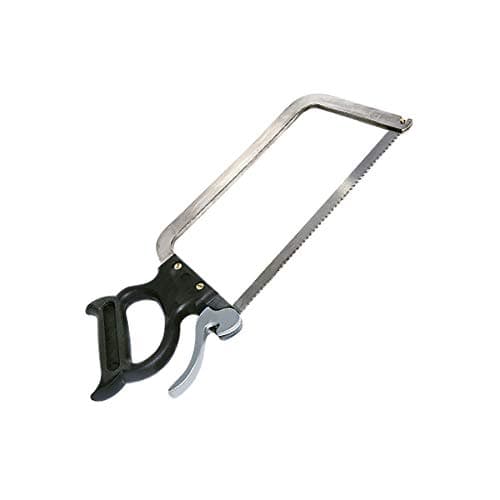
Best meat saw for most hunters
Weston 22 in Butcher Meat and Bone Saw (47-2201)
22 in. stainless blade and stainless frame with trigger-lock tension, a quick-release handle and replacement blades listed as available - the reason it is our default.
$39.99Amazon#ad · Price as of November 4, 2026 · Affiliate disclosure for the link to Weston 22 in Butcher Meat and Bone Saw (47-2201)
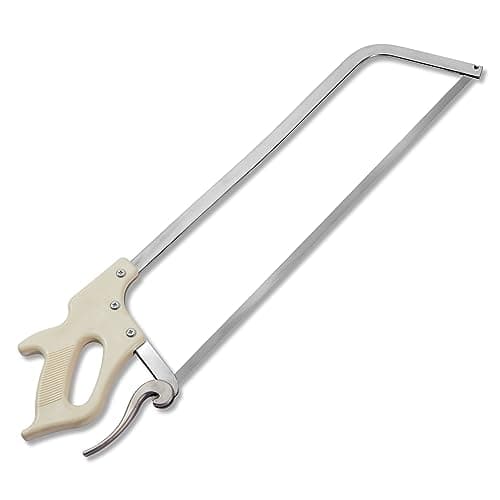
Best for 6+ deer or a half beef
KATA 25 in Manual Butcher Meat Saw
The long-stroke option at 25 in. (31 in. overall), and the only listing here that says it is intended for frozen meat as well as fresh. It needs a real processing table.
$48.99Amazon#ad · Price as of November 4, 2026 · Affiliate disclosure for the link to KATA 25 in Manual Butcher Meat Saw
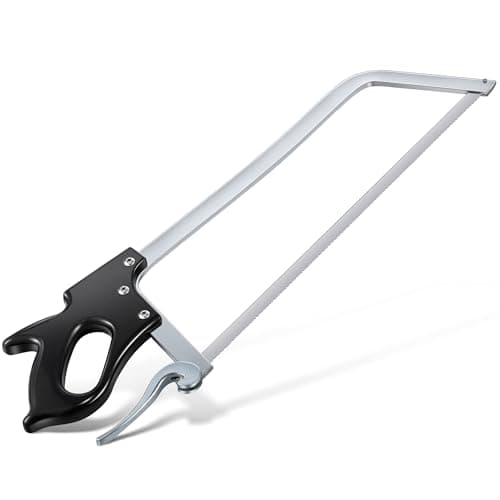
Best Weston alternative
Ceoighe 22 in Butcher Saw, Stainless Blade
Same 22 in. layout with a quick-release cam lever and a published 27.36 in. overall length. The listing is inconsistent about its blade steel, so we rank it second to the Weston.
$45.99Amazon#ad · Price as of November 4, 2026 · Affiliate disclosure for the link to Ceoighe 22 in Butcher Saw, Stainless Blade
Questions
Frequently asked
Which way do the teeth face on a hand meat saw?
Should you saw through meat or cut it first?
Can you use a hand meat saw on frozen meat?
How do you clean a butcher saw?
How often do you replace a meat saw blade?
Do you need a meat saw to butcher a deer?
Keep going down the chain
Related
Receipts
Sources
- Penn State Extension — Proper Processing of Wild Game and Fish (updated June 2023)
- Washington State University Extension — Sanitizing cutting boards
- CWD Alliance — State and province carcass import regulations
- US Centers for Disease Control and Prevention — About Chronic Wasting Disease
- Amazon listing, manufacturer-supplied copy — Weston 22 in. butcher meat and bone saw (47-2201)
- Amazon listing, manufacturer-supplied copy — KATA 25 in. manual butcher meat saw
- Amazon listing, manufacturer-supplied copy — Ceoighe 22 in. butcher saw
Specs come from the maker's own pages, manuals and maker-supplied listing copy (labeled as such); food-safety figures from USDA and university extension publications; yield from the Ohio Division of Wildlife; prices live from Amazon. Where a figure isn't published, we say so. Read the full method.