The Best Electric Meat Bandsaws, and What Their Listings Will Not Tell You
A bandsaw is the only tool that cuts bone-in chops at volume. It is also the category where makers publish the least, so this page ranks on what is actually on the record — certification, duty cycle, cut depth and guarding.
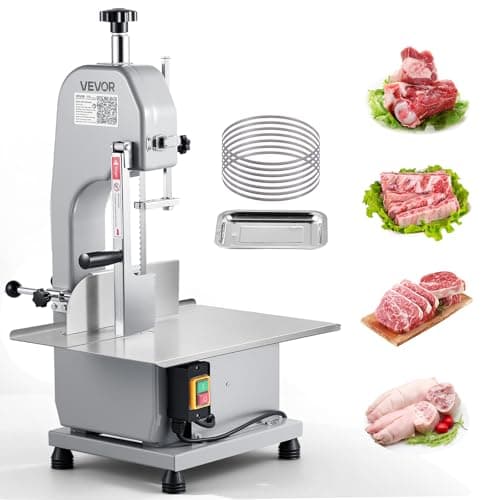
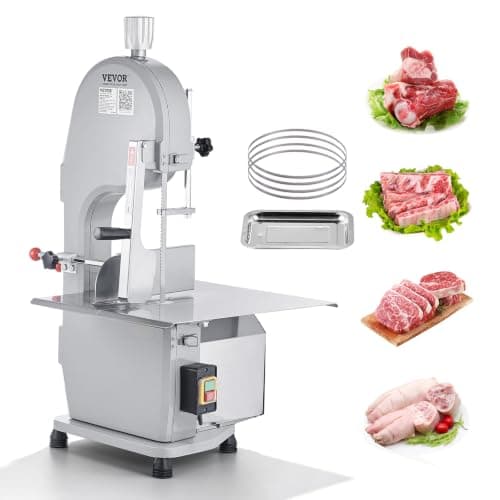
The only bandsaw in this field whose listing publishes a safety certification, a run limit and a cleaning method: ETL approved, two hours on and thirty minutes off, blade out and motor hosed down.
The only bandsaw in this field whose listing publishes a safety certification, a run limit and a cleaning method: ETL approved, two hours on and thirty minutes off, blade out and motor hosed down.
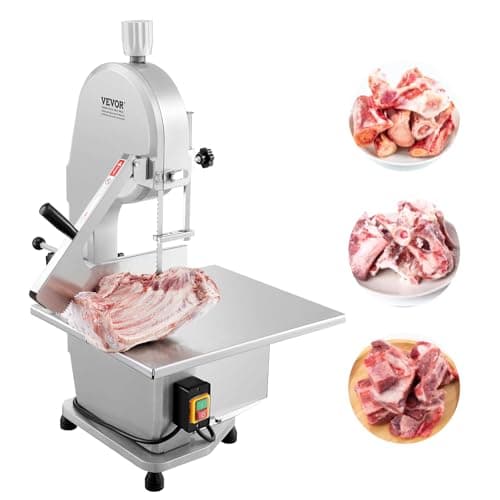
The most motor and the deepest cut on the page, in die-cast aluminum with both a pusher plate and a pusher rod. It is also the heaviest and the dearest.
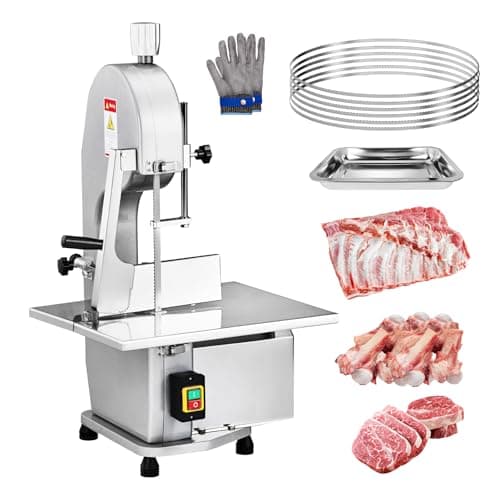
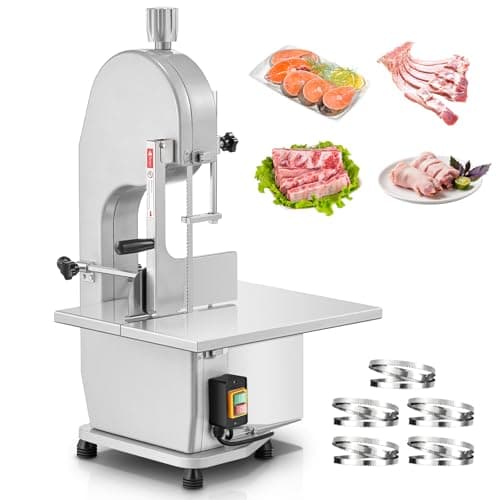
The countertop bandsaw for a heavy season of bone-in cuts: a 1100W copper motor, a 4.3 in maximum cut and seven spare blades in the box. Confirm the electrical specs before you buy.
#ad · Prices come live from Amazon, last checked November 6, 2026; where we have no verified live price we show none. Scores are ours on a published 8.4-9.8 scale, compiled from manufacturer specs, manuals and warranty terms — see how we pick. Tap a row for the full write-up.
An electric meat bandsaw earns its bench space in exactly one situation: you cut through bone, at volume, year after year. Bone-in chops and short ribs off a hanging deer, a frozen beef primal that needs splitting, pork trotters, lamb shanks. If that is not your processing day, a 22-inch hand butcher saw does the four or five bone cuts a boned-out deer actually needs, costs about a tenth as much, and washes in a sink. We argue that case at length in bone saw vs band saw, and nothing on this page reverses it.
This page is for the reader who has already decided against the hand saw. The awkward part of that decision is that electric bandsaws are the worst-documented category on this site. Grinder makers publish pounds per minute. Sealer makers publish duty cycles and seal widths. Bandsaw listings, almost without exception, publish a wattage and a photograph.
So we ranked these six on what is actually on the record: published cut depth, bench dimensions, hand protection, spare blades, cleaning method, certification and run limits — and we have marked, on every pick, what the listing leaves blank. Scores are our editorial judgment built from those published documents. We do not run a bench and we are not claiming one.
Most people should not buy one
Worth being blunt before any money changes hands, because this is a $250-to-$560 category and the honest answer for most of this site's readers is “no.”
At the Ohio Division of Wildlife's measured average, a whitetail yields about 52 pounds of venison. If you bone that out — taking the muscles off the skeleton rather than cutting through it — you will not touch bone at all except to split the pelvis, and a hand saw handles that in under a minute. The bandsaw only starts paying when you want bone-in product: chops cut across the loin, osso buco out of the shanks, ribs in racks rather than trimmed off. That is a butchery preference, not a processing requirement, and plenty of very experienced home processors never develop it.
What we ranked on
These six criteria, in this order of weight. They are the same knives-kits-and-saws rubric the rest of this hub uses, applied to a powered tool — see how we pick for the weights.
What the maker is prepared to state. A published duty cycle or a safety certification is worth more than a wattage claim, because it is a commitment rather than a marketing number. One machine here publishes both.
Cut depth. The maximum thickness the blade will pass. This is the spec that decides whether the machine can do the job you bought it for, and it ranges from 4.3 to 7.9 inches across this field.
Bench size and footprint. Every one of these is a permanent fixture weighing 50 to 88 pounds. The table is where the work happens and the smallest here is less than half the area of the largest.
Hand protection. A pusher plate, a pusher rod, a blade stabilizer, an emergency stop. An exposed band blade at 49 feet per second does not forgive a slip.
Cleaning. Raw meat and bone dust get everywhere. Whether the blade comes off without tools, and whether the motor is sealed well enough to rinse, is the difference between a ten-minute cleanup and a machine you quietly stop using.
Value at the live price. Checked at the last price refresh, shown on the button, never typed into this prose.
The blank spec sheet problem
Here is the single most useful thing on this page. Of the six machines below, one publishes a duty cycle and one claims a safety certification — and it is the same machine. Every other listing in this category gives you watts, a cutting range, a table size and a list of animals.
What we looked for
How many of the six publish it
Motor wattage
6 of 6
Maximum cutting thickness
6 of 6
Worktable dimensions
6 of 6
Number of spare blades
6 of 6
Any hand-protection detail
4 of 6
A run limit / duty cycle
1 of 6
A safety certification
1 of 6
Voltage or amp draw
0 of 6
That last row is the one to sit with. These are 750- to 1800-watt motors and not one listing in the field tells you what circuit to put them on. We have made it the “skip this if” line on more than one pick below, and it is the reason the ranking rewards the machine that published the most rather than the machine with the biggest number on the box.
Cut depth is the spec that decides it
If you only compare one number across these machines, make it maximum cutting thickness, because it is the one that determines whether a given piece of meat fits between the blade and the guide at all.
Machine
Motor
Max cut
Worktable
FOHERE 1500W
1500 W
7.09 in
19.3 x 19.7 in
ROVSUN 750W
750 W
7.9 in
18.5 x 12.4 in
VEVOR 1800W
1800 W
7.09 in
15 x 19.1 in
VEVOR 1500W (BS-130)
1500 W
4.3 in
12.4 x 18.1 in
VEVOR 1100W (BS-130)
1100 W
4.3 in
12.4 x 18.1 in
VEVOR 1500W countertop
1500 W
7.9 in
19.3 x 15 in
The split is sharp: the two BS-130 chassis machines stop at 4.3 inches, and everything else goes to 7.09 or 7.9. Four and a bit inches covers venison ribs, shanks and chops comfortably — a whitetail is a small animal and almost nothing on it is thicker than that once quartered. It does not cover a frozen beef primal or a bone-in pork shoulder.
So the decision is not “more is better.” It is: if the biggest thing you will ever push through it is deer, 4.3 inches is enough and the BS-130 machines are the smaller, cheaper way to get there. If beef or hog is in the picture, do not buy a 4.3-inch machine, because the day it will not take the cut is the day the whole purchase was pointless.
Note also that motor wattage and cut depth are not correlated here. The 750-watt ROVSUN cuts deeper than the 1500-watt BS-130. Wattage tells you how hard the motor will push through frozen bone; cut depth tells you what geometry fits. They are separate questions and the listings blur them.
Bench size and where it will live
These machines weigh between about 53 and 88 pounds and stand 28 to 35 inches tall on their own feet. That is a permanent installation, not something that goes back in a cupboard, and the height matters more than people expect: at 34.65 inches the FOHERE will not slide under a standard 36-inch wall cabinet with room to load.
The worktable area is the real working difference. The FOHERE's 19.3 by 19.7 inches is about 380 square inches; the ROVSUN's 18.5 by 12.4 is about 229. That is the gap between resting a bone-in hind quarter on the table while you line up a cut and holding it in the air while you line up a cut. If your bench is deep enough, take the bigger table.
Whatever you buy, it wants a dedicated surface at a comfortable height, and most garages do not have one. A stainless prep table is the usual answer — see best game processing tables for the ones that hold the weight — and the 6+ deer setup puts the whole bench together, because a bandsaw is a heavy-tier tool and belongs with heavy-tier everything else.
Guarding, and the one emergency stop
Four of the six listings describe some hand protection. The vocabulary is inconsistent, so here is what the terms mean in practice:
Pusher plate — a flat stainless plate you press the meat against to feed it, keeping your palm behind a barrier rather than on the product. The most useful of the four.
Pusher rod — a handle for the last few inches of a cut, when the piece is too short to hold safely. Only the VEVOR 1800W lists both this and a plate.
Blade stabilizer — a guide that reduces blade wander. A cut quality feature that is also a safety feature, because a wandering blade is a blade that can bind and throw the work.
Emergency button — a dedicated stop. Only the ROVSUN names one, and it is the single feature in this list we would most want on a machine with an open band blade.
No listing here publishes a blade guard specification or an interlock. Treat all six as open-blade machines, keep the pusher plate on the table rather than in a drawer, and do not run one with anyone else in arm's reach.
The electrical question nobody answers
Zero of six listings publish voltage or amp draw. All are sold as 110-volt North American appliances and the wattages run 750 to 1800. An 1800-watt load is 15 amps at 120 volts — in other words, a standard 15-amp household circuit with nothing left over, and garage circuits are frequently shared with a freezer.
That is a real planning problem when a chest freezer full of this season's meat is on the same run. Before you buy, work out which circuit the saw will sit on and what else is on it. If the bandsaw and the freezer share a 15-amp circuit, the breaker will find out for you at the worst possible moment — and the USDA's guidance on a freezer that has lost power is the kind of reading nobody wants to do in November. Our garage chest freezer page covers the freezer side of the same circuit question.
Ask the seller for the amp draw before ordering. If they cannot answer, derive the worst case from the wattage: watts divided by 120 gives you amps, and plan for a dedicated 20-amp circuit on anything at or above 1500 watts.
In detail
The picks, in full
1
Best overall: the documented one
FOHERE 1500W Electric Meat and Bone Band Saw (ETL)
9.3 /10
The only bandsaw in this field whose listing publishes a safety certification, a run limit and a cleaning method: ETL approved, two hours on and thirty minutes off, blade out and motor hosed down.
#ad · Price as of November 6, 2026 · Affiliate disclosure for the link to ROVSUN 750W Electric Bone Saw Machine
3
Most motor, deepest cut
VEVOR 1800W Commercial Electric Meat Bandsaw
8.9 /10
The most motor and the deepest cut on the page, in die-cast aluminum with both a pusher plate and a pusher rod. It is also the heaviest and the dearest.
#ad · Price as of November 6, 2026 · Affiliate disclosure for the link to VEVOR 1500W Electric Meat Bandsaw with 7 Spare Blades
5
The BS-130 at lower power
VEVOR 1100W Electric Meat Bandsaw (BS-130)
8.7 /10
The countertop bandsaw for a heavy season of bone-in cuts: a 1100W copper motor, a 4.3 in maximum cut and seven spare blades in the box. Confirm the electrical specs before you buy.
#ad · Price as of November 6, 2026 · Affiliate disclosure for the link to VEVOR 1500W Countertop Bone Sawing Machine, 19.3 x 15 in Bench
How to choose between them
Start with the animal, not the motor. Deer only, quartered: the 4.3-inch BS-130 machines do it and cost the least. Beef, hog, or anything that arrives frozen in primals: you need 7 inches of cut, which rules the BS-130s out entirely regardless of their wattage.
Then weigh documentation against raw power. This is where our ranking differs from a spec-sheet sort. The FOHERE is not the most powerful machine here — the VEVOR 1800W is, by 300 watts — but it is the only one that tells you how long you may run it, claims a tested safety certification, and explains how to clean it. In a category where every other maker publishes a wattage and a photograph, that is worth more than 300 watts you will not use.
Then look at your bench. Table area and overall height eliminate machines faster than any performance spec. Measure the space, including vertical clearance, before you shortlist.
Finally, budget for blades. Every machine here ships with five to eight spares, which sounds generous until you learn that a blade dulled on frozen bone cuts slowly and binds, and that a binding blade is the main way these machines hurt people. Replace on feel, not on a schedule: when it needs pressure, it is done.
What not to put through it
VEVOR states plainly on its BS-130 listings that the machine is for hard bones and frozen meat and not for boneless fresh meat. That is not a liability disclaimer, it is physics: a band blade designed to cut bone tears soft room-temperature muscle rather than slicing it, and the piece can grab and pull. A bandsaw does not replace a knife for any part of a deer, and it does not replace a slicer either — if what you actually want is thin, even slices of boneless meat, that is a different machine entirely (see best meat slicers for home use).
Freeze bone-in pieces firm before they go on the table. Partly frozen is where every one of these machines does its best work, which is also why the cut-depth number matters most on frozen product: frozen pieces cannot be squashed to fit.
Cleaning is the spec that decides whether you keep using it
Bone dust is the problem. It is fine, it is wet, it goes everywhere inside the housing, and it sets. Only the FOHERE listing describes a cleaning method — removable blade, sealed waterproof motor, rinse with a hose or pressure washer — and only the ROVSUN describes a tool-free blade removal knob. The rest say nothing at all, which in practice means wiping down a machine you cannot open.
Whatever you buy: pull the blade after every session, wash the table and the pusher plate separately, and let everything dry before reassembly. The sanitizing step for anything that touched raw meat is the same one we use across this site — a tablespoon of chlorine bleach per gallon of water, from Penn State Extension, after the detergent wash rather than instead of it.
If you are building the rest of the bench around this, the how to process a deer at home walkthrough sets out the order of operations, and best meat saws covers the hand saws that do the same job on a smaller season for a fraction of the money.
The only bandsaw in this field whose listing publishes a safety certification, a run limit and a cleaning method: ETL approved, two hours on and thirty minutes off, blade out and motor hosed down.
#ad · Price as of November 6, 2026 · Affiliate disclosure for the link to ROVSUN 750W Electric Bone Saw Machine
How we picked
Every pick, scored on the same published rubric
Each machine here is read end to end: the maker's spec sheet, the owner's manual and the warranty terms. We pull out the figures that decide whether it keeps up with your season — size number, motor rating, rated pounds per minute, capacity, duty cycle, gearing — confirm parts are still available, and score every pick on the same weighted rubric, so a score on one page means the same thing on the next. Then we show the season math, pounds per deer from the Ohio Division of Wildlife's yield study, so you can run it against your own freezer.
Do I need an electric meat bandsaw to process a deer?+
No. A 22-inch hand butcher saw handles the handful of bone cuts a boned-out deer needs, costs about a tenth as much, and cleans in a sink. A bandsaw earns its place when you want bone-in cuts as a matter of course, or when you take bulk beef and pork in frozen primals. See bone saw vs band saw.
What cutting thickness do I actually need?+
For deer, 4.3 inches covers ribs, shanks and chops on a quartered animal. For beef or hog — especially frozen primals — you want the 7.09 or 7.9 inch machines. Cut depth and motor wattage are separate specs: the 750-watt ROVSUN cuts deeper than the 1500-watt VEVOR BS-130.
What circuit does a meat bandsaw need?+
None of these six listings publishes a voltage or amp draw, which is the biggest documentation gap in the category. They are 110-volt appliances rated 750 to 1800 watts; 1800 watts is about 15 amps at 120 volts, which is a full standard circuit. Plan a dedicated 20-amp circuit for anything at or above 1500 watts, and check what else shares the run — a garage freezer on the same circuit is a common and expensive mistake.
Can you cut boneless meat on a meat bandsaw?+
VEVOR says explicitly not to. A blade ground for bone tears soft fresh muscle instead of slicing it, and the piece can grab. Use a knife for boneless work, or a slicer if you want thin even slices.
How long can you run a meat bandsaw continuously?+
Only one of the six publishes an answer: FOHERE recommends a maximum of two hours continuous running followed by a 30-minute cooldown. No other listing in this field states a duty cycle at all, so treat the FOHERE figure as the only published guidance in the category rather than a universal rule.
Are these machines certified?+
One of the six claims ETL approval on its listing. An ETL Listed Mark from Intertek means a sample was tested against the applicable North American safety standard. The other five listings make no certification claim we can cite.
Specs come from the maker's own pages, manuals and maker-supplied listing copy (labeled as such); food-safety figures from USDA and university extension publications; yield from the Ohio Division of Wildlife; prices live from Amazon. Where a figure isn't published, we say so. Read the full method.