Sausage & Curing ◆ Guide
How to Cure Bacon at Home, by the Extension Service's Numbers
Home-cured bacon is five ingredients, a zip-top bag and a week of patience. The only part that is not forgiving is the cure, so every figure on this page comes from a peer-reviewed extension publication.
We earn a commission if you buy through our links, at no extra cost to you. It never decides the ranking — the method is published · Affiliate disclosure
Bacon is cured pork belly. Coat the belly in salt, sugar and Prague Powder #1, cure it in the refrigerator at 40 °F for five to seven days flipping it daily, rinse it thoroughly, then smoke or cook it to a minimum internal temperature of 160 °F. That sequence, and every number in it, comes from PNW 784, the peer-reviewed Pacific Northwest Extension publication on making cured bacon at home.
The curing salt is the one ingredient you cannot improvise. PNW 784 is explicit that nitrite and nitrate salts “have a relatively high toxicity, so they must be used in the quantities established in researched recipes.” Follow a published recipe by weight and the method is genuinely straightforward.
The safety checklist, as published
Note the last line: home-cured bacon is not shelf-stable. Curing is a preservation method, not a substitute for a cold chain.
Which curing salt, and why
Prague Powder #1, also sold as Curing Salt #1 or Insta Cure #1. PNW 784 describes it as 6.25% sodium nitrite and 93.75% sodium chloride and recommends it for curing bacon at home.
Prague Powder #2 is the wrong product here. PNW 784 describes it as including up to 4% sodium nitrate alongside 6.25% sodium nitrite, with the nitrate acting as a slower, time-release curing agent — and says it is intended for cured meats that will not be cooked before eating, such as salami or prosciutto. Bacon gets cooked, so it wants #1.
Two other distinctions worth holding on to. Pink curing salts are dyed pink so they cannot be mistaken for table salt, and PNW 784 notes they are not the same as Himalayan pink salt, which is pink from trace minerals and has no curing function at all. And the publication adds a caution we would repeat: not all curing salt blends are recommended for curing bacon at home, so check the manufacturer's instructions on the product you buy.
Why nitrite at all? PNW 784: curing salts that include nitrite “are an important safety measure in the curing process because they are an effective inhibitor of Clostridium botulinum growth and toxin production.” It also produces the pink colour and the cured flavour, and prevents rancidity. Bacon can be made without nitrite, the publication says, but then temperature control is critical and the product must be constantly stored below 40 °F.
Our curing salt guide covers the #1-versus-#2 question in more detail, including dosing by weight.
Dry cure or wet brine
PNW 784 lists three methods and tells you which are home methods:
| Method | What it is | Used at home? |
|---|---|---|
| Dry curing | Coating the belly with table salt, curing salt and flavourings such as granulated sugar | Yes — commonly, both commercially and at home |
| Wet / immersion brine | Soaking the belly in a solution of salt, curing salt and flavourings | Yes — common at home, rare commercially |
| Pumping | Injecting the solution into the belly | No — common commercially, rare at home |
The publication's own dry-brine example for a 5 lb belly is five tablespoons each of coffee grounds, brown sugar, paprika and salt, plus one teaspoon of Prague Powder #1. Mix, pack the belly, bag it in a two-gallon zip-top bag, and cure in the refrigerator for five to seven days flipping it each day. A wet brine works the same way with the cure dissolved in liquid.
One teaspoon per five pounds is also the dose the Hoosier Hill Farm Prague Powder #1 listing gives — one level teaspoon per 5 lb of meat, or 1 oz per 25 lb — which is a useful cross-check when you are standing at the bench. Weigh the meat and weigh the cure. PNW 784's instruction to use researched quantities only works if you measure.
Five to seven days, flipped daily
Liquid accumulates in the bag as salt draws moisture out of the belly; that is the cure working. Flip the bag every day so both faces sit in it. PNW 784 says total curing time depends on the belly and that the meat should feel firm to the touch when it is ready — and after the cure, “the belly will be noticeably more rigid.” That firmness is the test, not the calendar alone.
The rinse everybody under-does
After curing, rinse the belly thoroughly under cold running water, massaging it to remove as much loose salt and brine as possible, then pat it dry. PNW 784 is blunt about the consequence: if the cured belly is under-rinsed, the final product will be too salty.
One thing the rinse does not do: it does not remove curing salts from the interior of the belly. That is the point of dosing by weight in the first place — you cannot wash a miscalculation out.
You can smoke or cook immediately, or store the rinsed belly uncovered in the refrigerator for up to 24 hours first.
Cooking to 160 F
Smoke or cook to a minimum internal temperature of 160 °F. That is a measured number, not a judged one, so an instant-read thermometer is the one piece of equipment this project genuinely requires. USDA FSIS's guidance on smoking is worth reading alongside it if you are using a smoker rather than an oven, because smokehouse temperature and internal temperature are different controls.
After cooking, PNW 784's finish is: cool at ambient temperature for one hour, wrap tightly in plastic wrap, chill overnight, then slice to the thickness you want.
Storing it
Refrigerate sliced bacon for up to seven days, or freeze it. PNW 784 recommends vacuum sealing for frozen storage and says to use it within four months for best quality.
Picks for this job
What this actually needs
Two of these are the cure, dosed by weight. The third is how PNW 784 says to store the finished bacon if you are freezing it.
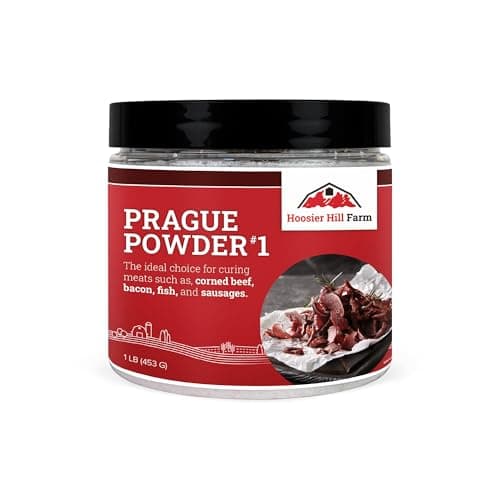
Best Cure #1
Hoosier Hill Farm Prague Powder No. 1 Curing Salt, 1 lb
The clearest-labelled Cure #1 we cover: the listing states the dose both ways - 1 oz per 25 lb, or one level teaspoon per 5 lb - and tells you to use a scale.
$12.99Amazon#ad · Price as of November 4, 2026 · Affiliate disclosure for the link to Hoosier Hill Farm Prague Powder No. 1 Curing Salt, 1 lb
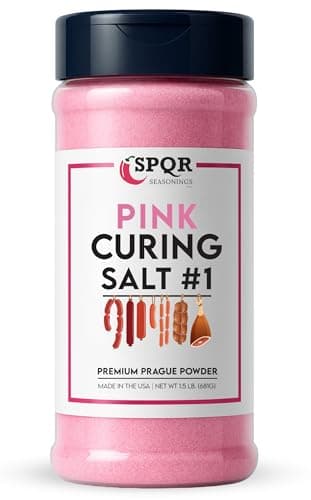
Biggest Cure #1 bottle
SPQR Seasonings Curing Salt No. 1, 1.5 lb Bottle
States its 6.25% sodium nitrite outright, which matches PNW 784's description of Prague Powder #1, in a 1.5 lb bottle with a teaspoon cap.
$13.94Amazon#ad · Price as of November 4, 2026 · Affiliate disclosure for the link to SPQR Seasonings Curing Salt No. 1, 1.5 lb Bottle

Best for wide cuts
Weston Pro-2300 Vacuum Sealer
For the freezer step: a fan-cooled sealer with a double-piston pump and bags up to 15 in. wide, so a whole slab seals in one piece before it is sliced.
$474.45Amazon#ad · Price as of November 4, 2026 · Affiliate disclosure for the link to Weston Pro-2300 Vacuum Sealer
Slicing is easier on a chilled slab than a room-temperature one, and a slicer with a published thickness dial makes rashers consistent — our best meat slicers for bacon page covers that step. If you are curing other things as well, read venison summer sausage and the DIY curing chamber next.
Questions
Frequently asked
How long does it take to cure bacon at home?
Do you need Prague Powder #1 or #2 for bacon?
Can you cure bacon without nitrites?
What temperature do you cook home-cured bacon to?
Is pink curing salt the same as Himalayan pink salt?
How long does home-cured bacon keep?
Keep going down the chain
Related
Receipts
Sources
- Oregon State University Extension / PNW Extension — Making cured bacon at home (PNW 784, August 2025; Waite-Cusic and Hibbard-Swanson)
- USDA Food Safety and Inspection Service — Safe Minimum Internal Temperature Chart
- USDA Food Safety and Inspection Service — Smoking Meat and Poultry
- Mississippi State University Extension — Making Sausage at Home (grinding, curing at 156 ppm, smoking, storage)
- Amazon listing, manufacturer-supplied copy — Hoosier Hill Farm Prague Powder No. 1, 1 lb
- Amazon listing, manufacturer-supplied copy — SPQR Seasonings Curing Salt No. 1, 1.5 lb
- Amazon listing, manufacturer-supplied copy — Weston Pro-2300 vacuum sealer (65-0220-W)
Specs come from the maker's own pages, manuals and maker-supplied listing copy (labeled as such); food-safety figures from USDA and university extension publications; yield from the Ohio Division of Wildlife; prices live from Amazon. Where a figure isn't published, we say so. Read the full method.