Sausage & Curing ◆ Guide
Venison Summer Sausage: Kits, Casings and the Internal Temp That Matters
Summer sausage is where venison trim becomes something people ask for by name. The kit handles cure and seasoning; you handle the fat, a tight casing fill and a thermometer reading of 160°F.
We earn a commission if you buy through our links, at no extra cost to you. It never decides the ranking — the method is published · Affiliate disclosure
Cook venison summer sausage to an internal temperature of 160°F, USDA's figure for ground meat and for uncooked sausage made with beef or pork. A kit is the simplest route: Hi Mountain's seasons up to 30 lb and includes pre-portioned cure and ten 2.5 x 20 inch fibrous casings. Add pork fat to your venison (about 20% of the batch), stuff tight, refrigerate overnight, then smoke or bake to 160°F.
Summer sausage is the batch most hunters make once they've got fresh links down, and it's where a few specifics matter: a cured mix, big casings with no air in them, and a finish temperature you actually measure. Every number below comes from USDA, a university extension bulletin, or the kit and casing makers' own instructions.
Venison summer sausage internal temp: who says what
You'll see several finish temperatures in print, and it's worth knowing where each comes from.
| Source | Finish temperature | Context |
|---|---|---|
| USDA FSIS, Safe Minimum Internal Temperature Chart | 160°F | All ground meats |
| USDA FSIS, Sausages and Food Safety | 160°F (165°F with poultry) | Uncooked sausages containing ground beef, pork, lamb or veal |
| Penn State Extension | 160°F | Cooked sausage made from game meat |
| LEM fibrous casing instructions | 165°F | Smoker or oven, until internal temperature reaches 165°F |
| Hi Mountain summer sausage kit | 156°F | Printed kit instruction |
| NDSU venison summer sausage recipe | 155°F | End of a staged smokehouse schedule for a cured recipe |
Kit or from scratch
The case for a kit is the cure. It arrives pre-portioned to the seasoning, so the one measurement that can hurt someone is done for you. The three kits we point to, per their makers' listings:
| Kit | Seasons | In the box | Notable |
|---|---|---|---|
| Hi Mountain Original | Up to 30 lb | 2 seasoning, 2 cure packets; 10 mahogany fibrous casings, 2.5 x 20 in | Refrigerate 12-24 hours before smoking; prints 156°F finish |
| Hi Mountain Hunter's Blend | Up to 30 lb | Same format as the Original | Garlic, pepper, a hint of hickory, some heat |
| Bearded Butchers Old Fashioned | 25 lb | Seasoning, pink curing salt, encapsulated citric acid, garlic; ten 2.5 in fibrous casings | Citric acid gives the tang without fermentation, per the maker; dye-free cure |
That tang is the other reason kits exist. USDA describes traditional summer sausage as a semi-dry sausage made with a lactic-acid starter culture, fermented and then heated in the smokehouse; the acid is where the flavor comes from. WSU Extension says semi-dry sausage can be made safely within 24 hours with very fresh ingredients, a properly handled starter culture and careful temperature control, but also that home production of dry sausage is not recommended. Bearded Butchers' encapsulated citric acid sidesteps fermentation: the maker says the coating holds until the smoker comes up to temperature, then releases the acid.
From scratch is fine if you're comfortable with cure math. NDSU's venison summer sausage formula (15 lb venison, 10 lb 50/50 pork trim) is a good published starting point; use Cure #1 at the package rate and read our curing salt guide before you measure.
How much pork fat to add
Bearded Butchers' kit says to blend venison with pork trim to around 20% fat by weight so the sausage slices clean instead of crumbling. NDSU's formula lands on the same number: 10 lb of 50/50 pork trim is 5 lb of fat in a 25 lb batch, which is 20%. Hi Mountain's instructions say to combine venison with ground pork without giving a ratio, so use 20% as your baseline. The reasoning behind the ratio, and the alternatives, are in how to make venison sausage and venison fat ratios.
Casings: fibrous, soaked and pricked
NDSU calls fibrous casings the more suitable choice for summer sausage because of their strength and range of sizes; they're permeable to smoke and moisture and peel off the finished sausage. Prep, per the makers and NDSU:
- Soak. LEM says at least 25-30 minutes in clear, warm water; NDSU says 80-100°F water for at least 30 minutes but no more than four hours.
- Prick. If the casings aren't pre-stuck, NDSU says to puncture them with a knife point or pin to eliminate air and fat pockets.
- Use a big tube. A 2.5 inch casing wants your largest stuffing tube, roughly 38-40 mm or 1-1/2 inch. Stuffing through a grinder struggles here; a piston stuffer with an air valve doesn't. See best sausage stuffers.
Picks for this job
Kit, casings and a thermometer for summer sausage
Two kits with the cure pre-portioned, spare casings for a second batch, and a fast, tight-tolerance thermometer.
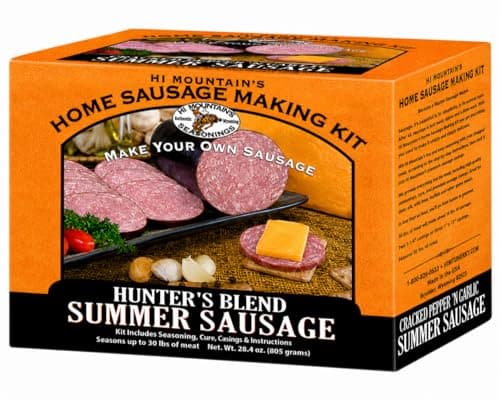
Best spiced summer sausage kit
Hi Mountain Hunter's Blend Summer Sausage Kit
The same kit format as the Original, with a garlic, pepper and hickory blend that finishes with some heat.
$29.99Amazon#ad · Price as of Sep 19, 2026 · Affiliate disclosure for the link to Hi Mountain Hunter's Blend Summer Sausage Kit
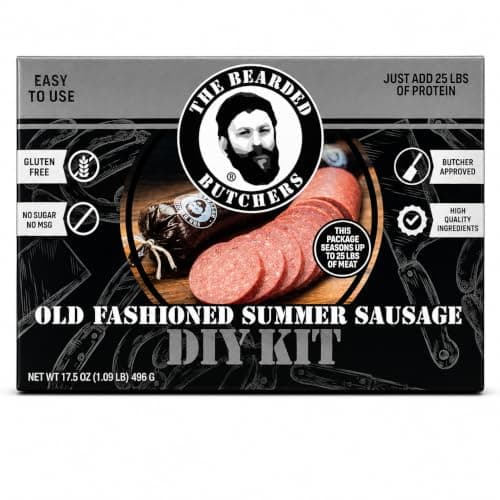
Best tangy kit
Bearded Butchers Old Fashioned Summer Sausage Kit with Casings
Salt-and-pepper summer sausage for 25 lb, with encapsulated citric acid for the tang and fibrous casings in the box.
$47.99Amazon#ad · Price as of Sep 19, 2026 · Affiliate disclosure for the link to Bearded Butchers Old Fashioned Summer Sausage Kit with Casings
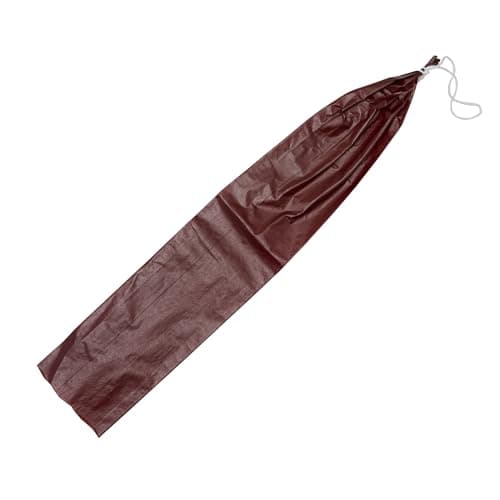
Best summer sausage casing
LEM Mahogany Fibrous Casings, 2.5 x 20 in (25 Count)
The standard summer-sausage casing: plant cellulose, string-tied, smoke-permeable, 25 to a pack.
$25.99Amazon#ad · Price as of Sep 19, 2026 · Affiliate disclosure for the link to LEM Mahogany Fibrous Casings, 2.5 x 20 in (25 Count)
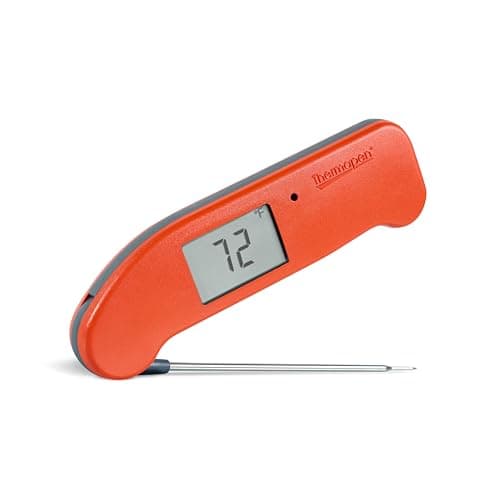
Best thermometer
ThermoWorks Thermapen ONE Instant-Read Thermometer
One-second reads to ±0.5°F and a five-year warranty, for when you're checking a smoker full of chubs.
$125.00Amazon#ad · Price as of Sep 19, 2026 · Affiliate disclosure for the link to ThermoWorks Thermapen ONE Instant-Read Thermometer
The process, start to finish
- Chill. Keep venison and pork at 40°F or below throughout, near 32°F when grinding (NDSU, Penn State, Mississippi State).
- Grind coarse. Cube and coarse-grind the venison and pork together.
- Mix in cure and seasoning. Dissolve them in the recipe's water, per Penn State, and mix 2-5 minutes (WSU). With a Hi Mountain kit, use a non-metal container.
- Regrind through a finer plate, if your recipe calls for it.
- Stuff tight into soaked, pricked fibrous casings, and tie off.
- Rest cold. Hi Mountain says 12-24 hours in the refrigerator before smoking or cooking; Mississippi State says cured sausage should sit about 24 hours before smoking.
- Smoke or bake, raising the heat in stages. NDSU's venison recipe runs 140°F for 2 hours, 160°F for 2 hours, then 170°F to finish. Hi Mountain's kit works in a smoker or oven. WSU notes a household oven used for sausage must be able to hold 185°F.
- Finish at 160°F internal, measured in the thickest chub.
- Cool fast and refrigerate. WSU: cool sausage quickly after cooking, then refrigerate or freeze.
How long homemade summer sausage keeps
USDA's sausage storage chart, which sits alongside its advice on reading the dates on store-bought sausage, lists summer sausage (semi-dry) at 3 months unopened in the refrigerator, 3 weeks after opening and 1-2 months in the freezer for best quality. For homemade sausage, WSU Extension is more conservative: 3-4 weeks refrigerated for properly fermented dry and semi-dry sausages, 1 week for non-vacuum-packaged cooked sausages, 2 weeks vacuum-packaged, and up to 6 months frozen at 0°F for cured, smoked sausage in a moisture-vapor-proof bag.
A kit summer sausage made without a fermentation step is, by our reading, closest to what WSU calls a cooked sausage, so we'd use the shorter cooked-sausage windows unless your kit's instructions give their own: about a week refrigerated as is, two weeks vacuum-sealed, and the freezer for anything longer. Vacuum sealing the chubs is the single best upgrade for keeping quality; see how long vacuum-sealed meat lasts.
Questions
Frequently asked
What internal temperature should venison summer sausage reach?
What's the best summer sausage kit for venison?
How much pork fat should I add to venison summer sausage?
Can I make summer sausage in the oven instead of a smoker?
How long does homemade summer sausage last?
Keep going down the chain
Related
Receipts
Sources
- USDA Food Safety and Inspection Service — Safe Minimum Internal Temperature Chart
- USDA Food Safety and Inspection Service — Sausages and Food Safety
- Penn State Extension — Proper Processing of Wild Game and Fish
- North Dakota State University Extension — The Art and Practice of Sausage Making (FN176, rev. Oct. 2022)
- Washington State University Extension — Homemade Meat, Poultry, and Game Sausages (EB1661) [PDF]
- Mississippi State University Extension — Making Sausage at Home (P2692)
- Amazon listing, manufacturer-supplied copy — Hi Mountain Original Summer Sausage Kit
- Amazon listing, manufacturer-supplied copy — Bearded Butchers Old Fashioned Summer Sausage Kit
- Amazon listing, manufacturer-supplied copy — LEM Mahogany Fibrous Casings 2.5 x 20 in (126B)
- Amazon listing, manufacturer-supplied copy — LEM Clear Fibrous Casings 2.5 x 20 in (124B)
- Amazon listing, manufacturer-supplied copy — ThermoWorks Thermapen ONE
- Amazon listing, manufacturer-supplied copy — ThermoWorks ThermoPop 2
- Ohio Department of Natural Resources, Division of Wildlife — Venison Meat Yield (115 deer, 2017 gun season) [PDF]
We haven't bench-tested this gear and we don't pretend to. Specs come from the maker's own pages, manuals and maker-supplied listing copy (labeled as such); food-safety figures from USDA and university extension publications; yield from the Ohio Division of Wildlife; prices live from Amazon. Where a figure isn't published, we say so. Read the full method.