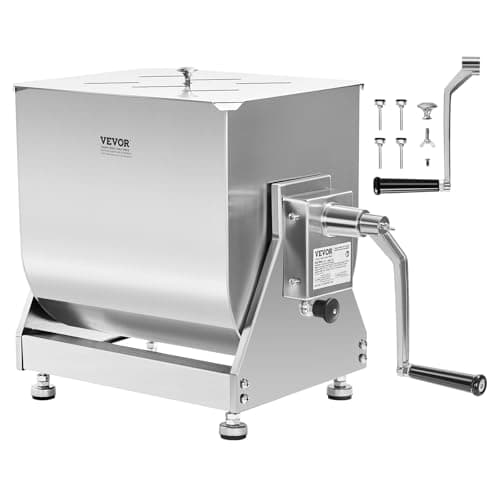
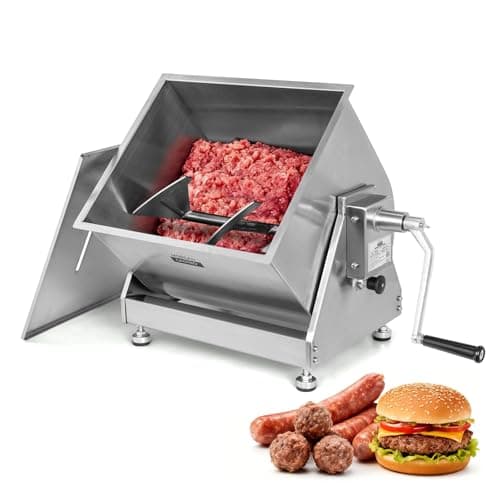
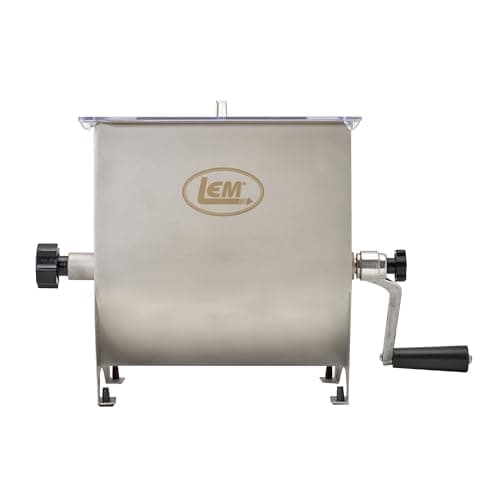
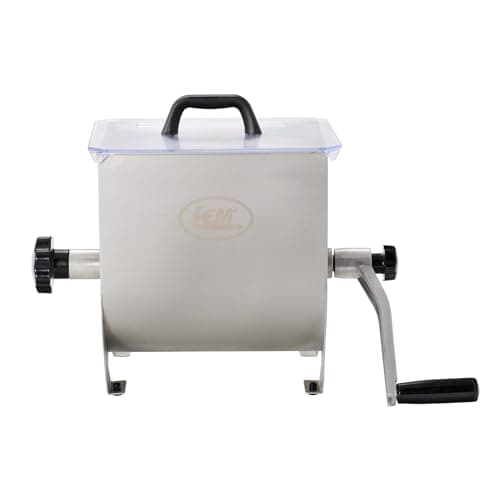
A mixer earns its place the first time you work 20 lb of cold venison and pork fat by hand. Five crank mixers, from 10 lb to a 40-liter tank, sized to the batches extension recipes call for.
#ad · Prices come live from Amazon, last checked Sep 19, 2026; where we have no verified live price we show none. Scores are ours, compiled from published specs, manuals and warranty terms, not bench tests. Tap a row for the full write-up.
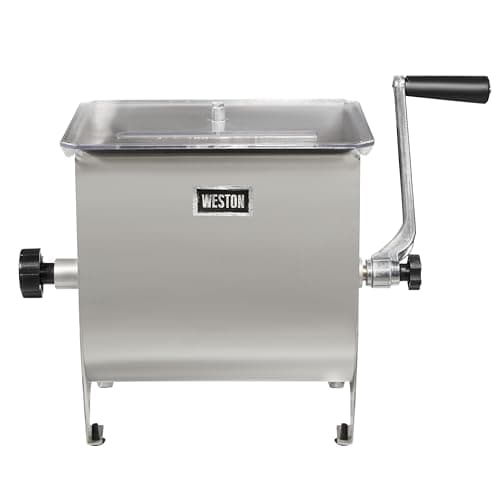
For most hunters, a 20 lb hand-crank mixer is the right size, and the Weston 36-1901-W ties for the top score with the most practical details: a seasoning slot in the lid and stainless paddles that pull out for the sink. If your batches run to 30 lb, VEVOR's 20-liter tilt tank is rated for it. For group processing days with six or more deer, Hakka's 40-liter tank mixes 57-77 lb at a time. LEM's 10 lb mixer fits small, occasional batches.
Mixing is the step most people do by hand until the day it costs them. It isn't just cold fingers: an even mix is how salt, seasoning and cure end up in every link rather than clumped in a few. We haven't cranked these ourselves. The ranking comes from published capacities, materials and features, scored on the rubric on our How We Pick page: capacity 30%, build and gauge 25%, grinder-mount compatibility 15%, cleanup 15% and value at the live price 15%.
Why a crank mixer beats your hands
It keeps the meat colder. Penn State Extension's game-sausage guidance is to keep meat below 40°F during grinding and mixing, and North Dakota State University Extension says the same. Every minute your hands spend working 20 lb of mix is heat going into the fat. A lidded tub and a crank shorten that time and keep your hands out of it.
It spreads the cure evenly. NDSU suggests batches of up to 25 lb, unless you have special equipment, so cure and seasoning distribute evenly, and Penn State recommends dissolving the dry ingredients in water so the cure spreads through the product. Cure is measured in parts per million; you want it everywhere, not in pockets.
It makes the bind repeatable. Washington State University Extension explains that salt pulls soluble proteins to the surface of the meat, where they trap fat and water and bind the sausage together on cooking. WSU recommends mixing thoroughly for 2 to 5 minutes, and warns that overmixing can make a rubbery sausage. A crank mixer lets you count turns and get the same result every batch.
Capacity: size the tub to your batch, not your season
Mixers are rated by what they mix at once, so match the tub to your batch. NDSU's venison summer sausage is a 25 lb batch (15 lb venison, 10 lb 50/50 pork trim), and Mississippi State's pork sausage recipe is 16 lb. Here's how each mixer handles a 25 lb batch.
Mixer
Maker's rated capacity
Rounds for a 25 lb batch
Season tier
LEM MightyBite 10 lb
10 lb
3
Light (1-2 deer)
LEM MightyBite 20 lb
Mixes 15-20 lb
2
Moderate (3-5 deer)
Weston 20 lb
Up to 20 lb
2
Moderate
VEVOR 20-liter
Max 30 lb
1
Moderate to heavy
Hakka 40-liter
57.2-77 lb
1
Heavy (6+ deer)
Build: what the listings do and don't tell you
All five are stainless, and none publishes steel gauge, so "build" comes down to what each maker does state. VEVOR names its grade: SUS201. Hakka describes polished, rust- and corrosion-resistant stainless throughout and a stainless cover. LEM uses a stainless tub and paddles with a clear acrylic lid and rubber feet, and publishes the only warranties in the group: two years on the 20 lb and one on the 10 lb. Weston calls its 20 lb "quality stainless steel" and adds a clear lid with a seasoning slot, so you can pour in cure water while the paddles turn.
The grinder-mount question
Some mixers can be driven by a grinder's motor. None of these five is sold that way. LEM states plainly that both of its manual mixers are standalone and don't attach to any grinder, and the Weston, VEVOR and Hakka listings don't mention a grinder mount at all. Per our rubric, a clear "doesn't attach" scores below an unpublished spec, so the LEMs take a small hit here. In practice every mixer on this page is a hand crank. If motor-driven mixing matters to you for a heavy season, check your grinder maker's accessory list first; our best grinders for deer is the place to start that search.
Cleanup
Paddles are where ground meat hides. Weston's pull out for the sink, VEVOR's detach, and Hakka's come off with two butterfly screws. The VEVOR and Hakka tanks also tilt, so you can tip the mix into a lug instead of scooping. Whatever you buy, finish the way the extension services do: wash, then sanitize with 1 tablespoon of chlorine bleach per gallon of water and let it air dry, per NDSU and Penn State.
#ad · Price as of Sep 19, 2026 · Affiliate disclosure for the link to LEM MightyBite 10 lb Manual Meat Mixer (1896)
Buyer's guide: where the mixer fits
The mixer sits between two grinds. NDSU says mixing should be done before the final grind; Mississippi State and WSU describe the same order: coarse grind (1/2 to 3/4 inch plate per MSU, 3/8 or 1/2 inch per WSU), mix in salt and seasoning, then regrind through a fine plate around 3/16 inch. Our grinder plate sizes guide covers the plates, and venison fat ratios covers how much pork or beef fat goes in before you mix.
1-2 deer
WSU notes that for small batches, clean, sanitized hands work. If you mix 10 lb at a time, LEM's 10 lb mixer keeps your hands out of cold meat; if you mix a 25 lb summer sausage batch once a year, a 20 lb mixer covers it in two rounds.
3-5 deer
A 20 lb mixer: the Weston for its seasoning slot and pull-out paddles, the LEM 20 lb for its published two-year warranty and compact footprint. If your standard batch is 25-30 lb, the VEVOR does it in one round.
6+ deer, or several families on one processing day
The Hakka 40-liter tank mixes a heavy batch in one go and tilts to unload. Plan space for it; a tank rated for 57-77 lb is not a cabinet appliance.
Using a mixer with cure
Dissolve the cure and dry ingredients in the recipe's water first, per Penn State Extension.
Add it through the lid slot (Weston) or with the lid open and the paddles stopped.
Mix 2-5 minutes, per WSU, then stop. Overmixing can make the sausage rubbery.
Keep the mix at 40°F or below, and go straight to the final grind and the stuffer.
What to check before you order
Footprint and storage. VEVOR lists its tank at 11.8 x 9.6 x 12.0 inches, with feet that adjust 1.57 inches; LEM describes its 20 lb as a compact footprint that stores easily. A mixer sits in a cabinet most of the year, so measure the shelf as well as the bench.
Lid. A clear lid lets you watch the mix come together. Weston's seasoning slot lets you add cure water without stopping; LEM says its acrylic lid adds safety while mixing.
Paddle removal. The fewer tools it takes, the more likely the paddles come out every time: Weston's pull out, VEVOR's detach, Hakka's come off with two butterfly screws.
Feet. Rubber feet on the LEMs and VEVOR, adjustable feet on the VEVOR and Hakka. Cranking 20 lb of cold mix pushes the tub sideways, and a mixer that slides is a mixer you end up holding.
Warranty. Only LEM publishes terms on these listings: two years on the 20 lb, one on the 10 lb.
What a mixer won't fix
A mixer spreads whatever you put in the tub. It won't rescue warm meat (keep it at 40°F or below), a wrong cure dose (weigh it), or a mix that is too lean to bind; the extension venison recipes land around 20-25% fat. And it doesn't replace the regrind: mix between the coarse and fine grinds, not after the last one.
Plenty of sites say they ground two hundred pounds through every grinder. We didn't, and we say so. What we do instead: read the maker's spec sheet, manual and warranty terms, record the figures that decide whether a machine keeps up with your season (size number, motor rating, rated pounds per minute, capacity, duty cycle, gearing), check parts availability, and score each pick on a published rubric. Then we show the season math — pounds per deer from the Ohio Division of Wildlife's yield study — so you can redo it with your own numbers.
Not for small batches. WSU Extension says clean, sanitized hands work for small batches. A mixer pays off at around 20 lb and up, where hand mixing warms the meat and makes an even cure harder to get.
How long should you mix sausage meat?+
WSU Extension recommends mixing thoroughly for 2 to 5 minutes and warns that overmixing can produce a rubbery sausage. Keep the meat below 40°F while you do it.
What size meat mixer do I need?+
Match the tub to your usual batch. Extension recipes commonly run 16-25 lb, so a 20 lb mixer covers most hunters in one or two rounds. Go to a 30 lb tank if you routinely mix 25-30 lb, and to a 40-liter tank for group processing days.
Can a manual meat mixer attach to my grinder?+
Not the five we rank. LEM says its 10 and 20 lb mixers are standalone and don't attach to any grinder, and Weston, VEVOR and Hakka don't list a grinder mount. Check your grinder maker's accessory list if you want motor-driven mixing.
Should you mix sausage before or after grinding?+
In between. NDSU, Mississippi State and WSU all describe the same order: coarse grind, mix in the salt, seasoning and cure, then regrind through a finer plate.
We haven't bench-tested this gear and we don't pretend to. Specs come from the maker's own pages, manuals and maker-supplied listing copy (labeled as such); food-safety figures from USDA and university extension publications; yield from the Ohio Division of Wildlife; prices live from Amazon. Where a figure isn't published, we say so. Read the full method.