Sausage & Curing ◆ Guide
Sausage Casings Explained: Natural, Collagen and Fibrous
Three families, three jobs, three completely different preparations. Pick by the product you are making and the diameter your stuffing tube can carry, not by what the shop had.
We earn a commission if you buy through our links, at no extra cost to you. It never decides the ranking — the method is published · Affiliate disclosure
Natural hog casings (32-35 mm) for brats and fresh venison links; collagen casings (19-21 mm) for snack sticks and (32 mm) for no-prep brats; fibrous casings (1.5 to 2.5 inches) for summer sausage. Natural and collagen are edible; fibrous is not and gets peeled. Those three lines cover almost every decision a home sausage maker has to make.
NDSU Extension's sausage publication is the clearest source on why: natural casings “are digestible and are very permeable to moisture and smoke,” and generally “hog casings are the most suitable for home use and work quite well for Polish and breakfast-type sausages.”
The three families
Natural casings. NDSU: “Natural casings are the gastrointestinal tracts of cattle, sheep and hogs.” Hog casings at 32-35 mm are the standard home size. They give the snap people associate with a good brat, they let smoke and moisture through, and they are edible. The cost is preparation and refrigeration.
Collagen casings. NDSU describes them as carrying “the attributes of both natural and fibrous casings,” used for products such as fresh pork sausage and pepperoni sticks, and “uniform in size, relatively strong and easy to handle.” In practice that uniformity is the selling point: they slide onto the tube dry, no soaking, and every stick comes out the same diameter. LEM's 19 mm collagen is the snack-stick workhorse; its 32 mm is the brat-size option for people who do not want to flush natural casings.
Fibrous casings. NDSU: they “are more suitable for summer sausage and similar products because of their greater strength and the variety of sizes available. They are permeable to smoke and moisture and can easily be removed from the finished product.” They are plant cellulose, non-edible, string-tied at one end so a chub hangs in a smoker, and they store in a cupboard.
There is a fourth family you will not want. NDSU notes that for cooked products that are water-cooked, like braunschweiger, “plastic casings impermeable to water are used” — the opposite of what you want for anything smoked.
Casing by product
| What you are making | Casing | Diameter | Edible? |
|---|---|---|---|
| Snack sticks | Collagen | 19-21 mm | Yes |
| Brats, Italian, fresh venison links | Natural hog | 32-35 mm | Yes |
| Brats with no prep time | Collagen | 32 mm | Yes |
| Breakfast links | Natural sheep, or small collagen | Under 24 mm | Yes |
| Summer sausage | Fibrous | 2.5 x 20 in (about 3 lb each) | No — peel it |
| Pepperoni-style chubs | Fibrous | 1.5 x 12 in (about 1 lb each) | No — peel it |
Soaking and flushing, by type
This is where most first batches go wrong, and the instructions differ sharply by family. NDSU: “All casings preserved in salt must be soaked in lukewarm water for at least 30 minutes before use. Flush each casing under cold water, running cold water through the casing. This removes excess salt.” For fibrous, it specifies soaking “in 80 to 100 F water for at least 30 minutes, but not more than four hours before use.”
| Casing | Preparation | Storage |
|---|---|---|
| Natural hog (salted) | Rinse and flush, then soak in cold water — LEM says 2 to 8 hours for its 32-35 mm casings | Refrigerate; LEM says do not freeze |
| Natural hog (pre-flushed) | Rinse, then soak 30 minutes in 95-100 °F water, per Bearded Butchers | Resealable pack; refrigerate unused casings in their brine |
| Collagen | None. LEM: slide straight onto the tube | Airtight, or they dry out |
| Fibrous | Soak in clear warm water 25-30 minutes (LEM); NDSU says 80-100 °F, not more than four hours ahead | Cool, dry place; no refrigeration |
Picks for this job
One of each, and the pre-flushed shortcut
Buy by the product you are making. A pack of hog casings and a pack of 19 mm collagen covers brats and sticks; add fibrous when summer sausage is on the list.
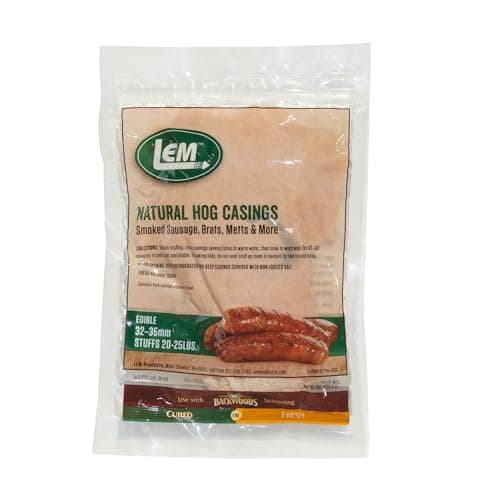
Best natural casing
LEM Natural Hog Casings, 32-35 mm (Stuffs about 30 lb)
The standard 32-35 mm natural casing, about 30 lb per pack. Needs flushing and a 2 to 8 hour cold soak, and must stay refrigerated.
$13.99Amazon#ad · Price as of November 4, 2026 · Affiliate disclosure for the link to LEM Natural Hog Casings, 32-35 mm (Stuffs about 30 lb)
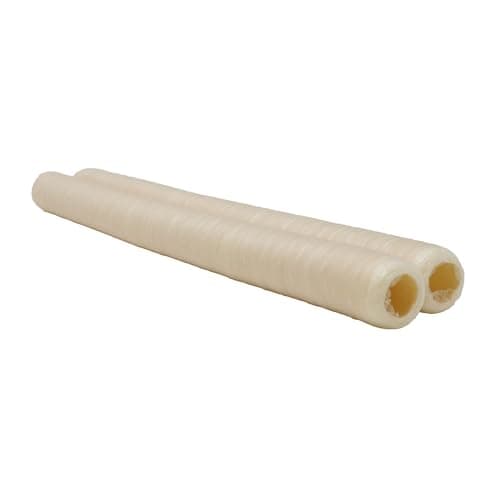
Best snack stick casing
LEM Clear Smoked Collagen Casings, 19 mm (2-Pack)
Snack-stick collagen: edible, no soaking, about 16 lb per pack. LEM recommends a tube of 1/2 inch OD or smaller to load them.
$15.39Amazon#ad · Price as of November 4, 2026 · Affiliate disclosure for the link to LEM Clear Smoked Collagen Casings, 19 mm (2-Pack)
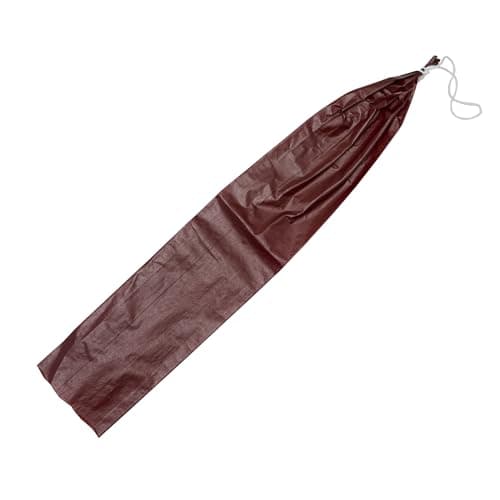
Best summer sausage casing
LEM Mahogany Fibrous Casings, 2.5 x 20 in (25 Count)
The classic summer-sausage casing: 2.5 x 20 in, string-tied, smoke-permeable, soaked 25-30 minutes in warm water. Non-edible.
$25.99Amazon#ad · Price as of November 4, 2026 · Affiliate disclosure for the link to LEM Mahogany Fibrous Casings, 2.5 x 20 in (25 Count)

Best pre-flushed hog casing
Bearded Butchers Natural Hog Casings, 32-35 mm (Pre-Flushed)
Pre-flushed 32-35 mm hog casings with a 30-minute soak in 95-100 degree water instead of hours, in a resealable pack.
$12.41Amazon#ad · Price as of November 4, 2026 · Affiliate disclosure for the link to Bearded Butchers Natural Hog Casings, 32-35 mm (Pre-Flushed)
Diameter, and the tube it needs
A casing you cannot load is a casing you cannot use. Match the casing to the stuffing tube before you buy either. LEM recommends a tube of 1/2 inch outside diameter or smaller for its snack-stick collagen, and most stuffers ship with nothing below 5/8 inch — which is why a dedicated 3/8 inch (10 mm) tube is the common aftermarket purchase. At the other end, a 2.5-inch fibrous casing needs the biggest tube in the set.
A horizontal or vertical stuffer will take whatever tube fits its canister base, so measure the base rather than guessing. Our LEM versus Hakka comparison lists exactly which tubes each of those two big stuffers includes, and stuffer versus grinder attachment covers the trade if you were planning to stuff through the grinder head.
How much a pack covers
Makers publish fill figures, which makes planning easy. LEM's 32-35 mm hog casings fill about 30 lb; its 19 mm collagen about 16 lb a pack, its 21 mm about 20 lb, its 32 mm about 21 lb; its clear 2.5 x 20 inch fibrous casings hold about 3 lb each, and the 1.5 x 12 inch ones about 1 lb each. Bearded Butchers gives 25-30 lb for its pre-flushed hog casings.
Against a season, that is generous. At the Ohio DNR average of about 52 lb of venison a deer, a two-deer season is roughly 104 lb of venison, and sausage is a share of it. One pack of hog casings and one pack of collagen will usually see out a household season — but buy a spare strand anyway, because a casing that tears mid-batch stops the whole afternoon.
Air pockets, and the pin trick
NDSU: “If the casings are not pre-stuck they should be punctured with a knife point or pin to eliminate air and fat pockets in the finished sausage.” Clear casings, fibrous or collagen, show every pocket you leave, which is an argument for the mahogany version if presentation matters to you and an argument for the clear one if you want to see your own mistakes.
Stuff firm but not to the bursting point, and let the stuffer do the work rather than forcing the crank. An air release valve on the stuffer handles the air inside the cylinder; the pin handles what gets trapped against the casing wall.
Storing casings between seasons
Natural casings stay refrigerated in their salt or brine, and LEM says do not freeze them. Collagen goes back in an airtight bag or it dries out and splits on the tube. Fibrous casings are the easy ones: a cool, dry cupboard, no refrigeration, and they will be there next November.
Whatever you are stuffing into them, finish to a temperature rather than a time. USDA's safe minimum internal temperature chart is the reference; NDSU's own worked examples hold water at 170 °F until the sausage reaches 155 °F, and finish summer sausage at 155 °F internal. The whole mixing, stuffing and cooking sequence is in how to make venison sausage.
Questions
Frequently asked
Which sausage casings are edible?
What size casing do you use for snack sticks?
How long do you soak hog casings?
Do collagen casings need soaking?
What casing is used for summer sausage?
How do you stop air pockets in sausage?
Keep going down the chain
Related
Receipts
Sources
- North Dakota State University Extension — The Art and Practice of Sausage Making (FN176, rev. Oct. 2022)
- Mississippi State University Extension — Making Sausage at Home (P2692)
- Washington State University Extension — Homemade Meat, Poultry, and Game Sausages (EB1661) [PDF]
- USDA Food Safety and Inspection Service — Safe Minimum Internal Temperature Chart
- USDA Food Safety and Inspection Service — Sausages and Food Safety
- Amazon listing, manufacturer-supplied copy — LEM Natural Hog Casings 32-35 mm (141)
- Amazon listing, manufacturer-supplied copy — Bearded Butchers Natural Hog Casings 32-35 mm
- Amazon listing, manufacturer-supplied copy — LEM Clear Smoked Collagen Casings 19 mm (241B)
- Amazon listing, manufacturer-supplied copy — LEM Clear Smoked Collagen Casings 21 mm (136B)
- Amazon listing, manufacturer-supplied copy — LEM Clear Smoked Collagen Casings 32 mm (138B)
- Amazon listing, manufacturer-supplied copy — LEM Mahogany Fibrous Casings 2.5 x 20 in (126B)
- Amazon listing, manufacturer-supplied copy — LEM Mahogany Fibrous Casings 1.5 x 12 in (130B)
- Amazon listing, manufacturer-supplied copy — LEM Clear Fibrous Casings 2.5 x 20 in (124B)
- Amazon listing, manufacturer-supplied copy — Smokehouse Chef long 3/8 in snack stick tube, 2 in base
Specs come from the maker's own pages, manuals and maker-supplied listing copy (labeled as such); food-safety figures from USDA and university extension publications; yield from the Ohio Division of Wildlife; prices live from Amazon. Where a figure isn't published, we say so. Read the full method.