If you stuff more than an occasional batch of fresh links, buy a dedicated piston stuffer. Stuffing through a grinder sends mix that is already ground and seasoned back through the auger, and the extension services tie fat smearing to exactly that: warm meat and the grinding head. Grinder tubes are acceptable for small batches of fresh links in hog casings when the meat is near 32°F and the grinder has a slow speed meant for stuffing.
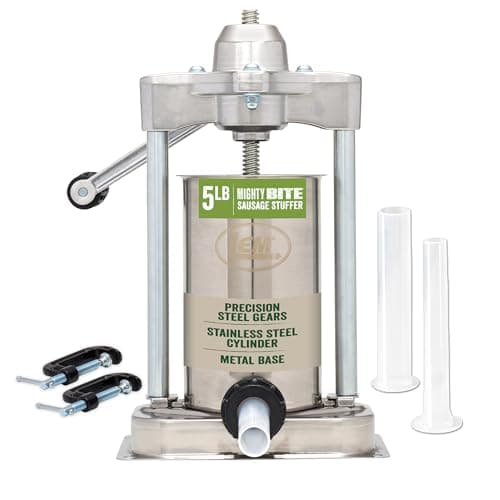
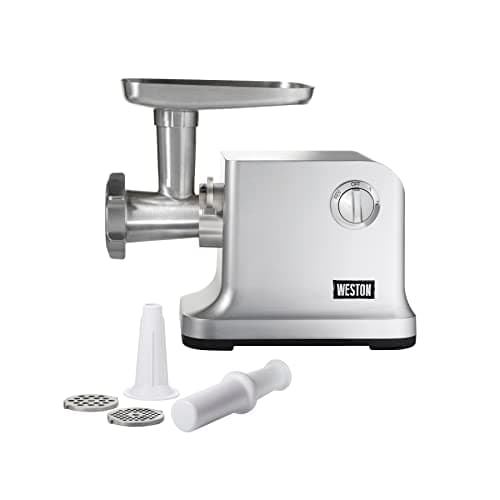
This is the question behind every "meat grinder with sausage stuffer" search. The combo is real: most grinders include stuffing tubes, and the extension bulletins list a grinder-mounted stuffing horn as legitimate equipment. It just isn't the same tool. To keep this concrete, we compare the Weston #12 Electric Meat Grinder & Sausage Stuffer (33-1301-W), a grinder whose listing gives it a slow first speed for stuffing, against the LEM MightyBite 5 lb, the smallest metal-gear piston stuffer in our rankings. We haven't bench-tested either; the comparison uses the makers' published specs.
Side by side
| Spec | Weston #12 grinder & stuffer | LEM MightyBite 5 lb stuffer |
|---|
| How it pushes mix | Auger (screw) through the grinder head | Piston down a cylinder |
| Power | 750 W, 1 HP motor | Hand crank |
| Speed control | 2 speeds plus reverse; slow first speed for stuffing | Single gear; you set the pace with the crank |
| Capacity per load | Continuous feed through the hopper | 5 lb cylinder |
| Air handling | Not listed | Piston air valve pushes air out the top, not into the casing |
| Stuffing parts included | Sausage stuffing funnel and stuffing spacer | 3 plastic tubes, 11/16-1 inch OD (1606SS: 1/2-1 inch stainless) |
| Gears | Metal gears, die-cast aluminum body | All-metal gears in a protective gearbox |
| Also does | Grinds 4-5 lb per minute | Stuffing only |
Sources: Weston's Amazon listing for the 33-1301-W; LEM's product page for the MightyBite 5 lb.
Why grinder stuffing risks smeared fat
Smearing shows up as sausage that looks pasty and greasy rather than showing distinct bits of lean and fat, and the extension services treat it as a temperature problem first. Mississippi State Extension says meat should be chilled to approximately 32°F to minimize fat smearing and kept cold throughout. Washington State University Extension goes further, tying it to the grinder itself: grinder knives must be kept very sharp and the meat very cold (32°F) to prevent product smearing, and before grinding the meat should be as close to freezing as possible (30-32°F).
Now picture stuffing through the grinder. The mix has already been ground, mixed and reground. To stuff it, it goes back into the hopper and the auger works it again, at the pace you can feed casing onto the tube, which is slower than the pace you grind. More time in the head and more time on the bench are the two variables those bulletins tell you to minimize. We haven't measured the temperature rise, and it will depend on your grinder, your room and your batch; the point is that grinder stuffing adds exactly the step the extension guidance warns about.
What a piston stuffer does differently
A piston stuffer doesn't cut or work the mix again. It pushes a column of already-finished sausage straight down the cylinder and out the tube. Two published features matter here: LEM's valve pushes trapped air out the top instead of into the casing, and the pace is set by your crank, not by an auger that wants to run at a fixed speed. That control is what lets you hold casing on the horn the way Mississippi State Extension describes: as much casing on the horn as possible, held firmly between your fingers, with enough pressure to fill it fully and no air pockets.
When grinder tubes are fine
NDSU Extension says it only requires a grinder, a good meat thermometer and some general household items to make excellent sausage, and both Mississippi State and WSU list a stuffing horn on the grinder head as acceptable equipment. Grinder stuffing is a reasonable choice when:
- You make fresh links a few times a year, in 32-35 mm hog casings.
- Batches are small, so the mix spends little time out of the refrigerator.
- The meat is near 32°F going in, and the grinder has a slow speed for stuffing, as the Weston #12 does.
- You are fine with bulk sausage or patties some of the time; NDSU notes fresh sausage doesn't have to be stuffed at all.
At a light season of 1-2 deer, roughly 52-104 lb of venison at the Ohio DNR average, that can describe your whole sausage year.
Where grinder stuffing falls short
Summer sausage in fibrous casings. A 2.5 x 20 inch fibrous casing holds about 3 lb, per LEM's listing for its clear version, and NDSU says to puncture casings that aren't pre-stuck to get rid of air and fat pockets. You want a steady, dense fill with no trapped air, which is what a piston and an air valve are for.
Snack sticks. Sticks need a tube of about 1/2 inch or smaller (LEM's recommendation for 19-21 mm collagen) and fine control of the flow. That's demanding even for piston stuffers; see stuffers for snack sticks.
Big batches. A 25 lb batch through a grinder's stuffing tube is a long session with the mix out of the cold. A 5 lb piston stuffer does it in 5 fills, an 11 lb in 3.
The call by season
Light season, 1-2 deer. Grinder tubes can carry your fresh links. Add a 5 lb piston stuffer the first year you make summer sausage or snack sticks; it's the smallest purchase that changes the result.
Moderate season, 3-5 deer (about 157-261 lb of venison at the Ohio DNR average). Buy the dedicated stuffer. At this volume you're stuffing 25 lb batches, and an 11 lb two-speed does each in 3 fills. It also splits the work: the grinder can be cleaned, or run the next batch, while someone else stuffs.
Heavy season, 6+ deer. A dedicated stuffer, 15 lb or motorized. The grinder has plenty to do without also being the stuffer.
Choose grinder tubes if, choose a stuffer if
Stay with the tubes that came with your grinder if
- You process one or two deer and make fresh links, not cured or smoked sausage.
- Your grinder has a slow speed and you can keep the meat near 32°F.
- Budget is better spent on the grinder itself; our best grinders for deer covers that.
Buy a dedicated stuffer if
- You make summer sausage, snack sticks or anything in fibrous or collagen casings.
- You stuff 25 lb batches, or more than a few batches a season.
- You've seen smeared, greasy links and want to rule out the second auger pass.
The cheapest upgrade in the whole chain is a 5 lb metal-gear stuffer next to the grinder you already own. When you outgrow it, our best sausage stuffers ranking sizes the next one to your season, and grinder plate sizes covers the plates that do the grinding before either tool stuffs.